
 AU
AU
 CA
CA
 US
US
 NZ
NZ
 IND
IND

 UK
UK

 Share
Share
 X (Formerly Twitter)
 Whatsapp
 Facebook
 LinkedIn
 Telegram
 Email This Article
 Copy Link
 Summarize with AI
 Chat GPT
 Perplexity
SSE PLC shares rise 3.4% on 11 February 2026 – will offshore wind expansion, regulated network growth, and UK economic stabilisation drive dividend growth and long-term returns? Deep FTSE 100 analysis with bull vs bear case, analyst outlook, and strategic investor positioning.
Key Takeaways – February 2026 (Latest Update)
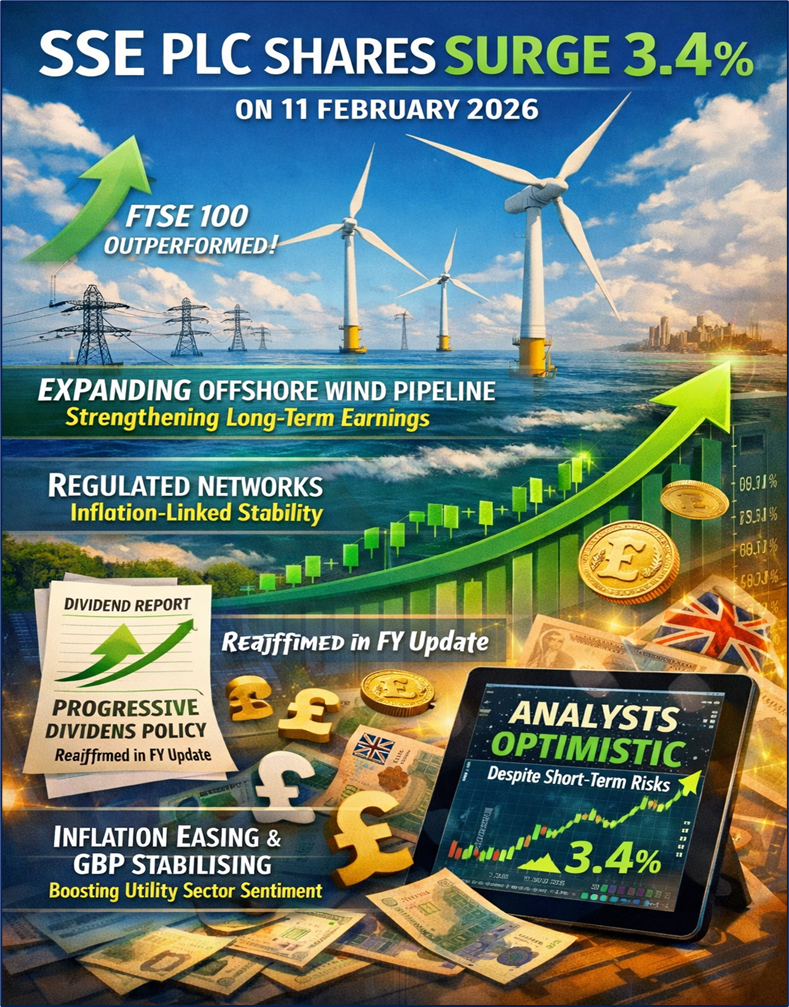
- SSE PLC shares climbed 3.4% on 11 February 2026, outperforming sections of the FTSE 100
- Expanding offshore wind pipeline strengthening long-term earnings visibility
- Regulated electricity networks providing inflation-linked stability
- Progressive dividend policy reaffirmed in latest FY trading update
- UK inflation easing and GBP stabilising, supporting utility sector sentiment
- Analysts broadly constructive despite short-term volatility risks
Source: Kalkine Group
Is SSE plc Emerging as the Premier FTSE 100 Dividend Compounder and Renewable Energy Growth Stock?
As February 2026 unfolds, SSE plc is increasingly viewed as a high-quality FTSE 100 dividend stock, renewable energy infrastructure leader, UK defensive utility play, ESG-focused investment opportunity, and long-term income compounder. With the share price up 3.4% on 11 February 2026, investor attention has shifted toward whether SSE’s wind power investments can meaningfully accelerate earnings per share growth and sustain dividend expansion.
In a market environment shaped by moderating UK inflation, Bank of England rate stability, resilient GBP performance, falling bond yield volatility, energy transition capital investment, and decarbonisation policy support, SSE’s hybrid structure of regulated network earnings and renewable generation capacity appears strategically positioned.
Unlike pure commodity energy producers, SSE combines predictable regulated cash flows with long-duration offshore wind assets, creating a powerful blend of income stability and structural growth exposure.
How Are UK Macroeconomic Conditions and GBP Trends Supporting SSE’s Momentum?
The UK economy in February 2026 shows signs of measured stabilisation:
- CPI inflation trending toward target levels
- Bank of England signalling policy predictability
- GBP strengthening against USD and EUR
- Industrial and commercial energy demand normalising
- Investor appetite returning to defensive dividend equities
For SSE, this macro backdrop is particularly constructive because:
- Regulated network returns are often inflation-linked
- Lower bond yield volatility enhances utility valuations
- Predictable financing costs support large-scale capex
- Stable currency reduces equipment import pressures
The FTSE 250 remains more cyclical and domestically sensitive, which reinforces the relative appeal of large-cap infrastructure-backed utilities like SSE within diversified portfolios.
Why Did SSE Shares Rise 3.4% on 11 February 2026?
Several converging factors appear to explain the upward move:
- Rotation into high-yield defensive dividend stocks
- Renewed optimism toward UK renewable infrastructure
- Positive operational signals in the latest company trading update
- Improved sentiment across regulated utility sector
- Institutional capital reallocating toward energy transition leaders
SSE’s diversified operational model includes:
- Electricity transmission and distribution networks
- Large-scale offshore wind developments
- Onshore renewable generation
- Flexible thermal generation capacity
This balance between regulated returns and renewable expansion reduces earnings volatility compared to pure wholesale power generators.
Can Offshore Wind Investment Accelerate Earnings and Dividend Growth?
SSE’s offshore wind portfolio represents a core long-term earnings catalyst. Large-scale projects benefit from:
- Long-term power purchase agreements
- Government-backed contracts for difference
- Multi-decade asset lives
- Inflation-linked pricing structures
As additional capacity comes online over the medium term, incremental EBITDA contribution is expected to enhance dividend cover and support progressive distribution growth.
SSE’s dividend framework historically targets sustainable increases supported by cash generation from regulated and renewable assets. Investors are closely monitoring:
- Dividend cover ratios
- Net debt management
- Capex efficiency
- Asset recycling strategy
How Does SSE Compare Against UK Utility Peers?
Within the FTSE 100 and broader UK energy sector, SSE competes with:
- National Grid plc
- Centrica plc
- Drax Group
Relative positioning highlights:
- Greater offshore wind exposure than transmission-focused peers
- More earnings stability than commodity-heavy energy suppliers
- Significant capital investment aligned with UK net zero strategy
- Competitive dividend yield profile
SSE’s infrastructure scale and renewable growth optionality differentiate it from traditional utilities.
Is SSE Stock Bullish or Bearish Across Time Horizons?
Short-Term Outlook – Neutral to Slightly Bullish
- Benefiting from defensive sector rotation
- Sensitive to UK bond yield movements
- Influenced by macro sentiment and inflation data
Medium-Term Outlook – Constructively Bullish
- Renewable capacity additions enhancing earnings visibility
- Regulated asset base expansion driving stable returns
- Dividend compounding potential improving
Long-Term Outlook – Structurally Bullish
- UK electrification and decarbonisation megatrend
- Offshore wind expansion cycle
- Grid modernisation investment wave
- Increasing institutional ESG capital flows
What Are Analysts Indicating About Valuation and Outlook?
Consensus broker sentiment as of February 2026 suggests balanced optimism:
- Barclays – Overweight
- JPMorgan – Neutral
- HSBC – Buy
- UBS – Hold
Analyst commentary centres on:
- Attractive long-term renewable growth
- Execution risk tied to capital programme
- Dividend resilience supported by regulated assets
- Fair valuation relative to infrastructure peers
Overall, market expectations reflect moderate upside potential driven by dividend yield plus steady earnings progression rather than aggressive re-rating.
What Does the Bull vs Bear Scenario Analysis Reveal?
Bullish Drivers
- Falling UK bond yields boosting utility multiples
- Faster-than-expected offshore wind commissioning
- Stronger GBP lowering capital equipment costs
- Continued regulatory support for decarbonisation
- Dividend growth exceeding guidance
Bearish Risks
- Capex overruns on major wind projects
- Regulatory return reductions
- Political energy pricing intervention
- Interest rate increases raising financing costs
- Delays in grid connection infrastructure
How Can Investors Strategically Position for Maximum Returns?
Short-Term Approach
- Monitor UK CPI releases and Bank of England policy signals
- Consider accumulating during sector pullbacks
- Track project milestones and operational updates
Medium-Term Approach
- Focus on dividend reinvestment strategy
- Evaluate progress of offshore wind portfolio
- Assess debt metrics and capital allocation discipline
Long-Term Approach
- Hold as core UK infrastructure allocation
- Benefit from dividend compounding
- Align portfolio with global energy transition megatrend
What Key Risks Should Investors Closely Watch?
- Regulatory framework changes
- Project execution delays
- Rising borrowing costs
- Commodity price fluctuations
- Political intervention in UK energy markets
Frequently Asked Questions
Is SSE plc a reliable dividend stock in 2026?
SSE combines regulated cash flows with renewable growth, supporting progressive dividend ambition.
Why did SSE shares rise 3.4% on 11 February 2026?
Improved macro sentiment, defensive rotation, and positive operational signals appear to have driven the move.
Does UK inflation impact SSE’s earnings?
Yes, though regulated returns often incorporate inflation-linked mechanisms that partially protect margins.
Is SSE positioned for long-term renewable growth?
Yes, particularly through offshore wind expansion and electricity transmission infrastructure.
Final Verdict: Can SSE’s Wind Power Strategy Deliver Sustainable Income and Growth?
SSE plc stands at the crossroads of defensive utility stability and renewable energy expansion. The 3.4% rise on 11 February 2026 reflects growing investor confidence in UK infrastructure, dividend resilience, and energy transition positioning.
While short-term volatility remains tied to macro signals and interest rate movements, the medium-to-long-term thesis is anchored in regulated earnings visibility, expanding offshore wind capacity, and dividend growth ambition.
For income-focused and ESG-aligned investors seeking exposure to the UK’s electrification journey, SSE presents a balanced blend of yield, stability, and structural growth potential.


 Jun 29, 2026




 Please wait processing your request...