
 AU
AU
 CA
CA
 US
US
 NZ
NZ
 IND
IND

 UK
UK

 Share
Share
 X (Formerly Twitter)
 Whatsapp
 Facebook
 LinkedIn
 Telegram
 Email This Article
 Copy Link
 Summarize with AI
 Chat GPT
 Perplexity
_02_05_2026_10_16_25_591087.jpg)
As global interest rates remain elevated and bank profitability stabilises, Standard Chartered stock is back in the spotlight in February 2026. With improving net interest margins, resilient credit quality, and deep exposure to Asia, India, China, and the Middle East, investors are increasingly asking whether this FTSE-listed global bank can finally deliver a sustained share price recovery.
Key Takeaways – Standard Chartered Stock Snapshot (February 2026)
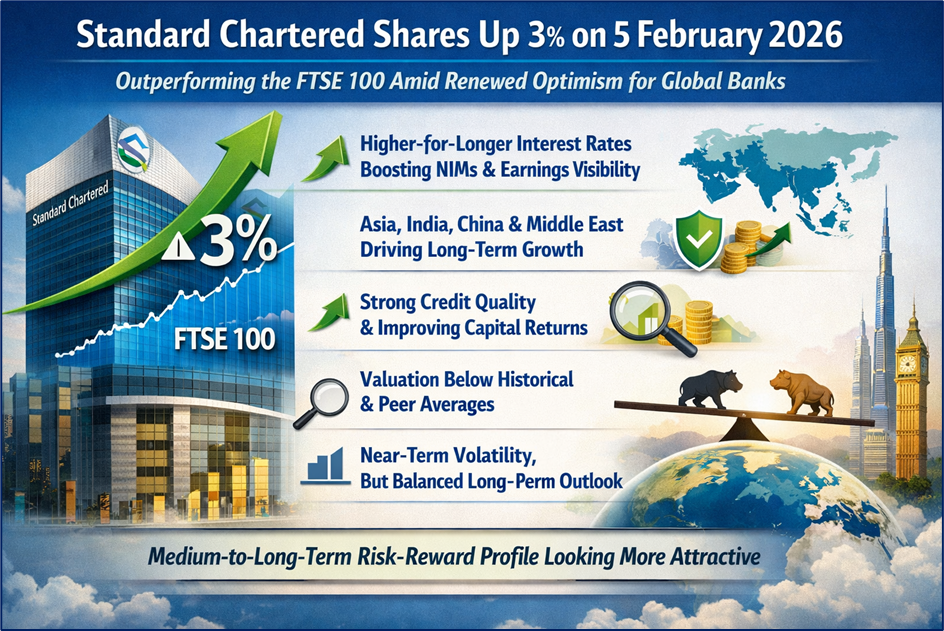
- Standard Chartered shares are up ~3% on 5 February 2026, outperforming the broader FTSE 100 amid renewed optimism toward global banking stocks
• Higher-for-longer interest rates are supporting net interest margins (NIMs) and earnings visibility
• Asia, India, China, and Middle East exposure remains the bank’s primary long-term growth engine
• Credit quality remains resilient, while capital ratios and shareholder returns continue to improve
• Valuation still trades below historical and global peer averages, despite stronger profitability
• Near-term volatility persists, but the medium-to-long-term risk-reward profile looks more balanced than in prior years
Source: Kalkine Group
Why Is Standard Chartered Share Price Rising Today and What’s Driving the 2026 Banking Rally?
Standard Chartered’s share price strength on 5 February 2026 reflects a broader global banking sector re-rating, as investors rotate into high-yield, value-oriented financial stocks with international revenue exposure.
Key drivers behind today’s move include:
• Stabilisation in global bond yields
• Reduced fears of aggressive further rate hikes
• Improving risk appetite across emerging markets
• Renewed inflows into income-generating FTSE banking stocks
Unlike UK-focused retail lenders, Standard Chartered benefits from limited exposure to the domestic UK mortgage market, making it more attractive during periods of uneven UK economic growth.
How Are Global Markets and the UK Economy Supporting Standard Chartered in 2026?
Global markets in early 2026 are navigating a “soft-landing” environment:
• US growth is cooling gradually
• China is stabilising via targeted stimulus
• India and the Middle East continue to deliver structurally higher growth
These trends are particularly supportive for Standard Chartered, given its cross-border banking footprint.
Meanwhile, the UK economy remains subdued but stable, with:
• Inflation trending lower
• Interest rates expected to remain restrictive but steady
This environment is favourable for banks, as elevated net interest margins persist without a sharp deterioration in credit conditions.
Why Standard Chartered’s Business Model Matters for Long-Term Investors
Standard Chartered operates a globally diversified banking model, focused on facilitating trade, investment, and capital flows across Asia, Africa, and the Middle East.
Core earnings drivers include:
• Transaction banking and trade finance
• Corporate and institutional banking
• Wealth management and private banking
• Treasury and global markets operations
This structure:
• Reduces dependence on UK consumer lending cycles
• Increases leverage to global trade, capital flows, and EM growth
• Supports recurring fee income alongside interest income
Ongoing cost discipline, balance-sheet optimisation, dividends, and buybacks are strengthening long-term shareholder returns.
How Does Standard Chartered Compare With UK and Global Banking Peers?
Relative valuation and fundamentals highlight a compelling positioning:
- Greater international growth optionality than UK-centric banks
• Trades at a discount to global peers, reflecting historical volatility and geopolitical exposure
• Capital adequacy and liquidity remain comfortably above regulatory requirements
• Dividend yield remains competitive within the FTSE 100 financial sector
For investors seeking global diversification, income, and value, this combination is increasingly attractive.
Is Standard Chartered Stock Bullish or Bearish in 2026?
Short-term (3–6 months):
Neutral-to-bullish bias, supported by sector momentum, yield demand, and improving sentiment—tempered by macro headlines and EM sensitivity.
Long-term:
Constructively bullish, driven by structural Asia growth, improving returns on tangible equity (RoTE), and consistent capital returns—assuming global financial stability holds.
What’s Behind the Recent Share Price Momentum?
- Improved global risk appetite
• Stabilising interest rate expectations
• Controlled impairments and resilient asset quality
• Attractive dividend and buyback narrative
• Renewed institutional and retail interest in FTSE 100 value stocks
What Should Investors Do Now?
Short-term strategy:
• Tactical exposure to banking momentum
• Dividend capture and volatility management
Medium-term strategy:
• Accumulate on macro-driven pullbacks
• Track credit quality, EM growth, and capital returns
Long-term strategy:
• Hold as part of a diversified global banking allocation
• Benefit from dividend compounding and profitability recovery
Bull vs Bear Scenario Analysis
Bull Case:
Strong Asia growth, stable geopolitics, rising RoTE, increasing dividends → valuation re-rating
Bear Case:
Emerging-market shocks, FX volatility, geopolitical stress, higher credit losses → earnings pressure
What Are Analysts Saying in 2026?
Broker consensus remains cautiously optimistic, with most ratings clustered between Buy and Hold. Forecasts generally assume:
• Gradual earnings growth
• Stable dividend payouts
• Valuation normalisation toward historical averages
Final Verdict: Buy, Hold, or Watch in February 2026?
In February 2026, Standard Chartered looks like a globally diversified FTSE banking stock transitioning from recovery to consolidation. The recent 3% rally reflects renewed confidence rather than speculative excess.
While risks remain—particularly around geopolitics and emerging markets—the blend of valuation, income, and long-term growth exposure makes the stock increasingly relevant for investors seeking global banking exposure beyond the UK.


 Jun 29, 2026




 Please wait processing your request...