
 AU
AU
 CA
CA
 US
US
 NZ
NZ
 IND
IND

 UK
UK

 Share
Share
 X (Formerly Twitter)
 Whatsapp
 Facebook
 LinkedIn
 Telegram
 Email This Article
 Copy Link
 Summarize with AI
 Chat GPT
 Perplexity
Views Expressed Disclaimer:
You are reading a free article with opinions that may differ from the recommendation given by Kalkine in its paid research reports. Become a Kalkine member today to get access to our research reports, in-depth technical and fundamental research.
Key Takeaways — February 2026
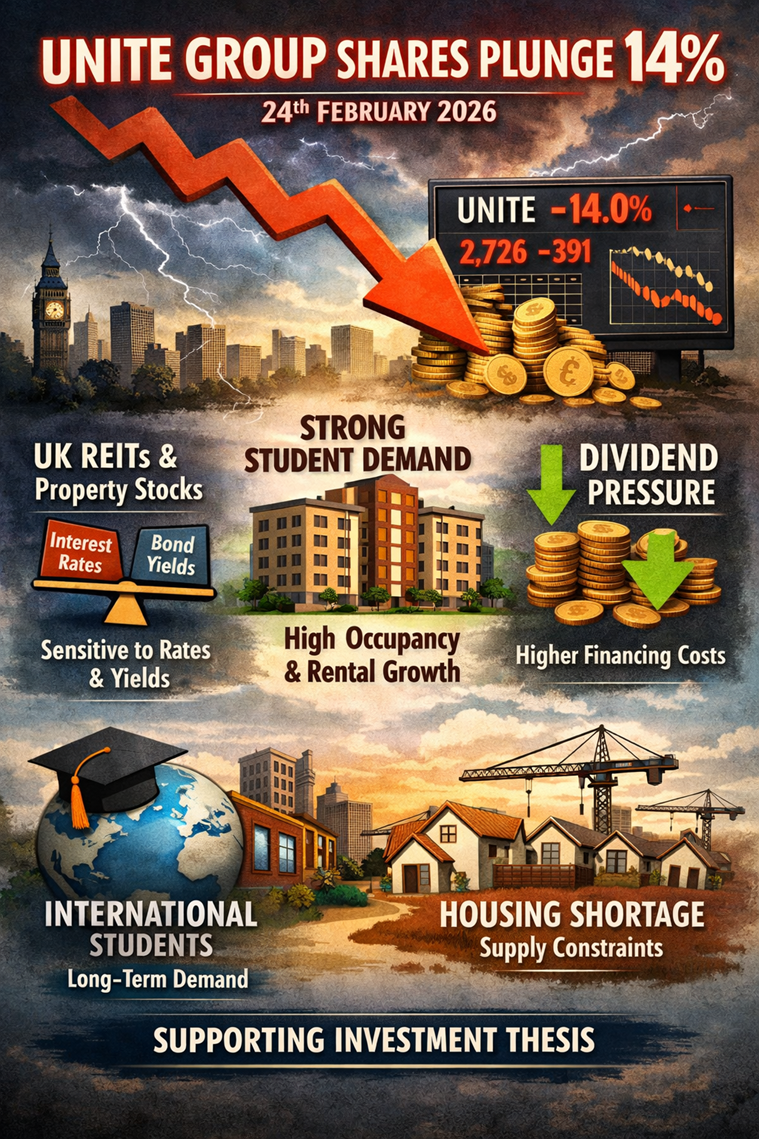
- Unite Group shares dropped approximately 14% on 24 February 2026 following results-driven sentiment weakness and sector valuation pressures.
• UK REIT and property stocks remain highly sensitive to interest-rate expectations and bond yield movements.
• Student accommodation demand fundamentals remain strong with near-full occupancy and rental growth visibility (company disclosures).
• Dividend outlook remains stable but growth may moderate due to higher financing costs.
• Long-term structural demand from international students and housing shortages continues to support investment thesis.
Source: Kalkine Group
Why Did Unite Group Shares Fall 14% on 24 February 2026?
Unite Group (FTSE 250: UTG) experienced a sharp share price decline in late February 2026, drawing attention across UK stock market news, FTSE 250 analysis, UK REIT investment discussions, and dividend stock research. Investors searching for terms like “why is Unite Group down,” “FTSE 250 property stocks falling,” “UK REIT outlook 2026,” and “best UK dividend stocks now” are reacting primarily to macroeconomic drivers rather than company-specific deterioration.
The sell-off appears linked to forward-looking guidance sensitivity, financing cost pressures, and property valuation concerns in a higher-for-longer interest-rate environment. Real estate investment trusts typically trade relative to government bond yields, meaning fluctuations in UK gilt yields can significantly influence share prices even when operating performance remains stable.
Broader FTSE 250 volatility, UK economic uncertainty, global risk sentiment shifts, and currency fluctuations also contributed to amplified downside momentum. Importantly, none of these factors suggest structural weakness in Unite’s core student accommodation business.
What Did the Latest Company Update Reveal About Performance?
Recent operational updates highlighted resilient business fundamentals (company reports):
- Occupancy levels close to full capacity for the academic year
• Continued rental growth supported by strong demand
• Development pipeline progressing across major university cities
• Stable cash flow visibility through university partnerships
• Dividend policy maintained with growth ambition
However, investors reacted negatively to:
- Higher interest expenses affecting future earnings growth
• Property valuation adjustments reflecting market conditions
• Moderation in near-term growth expectations
The combination of these factors triggered short-term market disappointment despite fundamentally stable operations.
How Are Global Markets and Interest Rates Impacting UK REIT Stocks?
The Unite Group decline cannot be understood without examining global macroeconomic forces.
Global influences include:
- Central bank policy uncertainty across the US, UK, and Europe
• Persistent inflation concerns keeping interest rates elevated
• Bond yield volatility affecting property valuations worldwide
• Capital rotation toward technology and AI growth sectors
For property companies, interest rates directly impact:
- Financing costs
• Property valuation models
• Investor yield comparisons
• Capital availability
This explains why REIT stocks often move sharply even without operational deterioration.
How Does the UK Economy and GBP Environment Affect Unite Group?
The domestic economic backdrop remains a key driver for FTSE 250 stocks.
UK economic factors:
- Inflation remains above long-term targets
• Interest rate trajectory remains uncertain
• Consumer confidence mixed but education demand resilient
• Structural housing shortage supporting rental markets
GBP currency trends also matter because:
- International student affordability links to currency strength
• Foreign capital flows into UK property depend on exchange rates
Overall, macro uncertainty has temporarily overshadowed company fundamentals.
How Does Unite Compare With Other Property and REIT Peers?
Unite operates within the purpose-built student accommodation (PBSA) niche, which is structurally more defensive than many real estate segments.
Competitive strengths:
- Long-term agreements with universities
• High occupancy predictability
• Demand driven by education rather than economic cycles
• Limited supply in key urban locations
Compared with office or retail REITs, student housing typically demonstrates:
- Higher occupancy resilience
• More stable rental growth
• Lower exposure to remote-working disruption
This positioning is why many investors consider Unite a premium-quality REIT.
What Is the Dividend Outlook for Unite Group Going Forward?
Dividend income remains central to the investment case.
Positive drivers:
- Inflation-linked rental increases
• Strong occupancy visibility
• Long-term contractual partnerships
• Predictable recurring income
Potential constraints:
- Higher borrowing costs
• Development funding needs
• Property valuation cycles
Most expectations suggest dividend stability rather than cuts, with moderate long-term growth potential.
What Are Analysts Saying About Unite Group Shares?
Broker sentiment remains cautiously constructive despite volatility.
Typical analyst perspectives include:
- Positive long-term demand outlook for student housing
• Recognition of interest-rate sensitivity risks
• Confidence in occupancy and rental growth fundamentals
• Valuation debates driven by macro conditions
While price targets vary, consensus generally supports long-term recovery potential once interest rates stabilize.
What Is the Sector and Stock Outlook Across Time Horizons?
Short-term outlook (3–6 months):
- Continued volatility likely due to macro uncertainty
• REIT sentiment tied closely to interest-rate expectations
• Potential valuation swings around economic data releases
Medium-term outlook (1–3 years):
- Interest rate stabilization could support recovery
• Rental growth remains structurally positive
• Institutional capital may return to property sector
Long-term outlook (3–10 years):
- Rising global student mobility
• UK higher-education demand strength
• Persistent urban housing shortages
• Inflation-linked income growth potential
Is Unite Group Stock Bullish, Bearish, or Neutral?
Short-term view: Neutral to bearish
Reasons:
- Interest-rate uncertainty
• Sector-wide sentiment weakness
• Financing cost concerns
Long-term view: Moderately bullish
Reasons:
- Structural demand tailwinds
• Defensive business model
• Dividend income appeal
• Limited supply competition
What Strategies Could Investors Consider Now?
Short-term strategies:
- Monitor macroeconomic data and rate expectations
• Expect volatility around central bank decisions
• Consider phased entry rather than lump-sum exposure
Medium-term strategies:
- Evaluate rental growth trajectory
• Track financing costs and leverage metrics
• Assess dividend sustainability
Long-term strategies:
- Focus on demographic demand drivers
• Benefit from dividend compounding potential
• Consider sector recovery cycles
What Are the Key Catalysts That Could Move the Stock?
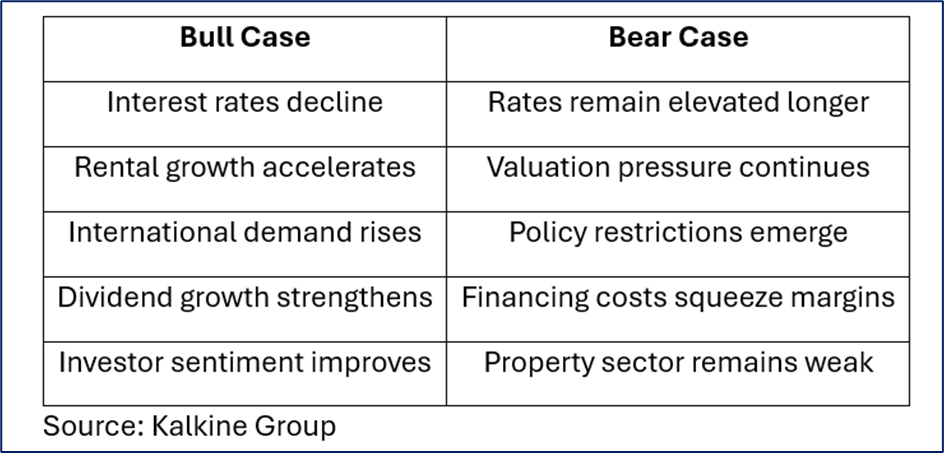
Potential positive catalysts:
- Interest rate cuts or stabilization
• Strong student enrollment growth
• Property valuation recovery
• Institutional investment inflows
Potential negative catalysts:
- Persistently high bond yields
• Regulatory changes affecting student visas
• Economic slowdown
• Financing cost increases
Bull vs Bear Scenario Matrix
What Are the Main Risks Investors Should Know?
- Interest rate sensitivity
• Property market valuation cycles
• Development execution risk
• Regulatory and immigration policy risk
• Macroeconomic downturn impact
FAQ — Unite Group Investment Questions
Is Unite Group affected by interest rates?
Yes, REIT valuations are highly sensitive to borrowing costs and bond yields.
Is student accommodation demand strong?
Yes, driven by international student growth and housing shortages.
Is the dividend safe?
Current indicators suggest stability, though growth may vary with financing conditions.
Could the stock recover?
Recovery depends largely on interest-rate trends and investor sentiment toward property assets.
Final Investment Conclusion — February 2026
The Unite Group share price decline in February 2026 appears primarily driven by macroeconomic pressures rather than structural business weakness. The company continues to operate within one of the most resilient real estate segments, supported by demographic demand, limited supply, and long-term university partnerships.
Short-term volatility may persist due to interest-rate uncertainty, but long-term fundamentals remain intact. For patient investors seeking income and structural growth exposure, periods of weakness may present opportunities, while short-term traders should remain aware of macro-driven risks.
Overall positioning:
- Short term: Volatile / cautious
• Medium term: Gradual stabilization potential
• Long term: Structurally attractive with dividend income appeal


 Jun 29, 2026




 Please wait processing your request...