
 AU
AU
 CA
CA
 US
US
 NZ
NZ
 IND
IND

 UK
UK

 Share
Share
 X (Formerly Twitter)
 Whatsapp
 Facebook
 LinkedIn
 Telegram
 Email This Article
 Copy Link
 Summarize with AI
 Chat GPT
 Perplexity
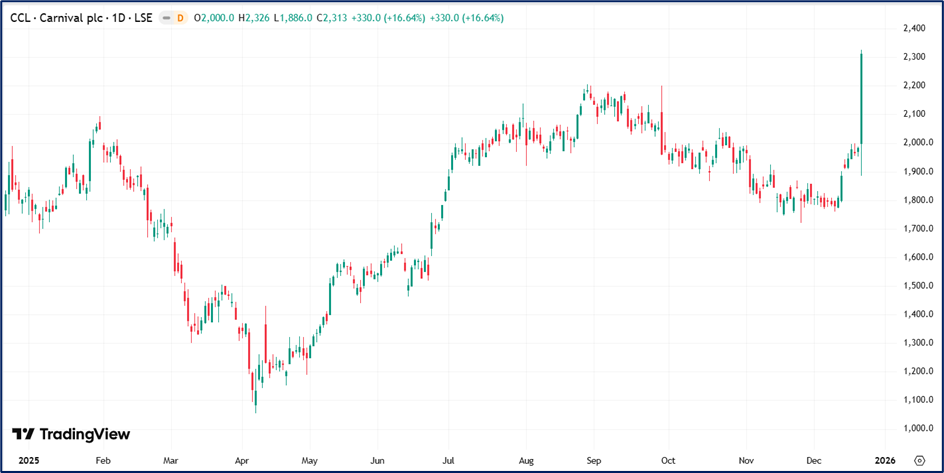
The cruise industry just sent a massive signal to the global markets. On December 19, 2025, Carnival PLC (LSE: CCL) - a cornerstone of the FTSE 250 - saw its stock price skyrocket by approximately 16.6% (with US-listed ADRs following suit).
This wasn't just a "dead cat bounce" or a minor correction; it was a fundamental rerating of the world's largest cruise operator. Here is the analytical breakdown of why the "Fun Ships" are suddenly the hottest ticket in the City.
The Big Mo: Key Drivers Behind the 16.6% Surge
Source: Kalkine Group
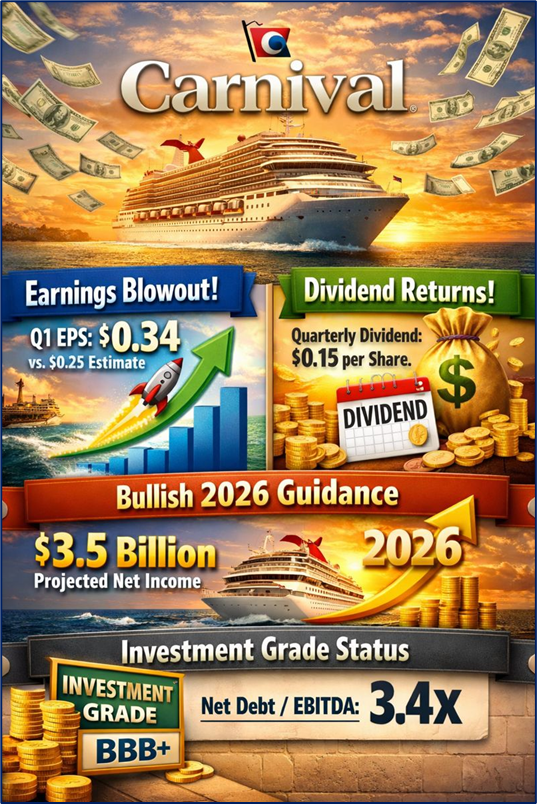
The rally was ignited by a "Triple Threat" of positive news delivered during the Q4 2025 earnings call:
- Earnings Blowout: Carnival delivered adjusted earnings per share (EPS) of $0.34, obliterating Wall Street and City analyst consensus of $0.25.
- The Return of the Dividend: For the first time since the pandemic-era pause, Carnival's board reinstated a quarterly cash dividend ($0.15/share), signaling that the "crisis era" is officially over.
- Bullish 2026 Guidance: Management projected 2026 adjusted net income of $3.5 billion, significantly higher than the record-breaking 2025 levels.
- Investment Grade Status: The company reached a "turning point" in its deleveraging journey, achieving a net debt to EBITDA ratio of 3.4x, moving it back toward investment-grade territory.
Business Model & Latest Updates
The "Floating City" Economics
Carnival operates a volume-driven hospitality model. They don't just sell tickets; they operate high-margin captive ecosystems.
- Ticket Revenue: Base fare covering accommodation and basic meals.
- Onboard Spend (The Real Alpha): This includes casinos, specialty dining, excursions, and WiFi. In 2025, onboard revenue per diem reached record highs.
- Asset Heavy, Cash Flow Rich: The model relies on high occupancy (currently ~100%+) to spread the massive fixed costs of operating a 90+ ship fleet.
2025 Strategic Updates
- Simplification of Structure: Carnival has proposed a plan to unify its dual-listed framework. This involves shifting its legal incorporation and streamlining governance to increase liquidity and weighting in major indices.
- Destination Strategy: The company is doubling down on private destinations, such as Celebration Key in Grand Bahama, which allows them to capture 100% of the shore excursion and food/beverage revenue.
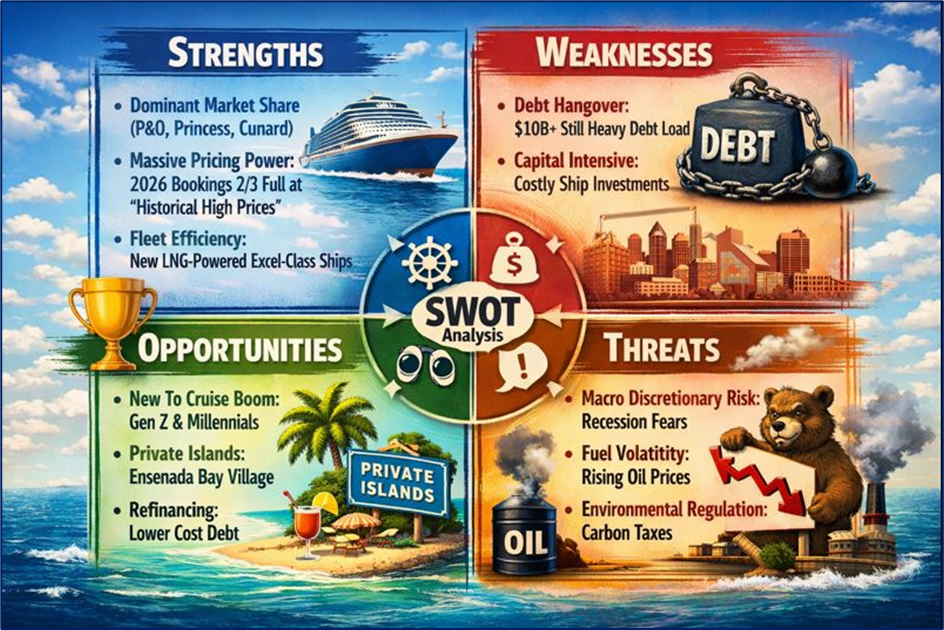
SWOT Analysis: Carnival PLC (Dec 2025)
Source: Kalkine Group
Strengths
- Dominant Market Share: Largest cruise operator globally with brands like P&O, Princess, and Cunard.
- Massive Pricing Power: 2026 bookings are already two-thirds full at "historical high prices."
- Fleet Efficiency: New Excel-class ships (powered by LNG) are significantly more fuel-efficient than older vessels.
Weaknesses
- Debt Hangover: Despite paying down $10B+, the company still carries a substantial debt load compared to pre-2020 levels.
- Capital Intensive: Requires constant multi-billion dollar reinvestment in new ships to stay competitive.
Opportunities
- New To Cruise (NTC): A surge in first-time cruisers (Gen Z and Millennials) is expanding the total addressable market.
- Private Islands: Higher margins from exclusive destinations like Ensenada Bay Village.
- Refinancing: Improving credit ratings will allow Carnival to swap high-interest "emergency" debt for cheaper corporate paper.
Threats
- Macro Discretionary Risk: If a hard recession hits in 2026, the high-end travel budget is usually the first to be cut.
- Fuel Volatility: While efficiency is up, a spike in Brent Crude directly eats into the bottom line.
- Environmental Regulation: Stricter maritime carbon taxes could increase operational costs.
The "Iceberg" Risks
While the sentiment is overwhelmingly bullish, retail investors should monitor:
- The "Altman Z-Score" Trap: Some analysts point out that despite record profits, traditional liquidity ratios (Current Ratio of ~0.3) remain tight.
- Geopolitical Shifts: Redeployments away from the Arabian Gulf have already impacted yields; further instability in key sailing regions is a constant wildcard.
- Supply Chain: Maintenance and dry-dock costs are rising due to global labor and parts inflation.
Conclusion
The 16.6% jump on December 19 was a "relief rally" combined with a "growth story." By reinstating the dividend and proving that consumers are willing to pay record prices despite inflation, Carnival has successfully transitioned from a "recovery play" to a "profitability powerhouse." The focus for 2026 shifts from "can they survive?" to "how much can they earn?"
Source: Trading View, 19 December 2025


 Jun 03, 2026




 Please wait processing your request...