
 AU
AU
 CA
CA
 US
US
 NZ
NZ
 IND
IND

 UK
UK

 Share
Share
 X (Formerly Twitter)
 Whatsapp
 Facebook
 LinkedIn
 Telegram
 Email This Article
 Copy Link
 Summarize with AI
 Chat GPT
 Perplexity
Can Centrica outperform the FTSE 100 in 2026? Deep dive into dividends, nuclear exposure, buybacks, and UK energy trends (latest updates – Jan 2026)
- FTSE 100 breaking 10,000 signals renewed global confidence in UK equities.
- Centrica (CNA) is benefiting from stabilising energy prices and strong cash flow.
- Share buybacks and rising dividends support downside protection in 2026.
- Nuclear exposure (Sizewell) and green CAPEX strengthen long-term growth.
Is the Centrica share price finally ready to deliver explosive returns for FTSE 100 investors in 2026? As the UK economy navigates a complex landscape of inflation targets, interest rate cuts, and energy price cap volatility, the spotlight is firmly on the British Gas parent company. With global market dynamics shifting toward green energy transitions and nuclear power investments like Sizewell C, the Centrica stock performance has become a critical barometer for the London Stock Exchange.
In this deep-dive equity analysis, we examine whether the GBP strength, dividend yield, and share buyback programs make CNA a must-watch blue-chip stock for your investment portfolio.
The FTSE 100 recently shattered the historic 10,000 level, marking a new era for UK shares amidst a stabilizing British economy. As wholesale gas prices fluctuate and Ofgem updates the domestic energy price cap, Centrica's business model is evolving from a traditional utility provider to a sustainable energy leader. Investors are asking:
Can Centrica (CNA) outperform the FTSE 250 and global energy sector peers? With a focus on capital allocation, cash flow resilience, and renewable energy storage, this stock market update provides the latest financial insights and operational updates released directly from company sources.
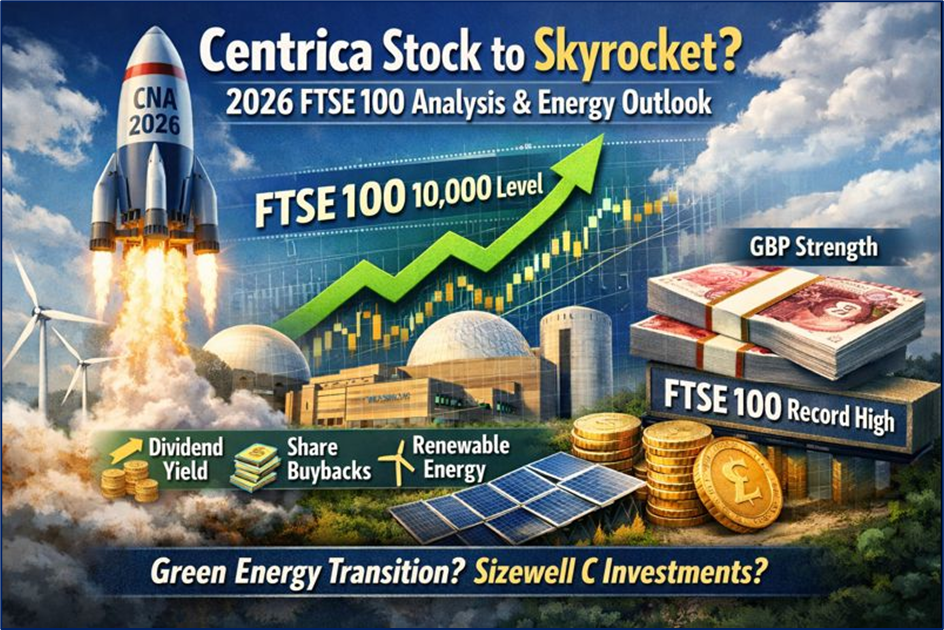
Source: Kalkine Group
What Are the Current Global Market Dynamics and UK Economic Trends?
The global energy landscape in early 2026 is defined by a "Higher for Longer" interest rate environment slowly beginning to thaw. While the US Federal Reserve signals caution, the Bank of England is eyeing a return to the 2% inflation target by spring 2026. This has created a unique "Goldilocks" zone for the FTSE 100, which finally breached the 10,000 mark, proving that UK equities are no longer "stuck in the mud."
- FTSE 100 & 250 Performance: The blue-chip index is benefiting from its heavy weight in commodity and energy stocks, while the FTSE 250 reflects a recovering UK consumer sentiment.
- GBP Analysis: The Pound Sterling (GBP/USD) has shown resilience, hovering near $1.38, driven by a narrowing interest rate differential as the US faces political and fiscal uncertainty. A stronger pound typically lowers the cost of wholesale energy imports, a direct tailwind for Centrica.
- UK Economic Outlook: GDP growth remains modest at 1%, but the energy sector is the primary engine of business investment. With mortgage rates stabilizing, household discretionary income is beginning to recover, though minimum wage increases pose cost pressures for service-heavy firms.
How Does the Sector and Stock Outlook Shape Up for Centrica?
The utilities sector is undergoing a seismic shift toward decarbonization. Centrica’s role as an integrated energy player puts it at the heart of the UK's net-zero 2050 goal.
- Short Term (3–6 Months): The outlook is dominated by the January 2026 Ofgem price cap and winter heating demand. While wholesale gas prices have cooled since their 2022 peaks, volatility remains a factor.
- Medium Term (1–3 Years): The focus shifts to infrastructure. Centrica’s recent moves—including the £800 million investment offer for Sizewell B and the Sizewell C nuclear project—position it as a strategic partner to the UK government.
- Long Term (5+ Years): The transition to hydrogen storage (via the Rough facility) and battery storage will determine if Centrica can shed its "legacy utility" label and become a green tech powerhouse.
What Forward-Looking Strategies Should Investors Consider?
Analyzing the Centrica investment case requires a tiered approach based on your time horizon and risk appetite.
- Short-Term Strategy (3–6 Months): Focus on liquidity and volatility. Traders are watching the 185p–190p resistance levels. With inflation falling, any faster-than-expected BoE rate cut could trigger a rotation into dividend-paying utilities.
- Medium-Term Strategy (1–3 Years): Monitor capital allocation. Centrica has been aggressive with share buybacks (Company Source: Transaction in Own Shares announcements, Jan 2026). This reduces share count and supports Earnings Per Share (EPS) growth even if revenue is flat.
- Long-Term Strategy (3+ Years): Evaluate the Energy Transition Plan. Investors should track the progress of green CAPEX—currently over 50% of capital expenditure is earmarked for green initiatives through 2028 (Company Source: 2025 Interim Results).
Is Centrica Looking Bullish, Bearish, or Neutral?
- Short Term: Bullish/Neutral. The stock has hit 52-week highs near 190p, outperforming the FTSE All-Share by over 12% in the past year. Momentum is strong, but the Relative Strength Index (RSI) suggests it may be approaching overbought territory.
- Long Term: Bullish. The "unbiased" retail view suggests that Centrica is no longer the "broken" company of five years ago. It has a strong net cash position and a lean business model. The pivot toward nuclear and renewables provides a "moat" that traditional gas retailers lack.
What Are the Latest Drivers of the Centrica Surge?
- Nuclear Expansion: The recent proposal to extend the life of Sizewell B by 20 years has ignited investor interest in Centrica’s generation portfolio.
- Financial Fortitude: The company reported a 2.62% dividend yield and is expected to increase payouts by 20% this year (Source: Centrica Dividend History).
- Operational Efficiency: British Gas Services has seen a turnaround in customer retention and a decrease in complaints per customer, strengthening the core retail brand.
- Shareholder Returns: Continuous share buyback programs (latest Jan 2026) act as a safety net for the share price.
Centrica 2026 SWOT Analysis
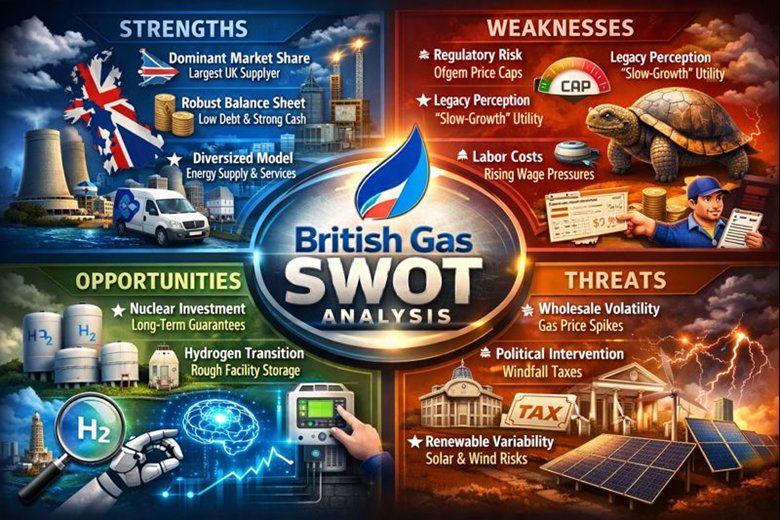
Source: Kalkine Group
Centrica FAQ: Everything Investors Are Asking Today
- Is Centrica (CNA) still a good buy in 2026? With the FTSE 100 at record highs and Centrica's P/E ratio looking attractive compared to global peers, many see it as a "value" play in a "growth" market.
- What is the latest Centrica dividend update? Centrica recently increased its interim dividend to 1.83p and has proposed a progressive policy aiming for a 22% increase in total annual payouts (Company Source: 2025 Reports).
- Will the British Gas owner benefit from lower interest rates? Yes. As a utility with significant infrastructure plans, lower rates reduce the cost of capital for projects like Sizewell C and make its dividend yield more attractive to income seekers.
- What is the significance of the Rough gas storage facility? It provides over half of the UK's gas storage capacity. Its future transition to hydrogen is a major "green" catalyst for the stock.
- Why did Centrica shares hit a 52-week high in January 2026? A combination of insider buying, the Vodafone partnership announcement, and a general rally in the FTSE 100 energy sector.
Analytical Investment Conclusion: Buy, Sell, or Hold?
After analyzing the FTSE 100's record-breaking run and Centrica’s operational pivot, the conclusion for 2026 leans toward a HOLD/BUY bias for different profiles.
- Income Seekers: This is a HOLD. The dividend is growing but isn't the highest in the sector yet.
- Value Investors: This is a BUY. With a forward P/E ratio around 12.6x and a PEG ratio of 0.66, the stock looks undervalued relative to its growth potential in the green energy space.
- Risk-Averse Investors: Caution is needed. Regulatory changes are the "black swan" for any utility.


 Jun 18, 2026




 Please wait processing your request...