
 AU
AU
 CA
CA
 US
US
 NZ
NZ
 IND
IND

 UK
UK

 Share
Share
 X (Formerly Twitter)
 Whatsapp
 Facebook
 LinkedIn
 Telegram
 Email This Article
 Copy Link
 Summarize with AI
 Chat GPT
 Perplexity
Views Expressed Disclaimer:
You are reading a free article with opinions that may differ from the recommendation given by Kalkine in its paid research reports. Become a Kalkine member today to get access to our research reports, in-depth technical and fundamental research.
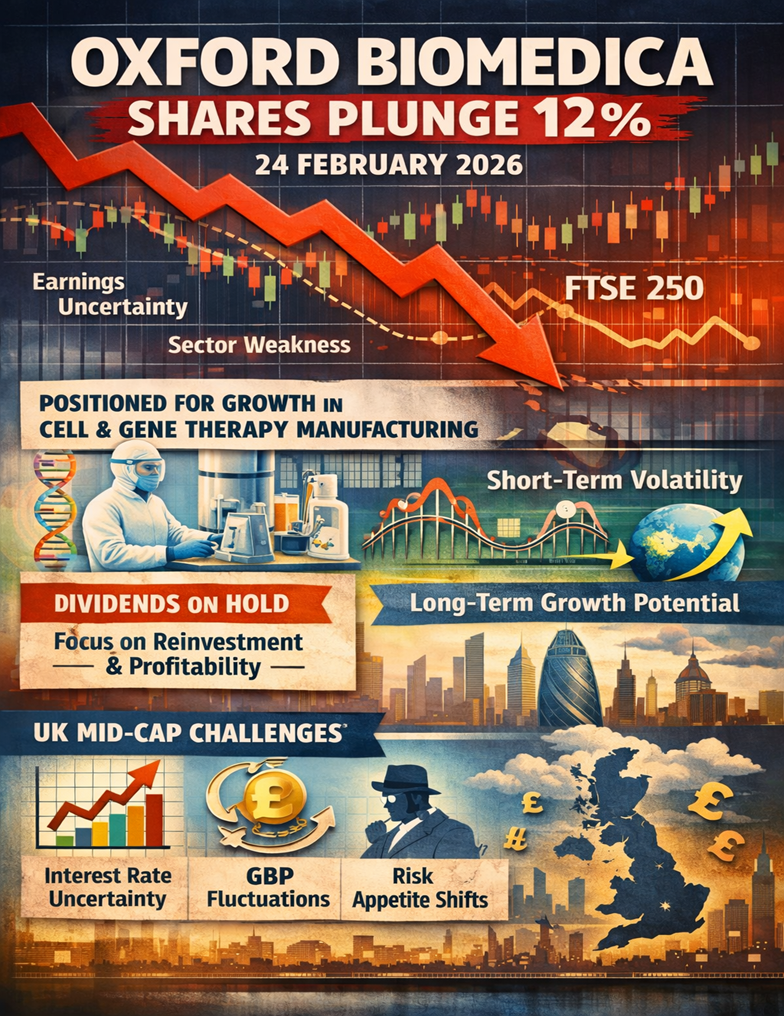
Key Takeaways — February 2026
- Oxford Biomedica share price fell approximately 12% on 24 February 2026 driven by investor concerns around earnings visibility, sector sentiment weakness, and FTSE 250 volatility rather than a single negative announcement.
• The company remains strategically positioned in the fast-growing global cell and gene therapy manufacturing market with structural demand tailwinds.
• Dividend payments remain unlikely in the near term as management prioritises reinvestment, operational scale-up, and profitability improvement (company disclosures).
• Short-term volatility may persist, but medium-to-long-term growth potential remains linked to execution and industry expansion.
• UK mid-cap equities continue facing macro headwinds including interest-rate uncertainty, GBP fluctuations, and investor risk appetite shifts.
Source: Kalkine Group
Why Is Oxford Biomedica Stock Falling Sharply in February 2026?
Oxford Biomedica share price decline, FTSE 250 biotech stocks weakness, UK biotech investment outlook, OXB stock forecast 2026, and why Oxford Biomedica is down today have become heavily searched financial topics in February 2026 following a steep double-digit sell-off. The Oxford Biomedica stock fall reflects broader pressures across UK growth stocks, global biotechnology equities, and mid-cap healthcare companies as investors reassess risk exposure amid macroeconomic uncertainty and sector-specific concerns.
The February 2026 correction appears to stem from a combination of cautious forward guidance expectations, ongoing profitability challenges common within emerging biotech infrastructure firms, and broader market risk-off sentiment affecting mid-cap innovation companies. Oxford Biomedica operates within viral vector manufacturing — a specialised segment of the biotechnology supply chain — where revenue timing depends heavily on client clinical progress, creating inherent earnings volatility.
From a global SEO and investor interest perspective, search trends including Oxford Biomedica forecast 2026, UK biotech stocks to buy now, FTSE 250 investment opportunities, and gene therapy manufacturing companies continue rising as investors attempt to evaluate whether the decline represents temporary weakness or structural risk.
What Company-Specific Factors Triggered the Sell-Off?
Several business-level dynamics likely contributed to the sudden decline:
- Investor sensitivity to revenue timing within contract development and manufacturing projects
• Concerns regarding operating margins during expansion phases
• Market caution toward companies with extended profitability timelines
• Profit-taking after prior share price recoveries
• Generalised weakness across biotech and healthcare growth equities
Oxford Biomedica’s strategy centres on providing lentiviral vector manufacturing services to biotechnology and pharmaceutical partners developing advanced therapies. This model offers high long-term growth potential but can produce uneven quarterly results depending on project milestones and regulatory timelines (company reports and investor updates).
How Are Global Markets, the UK Economy, and GBP Influencing FTSE 250 Sentiment?
The broader macroeconomic environment in February 2026 remains a significant influence on investor behaviour:
- Interest-rate expectations in the UK remain uncertain despite moderating inflation
• GBP currency volatility impacts foreign investment flows into UK equities
• Global biotech funding conditions remain tighter compared with previous liquidity cycles
• FTSE 250 companies remain more economically sensitive than FTSE 100 multinational firms
The UK economy is experiencing modest growth but faces productivity constraints and fiscal policy uncertainty. Mid-cap growth stocks such as Oxford Biomedica typically react more strongly to shifts in investor risk appetite than defensive large-cap companies.
How Does Oxford Biomedica Compare With Its Industry Peers?
Peer benchmarking provides insight into the company’s competitive positioning.
Competitive strengths include:
- Deep technical expertise in viral vector manufacturing
• Established partnerships with global biotechnology clients
• High regulatory and technological barriers to entry
Key challenges include:
- Smaller operational scale compared with large international CDMO providers
• Revenue concentration risk from major contracts
• Longer path to sustained profitability relative to mature competitors
Oxford Biomedica therefore offers higher potential growth but also higher volatility compared with larger contract manufacturing peers.
What Is the Outlook for the Cell and Gene Therapy Manufacturing Sector?
Short-term outlook:
- Funding conditions remain selective for biotechnology companies
• Investor sentiment toward early-stage therapy ecosystems remains cautious
• Revenue variability across the industry likely continues
Medium-term outlook:
- Increasing clinical pipeline activity globally
• Pharmaceutical outsourcing trends supporting demand for CDMO services
• Potential industry consolidation creating strategic opportunities
Long-term outlook:
- Structural growth driven by personalised medicine and gene therapies
• Significant expansion potential for advanced therapy manufacturing markets
• Increasing strategic importance to global healthcare innovation ecosystems
What Is Oxford Biomedica’s Dividend Outlook?
Oxford Biomedica currently does not prioritise dividend payments. Management focus remains directed toward:
- Scaling manufacturing capacity
• Enhancing technology platforms
• Improving operating margins
• Strengthening financial position
Dividend initiation may only become feasible once consistent profitability and free cash flow generation are achieved (company disclosures).
What Forward-Looking Strategies Could Investors Consider?
Short-term horizon:
- Volatility likely driven by news flow and earnings updates
• Suitable primarily for investors comfortable with higher risk
• Monitoring contract announcements and guidance revisions is essential
Medium-term horizon:
- Potential valuation recovery if operational milestones are achieved
• Sector sentiment improvement could support share price stabilisation
• Earnings visibility improvements may trigger re-rating
Long-term horizon:
- Structural industry growth remains compelling
• Successful execution could unlock substantial shareholder value
• Appropriate for investors seeking exposure to advanced healthcare innovation trends
Is Oxford Biomedica Stock Bullish, Bearish, or Neutral?
Short-term assessment: Neutral to bearish
Market momentum and sentiment remain weak following the sharp decline, and macro conditions continue to challenge mid-cap growth valuations.
Long-term assessment: Neutral to bullish
The company’s strategic positioning within gene therapy manufacturing provides potential upside if operational execution strengthens and industry demand expands.
This represents analytical reasoning rather than financial advice.
What Do Analysts and Brokers Suggest About Future Prospects?
Broker opinions remain mixed due to uncertainty around profitability timelines:
- Berenberg — Positive long-term industry view with execution risk considerations
• Jefferies — Constructive outlook with emphasis on contract pipeline development
• JPMorgan — Neutral stance reflecting margin and visibility concerns
• RBC Capital Markets — Balanced perspective on valuation versus risk
Forecast dispersion remains wide due to differing assumptions regarding growth and margin expansion.
What Are the Major Risks Investors Should Monitor?
- Dependence on key customer programmes
• Execution challenges during operational scale-up
• Funding environment for biotechnology clients
• Regulatory complexity and compliance costs
• Profitability timeline uncertainty
• Macroeconomic volatility affecting growth stock valuations
What Does the Bull vs Bear Scenario Analysis Show?
Bullish scenario drivers:
- Major contract wins and expanding pipeline
• Improved facility utilisation and margin expansion
• Strategic partnerships with large pharmaceutical companies
• Recovery in biotech sector investment sentiment
• Industry growth acceleration
Bearish scenario drivers:
- Programme delays from customers
• Continued operating losses and cash concerns
• Competitive pressure from larger CDMO providers
• Prolonged macroeconomic risk-off environment
• Investor confidence deterioration
FAQ — Oxford Biomedica Stock February 2026
Why did Oxford Biomedica shares fall 12%?
The decline appears linked to investor concerns around earnings visibility, sector sentiment, and macroeconomic pressures rather than a single event.
Is Oxford Biomedica a good long-term investment?
It may appeal to investors seeking high-growth healthcare exposure, but volatility and execution risk remain significant.
Does Oxford Biomedica pay dividends?
Currently, dividend payments are not expected in the near term due to reinvestment priorities.
What sector does Oxford Biomedica operate in?
The company operates in viral vector manufacturing for cell and gene therapies within the biotechnology CDMO industry.
Final Investment Conclusion — Is Oxford Biomedica a Buy After the Drop?
Oxford Biomedica’s sharp share price decline in February 2026 highlights the volatility inherent in mid-cap biotechnology infrastructure companies operating at the intersection of innovation and capital intensity. While near-term uncertainty surrounding profitability and macroeconomic conditions continues to weigh on sentiment, the company’s strategic positioning within a rapidly expanding advanced therapy manufacturing ecosystem provides a credible long-term growth narrative.
Investors should align decisions with risk tolerance and investment horizon. Income-focused investors may find limited appeal due to absent dividends and earnings variability. Growth-oriented investors with long time horizons may view current weakness as a potential accumulation phase if execution milestones improve.
Overall positioning assessment:
- Short term — cautious
• Medium term — balanced
• Long term — selectively optimistic


 Jun 29, 2026




 Please wait processing your request...