
 AU
AU
 CA
CA
 US
US
 NZ
NZ
 IND
IND

 UK
UK

 Share
Share
 X (Formerly Twitter)
 Whatsapp
 Facebook
 LinkedIn
 Telegram
 Email This Article
 Copy Link
 Summarize with AI
 Chat GPT
 Perplexity
INTRODUCTION: THE SYSTEMIC TURNING POINT
The unfolding crisis around the Strait of Hormuz has transitioned from a geopolitical flashpoint into a systemic shock with deep implications across energy, finance, and global power structures. As of April 10, 2026, the convergence of restricted oil flows, rising military tensions involving Iran, United States, and Israel, and the unprecedented emergence of Bitcoin in trade settlement mechanisms has created a moment that could redefine global markets for years to come.
The diplomatic axis centered in Islamabad further amplifies the complexity, as Pakistan positions itself as a mediator in a high-stakes geopolitical negotiation that blends energy security with financial sovereignty.
What follows is an expanded deep-dive with additional critical sections to fully capture the evolving dynamics, risks, and strategic implications.
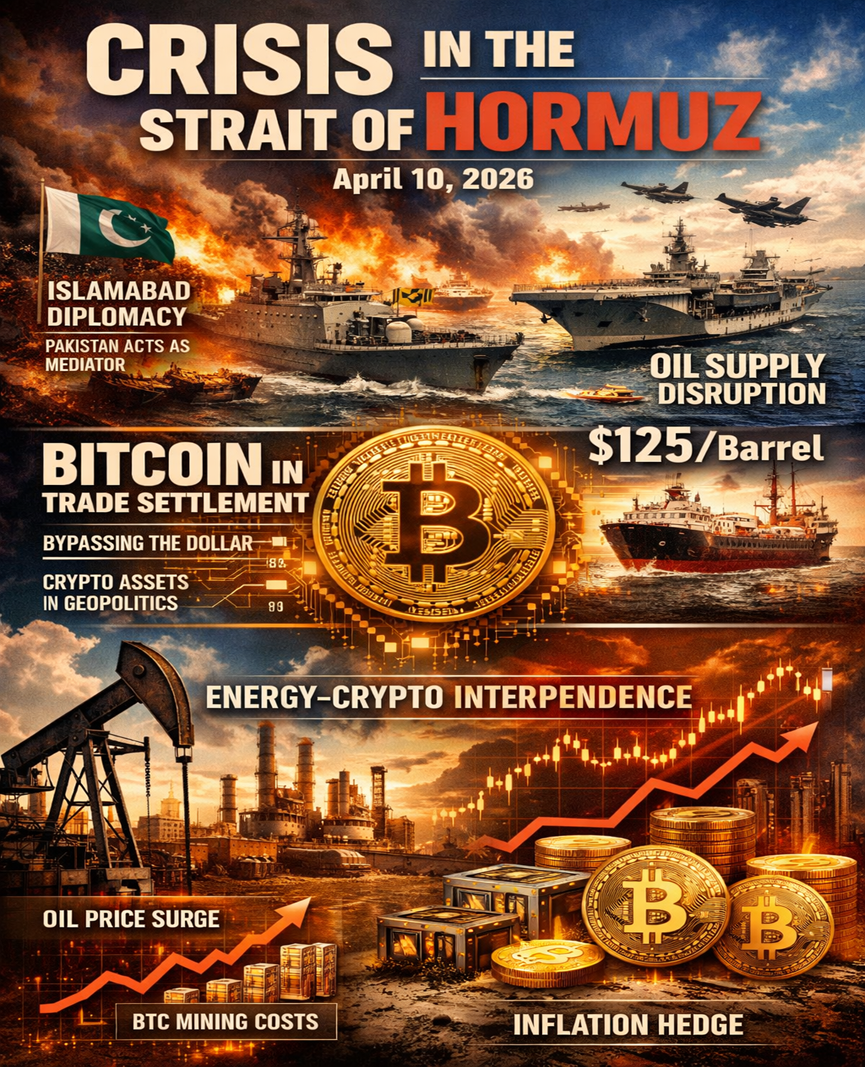
Source: Kalkine Group
LATEST HORMUZ STATUS AND MARKET REACTION
The Strait remains partially constrained, operating under controlled throughput rather than free navigation. This hybrid blockade allows Iran to maximize leverage while avoiding immediate escalation into full-scale war. Oil markets are pricing in prolonged disruption rather than temporary shock, which explains sustained elevated prices rather than short-lived spikes.
Shipping congestion, insurance premiums, and rerouting inefficiencies are compounding supply-side stress, creating a layered disruption that extends beyond crude into refined products and downstream industries.
BITCOIN AS A GEOPOLITICAL SETTLEMENT LAYER
The introduction of Bitcoin into transit fee discussions is reshaping perceptions of cryptocurrency from speculative asset to geopolitical instrument. Iran’s strategic calculus is clear: reduce dependency on dollar-denominated systems and create a parallel settlement infrastructure immune to sanctions.
This development aligns with a broader trend toward financial decentralization, where state and non-state actors increasingly explore alternatives to traditional banking systems.
ENERGY–CRYPTO INTERDEPENDENCE
The relationship between energy markets and Bitcoin is becoming structurally significant. Rising oil prices increase inflation expectations, which historically benefit scarce digital assets like Bitcoin. At the same time, higher energy costs increase mining expenses, influencing supply-side dynamics.
This dual impact creates a non-linear correlation that becomes particularly pronounced during periods of geopolitical stress.
OIL FLOWS, BITCOIN REQUIREMENTS, MINING ECONOMICS, AND GLOBAL SUPPLY–DEMAND DYNAMICS
The most critical way to understand the magnitude of the current crisis around the Strait of Hormuz is through hard data. Beneath the headlines lies a massive system of daily flows, financial equivalents, and energy conversions that reveal just how interconnected oil, Bitcoin, and global markets have become.
At baseline, the Strait of Hormuz handles approximately 20 million barrels of oil per day, representing roughly 20% of total global oil consumption and up to 25–30% of seaborne oil trade globally. This makes it the single largest energy chokepoint on the planet. In value terms, even at a conservative oil price of $100 per barrel, this translates to $2 billion worth of oil moving through the strait every single day.
However, the 2026 crisis has significantly disrupted these flows. At peak disruption, shipments fell by more than 50–60%, dropping to around 10 million barrels per day, effectively removing a double-digit percentage of global supply from the market. In extreme estimates, analysts suggest 13–15 million barrels per day of supply disruption, which is historically unprecedented in scale.
This is where the Bitcoin linkage becomes quantitatively fascinating.
Under the reported Iranian toll structure of approximately $1 per barrel, the daily economic extraction from Hormuz traffic can be modeled directly. At normal flow levels of 20 million barrels per day, this implies $20 million per day in toll revenue, or approximately $7–8 billion annually.
Now translating this into Bitcoin terms introduces a new analytical layer. Based on recent Bitcoin price levels around ~$70,000 per BTC, daily toll revenue of $20 million equates to roughly 280–300 BTC per day. Over a two-week period, this aligns with estimates of approximately 4,000+ Bitcoins collected, confirming the scale of crypto integration into real-world commodity logistics.
This effectively creates a direct conversion pipeline:
Oil flow (barrels per day) → Dollar value → Bitcoin settlement demand
At full capacity, the Strait of Hormuz could theoretically generate over 100,000 BTC annually in settlement demand, depending on pricing and compliance levels. While not all flows will convert to Bitcoin, even partial adoption introduces meaningful incremental demand pressure into the crypto ecosystem.
From a mining perspective, this introduces a second-order effect.
Bitcoin mining is fundamentally an energy conversion process. On average, producing one Bitcoin currently requires approximately 100,000 to 150,000 kWh of electricity, depending on hardware efficiency and network difficulty. At an average industrial electricity cost of $0.05–$0.10 per kWh, this implies a production cost range of $5,000 to $15,000 per Bitcoin, though real-world costs are often higher due to infrastructure, cooling, and capital expenditure.
Now linking this to oil markets creates a powerful analytical bridge. One barrel of oil contains roughly 1,700 kWh of energy equivalent. This means:
- 1 Bitcoin (at ~120,000 kWh average) ≈ energy equivalent of ~70 barrels of oil
At $100 per barrel, this implies a theoretical energy-equivalent cost of $7,000 per Bitcoin, which aligns closely with the lower bound of mining costs.
However, this relationship becomes nonlinear during crises. As oil prices rise due to supply disruptions, electricity costs increase globally, pushing mining costs higher. At the same time, geopolitical demand for Bitcoin (as seen in Hormuz tolls) increases price pressure upward. This creates a dual-sided squeeze:
- Rising oil prices → higher mining costs
• Rising geopolitical demand → higher Bitcoin price
This dynamic effectively links the marginal cost of Bitcoin production to global energy markets more tightly than ever before.
On the demand–supply side, the oil market is currently operating under extreme stress conditions. Global oil demand in 2026 is estimated at around 104–105 million barrels per day, while supply disruptions of 10–15 million barrels represent a 10–15% shock to global supply.
Even small imbalances in oil markets—typically 1–2 million barrels per day—can cause significant price swings. A disruption of this magnitude explains why prices have surged toward or beyond $100 per barrel and why forecasts are pointing toward $120–$150 in worst-case scenarios.
Inventory buffers provide only limited relief. Strategic reserves released globally—such as the 400 million barrels coordinated by major economies—represent only a few days of global consumption. This highlights the structural vulnerability of the system: the world consumes oil at such scale that even large reserves are quickly exhausted during sustained disruptions.
Another critical data point is the limited capacity of alternative routes. Existing pipelines bypassing the Strait of Hormuz can handle only 2–3 million barrels per day, far below the normal 20 million barrel throughput. This means that over 85% of disrupted flows cannot be rerouted, reinforcing the strait’s irreplaceability in the short term.
From a macro-financial perspective, the oil–Bitcoin linkage introduces a new form of cross-asset correlation. Traditionally, oil shocks primarily affected inflation, currencies, and equities. Now, they also have the potential to influence cryptocurrency demand directly through settlement use cases.
If we model a scenario where even 10% of Hormuz oil flows require Bitcoin settlement, this would translate to:
- 2 million barrels/day × $1 toll = $2 million/day
• Equivalent to ~30 BTC/day
• ~10,000 BTC annually
This is non-trivial when compared to Bitcoin’s annual issuance of approximately 165,000 BTC post-halving, meaning Hormuz-related demand alone could account for 5–10% of new supply absorption under moderate adoption scenarios.
This creates a structural demand narrative that did not exist in previous cycles.
At the same time, risks remain substantial. Bitcoin’s volatility introduces settlement risk for oil traders. A 5–10% price swing in Bitcoin within hours could materially impact transaction costs, making hedging mechanisms essential. Additionally, regulatory responses from major economies could limit the scalability of such systems.
In conclusion, the data reveals that the Strait of Hormuz crisis is not just an energy disruption—it is a quantitative transformation of global financial flows. The integration of Bitcoin into oil transit economics introduces a new layer of demand, while energy price dynamics reshape mining costs and supply structures. The result is a tightly coupled system where barrels of oil and units of Bitcoin are increasingly linked through both economics and geopolitics.
This is the first time in modern history that a physical commodity chokepoint and a decentralized digital asset are interacting at scale—and the numbers suggest that this relationship, if sustained, could become one of the defining financial dynamics of the decade.
ISLAMABAD TALKS AND STRATEGIC DIPLOMACY
The diplomatic engagement in Islamabad is not merely about crisis resolution but about redefining strategic alignments. Pakistan’s role as a mediator enhances its geopolitical leverage, while the United States seeks to restore stability without conceding too much ground.
Iran, on the other hand, is negotiating from a position of strength, leveraging its control over the Strait to extract concessions that extend beyond immediate economic gains.
GLOBAL ENERGY SECURITY RESET
One of the most profound consequences of the current crisis is the acceleration of a global energy security reset. Countries heavily dependent on Middle Eastern oil are now reassessing their vulnerabilities. Strategic petroleum reserves are being reconsidered not as temporary buffers but as long-term policy tools.
Nations in Europe and Asia are increasingly looking toward diversification strategies, including increased imports from the United States, Africa, and Latin America. Simultaneously, investments in renewable energy are gaining urgency, not just from a climate perspective but as a matter of national security.
This shift will not happen overnight, but the trajectory is clear: the Hormuz crisis is catalyzing a structural transformation in global energy sourcing and policy frameworks.
OIL MARKET MICROSTRUCTURE AND PRICE FORMATION
Beyond headline oil prices lies a complex microstructure involving futures markets, options positioning, and physical delivery constraints. The current crisis has distorted these mechanisms, leading to increased volatility and widening spreads between different crude benchmarks.
Backwardation in oil futures has intensified, reflecting immediate supply concerns. At the same time, speculative positioning has increased, amplifying price swings. Understanding these dynamics is crucial for interpreting market behavior beyond simple supply-demand narratives.
ROLE OF OPEC AND GLOBAL PRODUCERS
The role of OPEC has come into sharp focus. While some member countries have spare capacity, geopolitical considerations limit their ability to offset disruptions fully.
Saudi Arabia and the UAE could theoretically increase production, but doing so involves strategic trade-offs, including price stability and political alignment. Non-OPEC producers, particularly US shale companies, stand to benefit from higher prices but face constraints related to capital discipline and infrastructure.
This creates a fragmented supply response that contributes to sustained volatility.
DEFENSE AND MILITARY-INDUSTRIAL COMPLEX IMPACT
Rising geopolitical tensions are driving increased defense spending globally. Defense contractors and military suppliers are experiencing heightened demand as countries prepare for potential escalation.
This sector often acts as a hedge during geopolitical crises, benefiting from increased government spending. The current environment suggests sustained growth in defense budgets, particularly among NATO and regional allies.
EMERGING MARKETS VULNERABILITY
Emerging markets are among the most vulnerable to the current crisis. Higher oil prices increase import costs, strain fiscal balances, and contribute to inflationary pressures.
Currencies in these markets are particularly sensitive to capital outflows during periods of global uncertainty. Countries with high external debt and limited reserves face heightened risk, making this a critical area for investors to monitor.
DIGITAL CURRENCY REGULATION AND POLICY RESPONSE
The use of Bitcoin in geopolitical contexts is likely to accelerate regulatory responses from major economies. Governments may introduce stricter controls on cryptocurrency transactions, particularly those linked to sanctioned entities.
At the same time, central banks may accelerate the development of digital currencies to maintain control over monetary systems. This creates a dual dynamic of innovation and regulation that will shape the future of digital finance.
SHIPPING, INSURANCE, AND MARITIME ECONOMICS
The maritime industry is at the frontline of the crisis. Insurance premiums for vessels passing through the Strait have surged, reflecting increased risk. Some shipping companies are rerouting or delaying shipments, leading to supply chain disruptions.
These changes have broader economic implications, affecting everything from energy prices to consumer goods availability. Maritime logistics, often overlooked, is a critical component of global economic stability.
ALTERNATIVE ROUTES AND INFRASTRUCTURE BOTTLENECKS
Efforts to bypass the Strait of Hormuz are limited by infrastructure constraints. Pipelines and alternative routes lack the capacity to fully replace maritime flows.
Projects aimed at expanding these alternatives are likely to gain momentum, but they require significant investment and time. In the short term, the Strait remains irreplaceable, reinforcing its strategic importance.
INFLATIONARY SPILLOVERS AND MONETARY POLICY DILEMMA
Central banks face a challenging environment. Rising oil prices contribute to inflation, while geopolitical uncertainty weighs on economic growth.
This creates a policy dilemma: raising interest rates to combat inflation risks slowing the economy further, while maintaining accommodative policies could exacerbate inflation. The outcome of this balancing act will have significant implications for global financial markets.
CORPORATE EARNINGS AND SECTOR ROTATION
Corporate earnings are beginning to reflect the impact of higher energy costs. Energy-intensive industries such as manufacturing and transportation are experiencing margin pressures, while energy producers benefit from higher prices.
This divergence is driving sector rotation in equity markets, with investors shifting toward sectors that can withstand or benefit from the current environment.
LONG-TERM STRUCTURAL SHIFTS IN GLOBAL TRADE
The crisis is accelerating a broader shift toward regionalization of trade. Companies and governments are reassessing global supply chains, prioritizing resilience over efficiency.
This could lead to a gradual unwinding of globalization trends, with significant implications for economic growth and market dynamics.
EXTREME RISK SCENARIOS AND BLACK SWAN EVENTS
Beyond baseline scenarios lie extreme risks that could dramatically alter the trajectory of the crisis. A complete closure of the Strait, direct military confrontation between major powers, or large-scale cyberattacks on energy infrastructure could trigger unprecedented market reactions.
These scenarios, while low probability, carry high impact and must be considered in strategic planning. The Strait of Hormuz crisis is a multi-dimensional event that intersects energy markets, financial systems, and geopolitical strategies. The introduction of Bitcoin into this equation adds a transformative element that could reshape global trade.
CONCLUSION: THE DAWN OF A NEW GLOBAL ORDER IN ENERGY, MONEY, AND POWER
The crisis unfolding around the Strait of Hormuz in April 2026 is not simply another geopolitical flare-up—it is a structural inflection point that is redefining how the world understands energy security, financial systems, and geopolitical leverage. What makes this moment uniquely consequential is not just the scale of disruption, but the convergence of forces that were previously evolving in isolation: great-power rivalry, supply chain fragility, energy dependency, and the emergence of decentralized financial infrastructure led by Bitcoin.
At its core, this crisis exposes a fundamental truth that markets often underestimate until stress events occur: the global economy is still deeply dependent on physical chokepoints. Despite decades of globalization, digitization, and financial innovation, the movement of real assets—especially oil—remains constrained by geography. The Strait of Hormuz is not just a narrow waterway; it is a strategic pressure valve through which nearly a quarter of the world’s oil supply flows. When that valve is tightened, even partially, the ripple effects extend into inflation, currency stability, equity markets, and political decision-making across continents.
Yet, what elevates this crisis beyond historical comparisons is the introduction of a parallel financial layer. The potential use of Bitcoin by Iran as a mechanism for collecting transit tolls represents a profound shift in how economic power can be exercised under sanctions. For decades, the global financial system has been anchored by dollar dominance, enforced through institutions, payment rails, and regulatory frameworks largely influenced by the United States. The emergence of cryptocurrency as a viable alternative—especially in a real-world, high-value context like oil transit—signals the beginning of a potential fragmentation of that system.
This does not mean the dollar is immediately threatened, nor that Bitcoin will replace traditional financial infrastructure in the near term. However, it introduces optionality, and in geopolitics, optionality is power. Even if only a fraction of global trade begins to experiment with crypto-based settlement, the implications are far-reaching. It reduces the effectiveness of sanctions, introduces new channels of liquidity, and forces policymakers to reconsider how financial control is exercised in an increasingly decentralized world.
Simultaneously, the diplomatic efforts centered in Islamabad highlight another critical dimension of this crisis: the shifting geometry of global influence. Pakistan’s role as a mediator underscores the growing importance of regional powers in managing global crises. The traditional binary frameworks of global politics—East versus West, developed versus emerging—are giving way to more fluid, multi-polar dynamics where influence is distributed across a wider set of actors.
For the United States, the challenge is multifaceted. It must ensure the stability of global energy markets, maintain the credibility of its financial system, and navigate complex alliances in a region where interests are often misaligned. For Iran, the crisis represents an opportunity to convert geographic advantage into strategic leverage, pushing back against sanctions while asserting its role as a regional power. For Israel, the calculus remains rooted in security, often prioritizing long-term strategic objectives over short-term economic stability.
From a market perspective, the implications are equally profound. The immediate impact—higher oil prices, increased volatility, and risk-off sentiment—is only the surface layer. Beneath it lies a deeper transformation in how assets are valued and how risk is priced. Energy is no longer just a commodity; it is a geopolitical instrument. Bitcoin is no longer just a speculative asset; it is becoming a tool of financial sovereignty. Supply chains are no longer just efficiency-driven systems; they are strategic assets subject to disruption and reconfiguration.
Investors, therefore, must shift their frameworks accordingly. Traditional models that rely heavily on macroeconomic indicators and corporate fundamentals must now incorporate geopolitical analysis as a core component. The ability to interpret diplomatic signals, military developments, and policy shifts is becoming as important as analyzing earnings reports or interest rate trends. This does not mean abandoning fundamentals, but rather augmenting them with a broader understanding of the forces shaping global markets.
The crisis also reinforces the importance of adaptability. In an environment characterized by uncertainty and rapid change, rigid strategies are likely to underperform. Instead, investors and institutions must remain flexible, ready to adjust positions as new information emerges. This includes maintaining diversified portfolios, managing risk proactively, and being prepared to capitalize on opportunities created by volatility.
Another key takeaway is the acceleration of long-term structural trends. The push toward energy diversification, the exploration of alternative trade routes, and the development of digital currencies are not new phenomena. However, crises like this act as catalysts, compressing timelines and forcing decisions that might otherwise have taken years to materialize. Governments and corporations are now incentivized to act with urgency, whether it is investing in renewable energy, expanding strategic reserves, or developing new financial infrastructure.
At the same time, the risks cannot be understated. The potential for escalation remains significant, with scenarios ranging from prolonged disruption to full-scale conflict. Each scenario carries its own set of economic and financial consequences, from sustained inflation to global recession. The integration of cryptocurrency into geopolitical strategies also introduces new uncertainties, including regulatory responses and the potential for misuse.
Ultimately, the events of April 2026 may be remembered as a turning point—a moment when the interconnectedness of energy, finance, and geopolitics became impossible to ignore. The Strait of Hormuz, long recognized as a critical chokepoint, has now become a symbol of a broader transformation. It represents the intersection of old-world constraints and new-world innovations, where physical geography meets digital finance, and where traditional power structures are challenged by emerging alternatives.
The path forward is unlikely to be linear. There will be periods of de-escalation and renewed tension, moments of clarity followed by uncertainty. However, the direction of change is becoming increasingly clear. The global system is evolving toward greater complexity, with multiple centers of power and a wider array of tools for exercising influence.
For those navigating this landscape—whether investors, policymakers, or business leaders—the imperative is clear: understand the interplay between these forces, remain adaptable, and recognize that the rules of the game are changing. The Strait of Hormuz crisis is not just an event; it is a signal. A signal that the future of global markets will be shaped not just by economics, but by the dynamic and often unpredictable interaction of geopolitics, technology, and human decision-making.


 Jun 08, 2026




 Please wait processing your request...