
 AU
AU
 CA
CA
 US
US
 NZ
NZ
 IND
IND

 UK
UK

 Share
Share
 X (Formerly Twitter)
 Whatsapp
 Facebook
 LinkedIn
 Telegram
 Email This Article
 Copy Link
 Summarize with AI
 Chat GPT
 Perplexity
As the global economy shifts into a new phase of the rate-cutting cycle in early 2026, the FTSE 250 has emerged as the primary battlefield for "Smart Money." While the FTSE 100 captured headlines with record highs driven by mining M&A, fund managers are quietly rotating into mid-caps where valuation gaps remain historically wide.
With the Bank of England projected to lower the terminal rate to 3.25% by mid-year, the domestic-heavy FTSE 250 is positioned to benefit from lower borrowing costs and a recovery in UK consumer discretionary spending. Analysts from UBS and Peel Hunt have noted that PMI new orders are sustaining expansionary territory, signaling a fundamental shift from "survive" to "thrive" for the UK’s mid-market leaders.
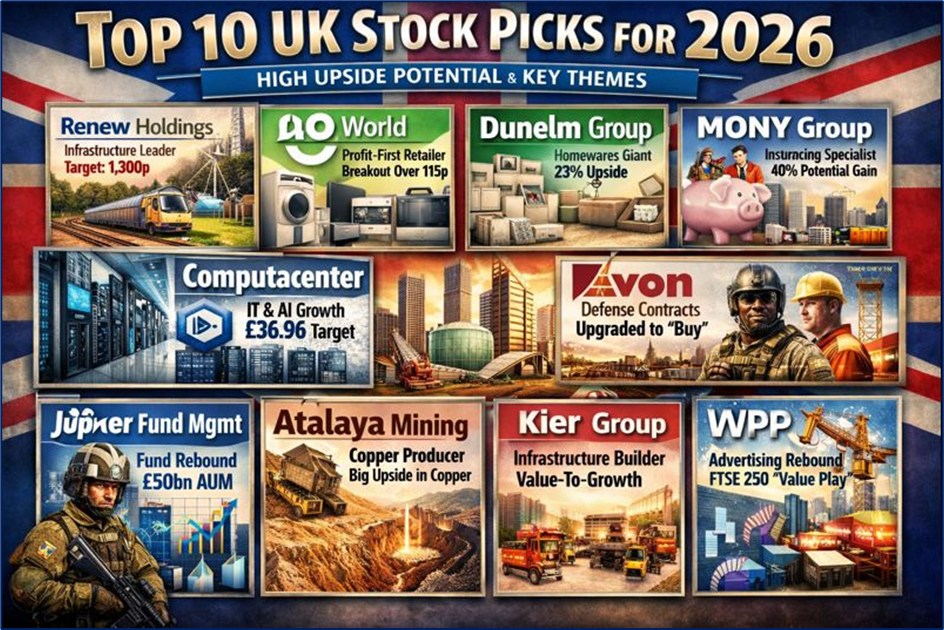
Source: Kalkine Group
Key Drivers and Business Model: Renew operates as a leader in "essential engineering," maintaining critical UK infrastructure across rail, water, and energy. Its low-risk, non-discretionary revenue model is highly attractive in a volatile macro environment.
- Latest Updates: The company recently completed a strategic acquisition to bolster its water sector presence ahead of the new AMP8 regulatory cycle.
- Technical Analysis: Shares have consolidated in a tight bullish flag pattern after a 15% run-up in late 2025. Support is firm at the 200-day moving average.
- Analyst View: Peel Hunt maintains a "Buy" with a price target of 1,300p, citing its defensive compounding nature.
- Risks: Margin pressure from skilled labor shortages and potential delays in government infrastructure spending.
Key Drivers and Business Model: The online electrical retailer has undergone a massive transformation, pivoting from "growth at all costs" to a "profit-first" model focused on market share in the UK.
- Latest Updates: Recent trading updates show record levels of profitability and successful expansion into new categories beyond white goods.
- Technical Analysis: The stock is exhibiting a classic "cup and handle" formation, suggesting a breakout above 115p could lead to a rapid re-rating.
- Analyst View: Labeled as one of the few retailers delivering "upgrades through execution," with a 25% upside predicted by major City banks.
- Risks: Intense competition from Currys and Amazon, and sensitivity to UK housing market transactions.
Key Drivers and Business Model: A "best-in-class" homewares retailer that has consistently gained market share during the cost-of-living crisis through its value-driven "Good, Better, Best" pricing strategy.
- Latest Updates: Operational focus has shifted to digital integration, with "click-and-collect" now making up over 35% of total sales.
- Technical Analysis: Dunelm is a "serial compounder," currently trading near its 52-week highs with strong RSI momentum.
- Analyst View: Fund managers favor it for its mid-teen total shareholder return history; brokers see a 23% upside as consumer confidence rebounds.
- Risks: Raw material inflation and potential supply chain disruptions in the Red Sea affecting shipping costs.
Key Drivers and Business Model: Formerly MoneySuperMarket, this interactive media giant thrives when consumers seek to switch providers for insurance, energy, and broadband.
- Latest Updates: High conversion rates in its "Cashback" and "Lead Gen" divisions have driven a Great health score on InvestingPro.
- Technical Analysis: The stock offers a "floor" for investors with a 5% dividend yield, trading at a significant discount to its 5-year average P/E.
- Analyst View: High confidence "Buy" with a fair value estimate near £2.63, representing over 40% potential upside.
- Risks: Regulatory changes in the insurance "price-walking" space and reduced switching activity if energy prices stabilize too quickly.
Key Drivers and Business Model: A global provider of IT infrastructure services, Computacenter is a primary beneficiary of the corporate "AI-readiness" wave.
- Latest Updates: Maintaining a healthy balance sheet with net cash, allowing for continued share buybacks and organic investment in US expansion.
- Technical Analysis: Following a period of sideways trading, the stock is showing signs of institutional accumulation near the £24 support level.
- Analyst View: Consensus fair value sits at £36.96, supported by a 2.4% yield and strong public sector contract wins.
- Risks: Slower corporate IT spending if global recession fears resurface.
Key Drivers and Business Model: Specializing in mission-critical protective equipment (respirators and ballistic helmets), Avon is riding the "conflict capex" wave.
- Latest Updates: The business has moved from a "margin optimization" phase into an aggressive growth phase with significant NATO contract wins.
- Technical Analysis: The stock has broken out of a multi-year downtrend, characterized by increasing volume on up-days.
- Analyst View: Upgraded to "Buy" by several brokers who see it as a pure-play on global defense fragmentation.
- Risks: High customer concentration with the US Department of Defense and potential lumpiness in contract awards.
Key Drivers and Business Model: A copper producer with its flagship Proyecto Riotinto in Spain. It provides a "Green Transition" play within the mid-cap space.
- Latest Updates: Copper production remains steady; the company is benefiting from the 2026 surge in copper prices driven by AI data center demand.
- Technical Analysis: Despite a 140% return in 2025, the stock remains on "top pick" lists due to its low valuation relative to global peers.
- Analyst View: Target prices remain aggressive, with some analysts forecasting another 50-70% upside if copper breaches $12,000/tonne.
- Risks: Operational risks common to mining and volatility in global commodity prices.
Key Drivers and Business Model: A leading UK construction and infrastructure services group with a massive order book primarily linked to government-backed projects.
- Latest Updates: Successful deleveraging has transformed the investment case, moving the stock from "distressed" to "dividend grower."
- Technical Analysis: Trading at a P/E multiple below 8x, the stock is a classic "value-to-growth" transition play.
- Analyst View: Top growth pick for 2026 by Peel Hunt, citing improved margins and strong cash generation.
- Risks: Fixed-price contract exposure in an inflationary environment.
Key Drivers and Business Model: An active fund manager that has finally seen the tide turn, moving from years of outflows to net positive inflows in late 2025.
- Latest Updates: Assets Under Management (AUM) climbed to over £50bn, a 11% annual increase, signaling a return of retail investor appetite.
- Technical Analysis: The stock outperformed the index by 40% last year but still trades at a P/E of 11.8, below the FTSE 250 average.
- Analyst View: The Motley Fool and others highlight it as an "undervalued recovery play" for 2026.
- Risks: Performance-related fee volatility and the ongoing shift toward passive low-cost ETFs.
Key Drivers and Business Model: The global advertising powerhouse, recently demoted to the FTSE 250, is now the ultimate "Deep Value" turnaround play.
- Latest Updates: New CEO Cindy Rose is streamlining operations and doubling down on AI-powered marketing platforms.
- Technical Analysis: The stock has taken a "battering," trading at a P/E of 10 with a "punchy" 9% trailing dividend yield (though subject to re-basing).
- Analyst View: Berenberg and others are watching for a "mean-reversion" upward as revenues stabilize and new contracts (like the £2bn UK Gov deal) kick in.
- Risks: Structural decline in traditional ad agencies and fierce competition from digital consultancies.
Investment Outlook and Risks for 2026
The primary risk for the FTSE 250 in 2026 remains the "sticky" nature of inflation, which could force the Bank of England to pause its rate-cutting cycle prematurely. Furthermore, geopolitical fragmentation—highlighted by J.P. Morgan in their 2026 Outlook—could disrupt the supply chains of many mid-cap manufacturers. However, the prevailing sentiment is one of "cautious optimism."
Conclusion: For the first time in a decade, the FTSE 250 is no longer just a "trap" for value investors. The combination of structural UK economic improvements, AI-driven efficiencies, and a desperate need for global fund managers to find yield outside of overstretched US tech stocks has created a perfect storm for mid-cap outperformance.


 Jun 29, 2026




 Please wait processing your request...