
 AU
AU
 CA
CA
 US
US
 NZ
NZ
 IND
IND

 UK
UK

 Share
Share
 X (Formerly Twitter)
 Whatsapp
 Facebook
 LinkedIn
 Telegram
 Email This Article
 Copy Link
 Summarize with AI
 Chat GPT
 Perplexity

The Aviva plc (LSE: AV) share price witnessed a robust climb of approximately 1.4% during trading on January 8, 2026, outperforming several of its blue-chip peers on the FTSE 100. This upward movement is not an isolated event but rather the culmination of strategic execution and a favorable regulatory tailwind that has materialized in the first week of the new year.
Investors are increasingly viewing Aviva not just as a defensive income play, but as a lean, capital-light growth engine.
Key Reasons and Market Drivers
The primary catalyst for the movement on January 8 is the recent confirmation from the Prudential Regulation Authority (PRA) regarding the capital model transition for the newly integrated Direct Line business.
- Capital Synergy Realization: The market is reacting to the news that Aviva has received the green light to move Direct Line's capital requirements to a "Standard Formula" basis. This technical shift is expected to unlock approximately £0.1 billion in immediate capital synergies, effectively boosting Aviva’s Solvency II ratio by 2 percentage points.
- Dividend & Buyback Confidence: With the full-year 2025 results looming in March, the market is pricing in the reintroduction of "regular and sustainable" capital returns. Management’s earlier signal that buybacks would be "increased to reflect the higher share count" post-acquisition has created a "buy-on-anticipation" trend among institutional investors.
- Defensive Rotation: Amidst broader macroeconomic uncertainty in early 2026, capital is rotating back into high-yield, diversified insurers. Aviva’s yield, which remains comfortably above the FTSE 100 average, acts as a significant floor for the stock price.

Source: Kalkine Group
Current Technical Analysis: The Chart Outlook
From a technical perspective, Aviva’s price action on January 8 saw it testing the psychological resistance level of 700p. The stock has been carving out a series of higher lows since the Q3 2025 update, suggesting a steady accumulation phase.
- Moving Averages: The stock is currently trading well above its 50-day and 200-day Simple Moving Averages (SMAs), indicating a confirmed bullish trend in the medium-to-long term. A "Golden Cross" observed late in 2025 continues to provide tailwinds.
- Support and Resistance: Immediate resistance sits at 708p; a clean break above this could see the stock challenge the 750p mark, a level last seen in a much lower interest rate environment. On the downside, strong support has formed at 685p, which acted as a pivot point during December’s volatility.
- RSI Levels: The Relative Strength Index (RSI) is hovering around 63. While this shows strong momentum, it is not yet in "overbought" territory (typically >70), suggesting there is still room for further appreciation before a technical cooling-off is required.
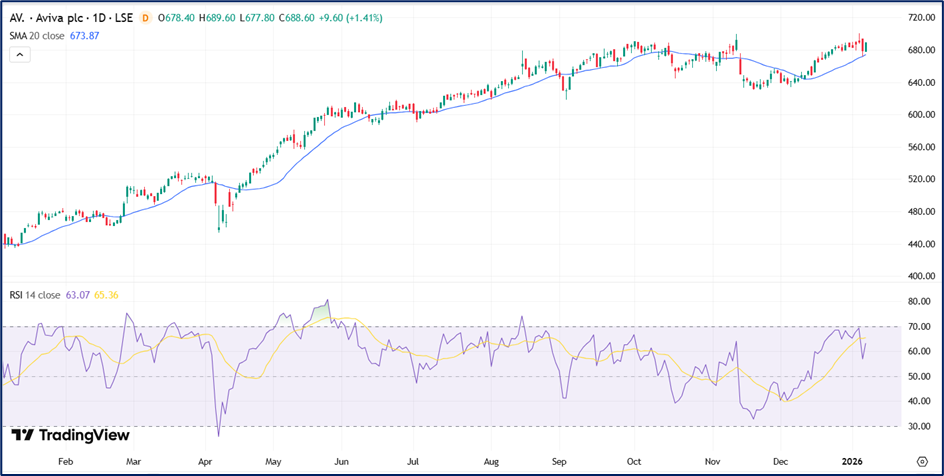
Source: Trading View
Latest Analyst Upgrades and Sentiment
Broker sentiment has turned increasingly positive as the "execution risk" associated with the Direct Line merger begins to fade.
- UBS Group: Maintained a "Buy" rating with a price objective of 750p, citing the company's superior cash remittance profile.
- Citigroup: Recently adjusted their stance to "Neutral" with a price target of 671p, reflecting a more cautious view on the general insurance pricing cycle in the UK, though acknowledging the strong balance sheet.
- Consensus: The median 12-month price target among major analysts currently sits near 690p-710p, though several "High" estimates reach as far as 760p. The consensus remains a "Hold/Buy" blend, with very few "Sell" recommendations currently active in the market.
Business Model and Operational Strategy
Aviva has undergone a radical transformation under CEO Amanda Blanc, shifting from a sprawling global conglomerate to a focused, capital-light powerhouse centered on the UK, Ireland, and Canada.
- The "Capital-Light" Pivot: The business model now prioritizes Wealth, Health, and Protection—sectors that require less regulatory capital to grow compared to traditional life insurance. Aviva aims for over 75% of its business to be in these capital-light areas by 2028.
- Direct Line Integration: The acquisition of Direct Line has transformed Aviva into the UK’s leading multi-line insurer. The strategy is built on achieving £225 million in cost synergies by 2028, nearly double the initial estimates, by migrating customers to Aviva’s superior tech stack.
- Digitization: Operationally, Aviva is leveraging AI to streamline claims processing in its General Insurance (GI) arm, aiming for a Combined Operating Ratio (COR) consistently below 94%, which signals high underwriting profitability.
Financial and Operational Updates
The latest trading data suggests that Aviva is actually ahead of its own ambitious schedule.
- Financial Targets: Aviva recently announced it expects to hit its 2026 operating profit target of £2 billion a full year early, in 2025. This "beat and raise" narrative is a primary driver of the current share price strength.
- Operating Profit: For the full year 2025, operating profit is guided at approximately £2.2 billion, which includes a maiden contribution of £150 million from the Direct Line assets.
- Wealth Momentum: The Wealth business is a standout performer, with net flows reaching over £8 billion in the most recent reporting period, supported by a robust Workplace savings platform.
Risk Factors to Monitor
Despite the bullish run, several headwinds remain that could dampen the rally:
- Macroeconomic Sensitivity: As a major holder of corporate bonds, Aviva’s investment income is sensitive to interest rate fluctuations. A faster-than-expected cutting cycle by the Bank of England could squeeze margins.
- Claims Inflation: While Aviva has successfully pushed through premium increases, persistent inflation in auto parts and labor costs could pressure the General Insurance margins.
- Integration Hurdles: While currently on track, the final stages of the Direct Line migration carry inherent IT and operational risks that could lead to one-off costs.
Conclusion
Aviva’s 1.4% gain on January 8, 2026, reflects a market that is gaining confidence in the company’s ability to generate "dry powder" through capital synergies and operational efficiency. By hitting its 2026 targets early and streamlining its model toward capital-light sectors, Aviva has positioned itself as a premier total-return play in the FTSE 100. While risks regarding claims inflation and the interest rate environment persist, the current momentum is firmly supported by fundamental upgrades and regulatory approvals.


 Jun 03, 2026




 Please wait processing your request...