
 AU
AU
 CA
CA
 US
US
 NZ
NZ
 IND
IND

 UK
UK

 Share
Share
 X (Formerly Twitter)
 Whatsapp
 Facebook
 LinkedIn
 Telegram
 Email This Article
 Copy Link
 Summarize with AI
 Chat GPT
 Perplexity
The FTSE 100 has entered uncharted territory in January 2026, extending its historic rally and trading near 10,200, up 0.42% at 10,196.49. Earlier this month, the UK’s flagship index decisively broke above the long-standing psychological barrier of 10,000, reshaping the long-term narrative around UK equities.
This powerful move is being fuelled by a near-perfect “Goldilocks” macro environment: easing inflation, a softer pound supporting overseas earnings, and growing expectations of interest-rate cuts from the Bank of England. Against a backdrop of persistent global geopolitical risk, the FTSE 100 has emerged as a safe-haven equity market, attracting international capital as investors rotate away from expensive US growth stocks toward dependable UK value and income names.
Market Environment & Asset Allocation Snapshot (January 2026)
The investment regime in early 2026 is clearly shifting from growth dominance to yield, value, and cash-flow resilience.
- UK Economy: GDP growth is expected to remain modest at 1.4% in 2026, but inflation cooling toward the 2% target is the key bullish catalyst for equities.
- Sterling Outlook: The pound is hovering around $1.37, below 2025 highs—providing a meaningful earnings tailwind for FTSE 100 multinationals with US-dollar revenues.
- Asset Class Trends:
- Equities: Strong global preference for UK value stocks over US tech-heavy growth.
- Commodities: Gold remains a core hedge near $5,158/oz, despite mild short-term profit-taking.
- Bonds: UK 10-year gilt yields are stabilising around 4%, with the BoE expected to cut the base rate toward 3.25% by autumn 2026.
FTSE 100 Outlook: Short, Medium, and Long-Term Strategy
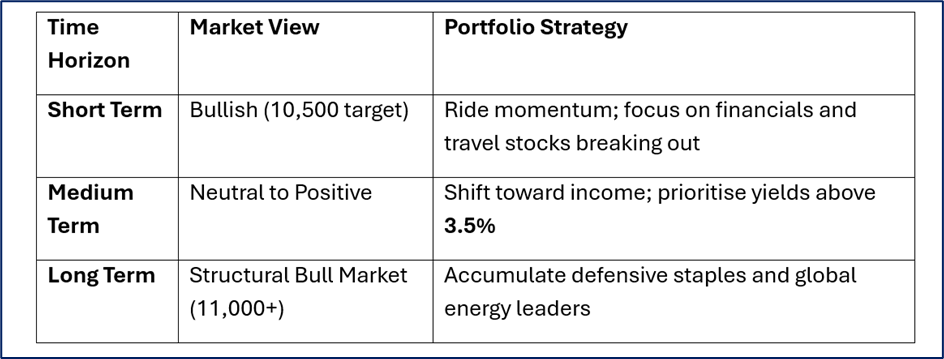
Source: Kalkine Group Analysis
Latest Analyst Targets & Broker Commentary
- FTSE 100 (end-2026): 10,750 target (AJ Bell)
- Hikma Pharmaceuticals: Consensus target 2,216p
- HSBC: Target upgrades following a record $300bn market capitalisation
- AstraZeneca: 14,000p target after US tariff reprieves
FTSE 100 Sector Performance (30 January 2026)
Top Performing Sectors
- Banking (capital reforms and rate-cut optimism)
- Travel & Leisure (strong demand and falling fuel costs)
- Consumer Discretionary (boosted by whisky tariff cuts benefiting Diageo)
Lagging Sectors
- Mining & Natural Resources (profit-taking after a stellar 2025)
- Telecommunications (company-specific pressure on Airtel Africa)
Top FTSE 100 Gainers and Losers Today
Leading Gainers
- Experian (+3.75%) – Rising demand for data analytics as credit conditions ease
- Smith & Nephew (+2.93%) – Elective surgery recovery and margin upgrades
- Lloyds Banking Group (+2.48%) – Positive NIM outlook and retail reform momentum
- Diageo (+2.29%) – China cuts whisky tariffs from 10% to 5%
- International Airlines Group (+1.98%) – Strong trans-Atlantic bookings and lower jet fuel costs
Biggest Decliners
- Airtel Africa (-7.72%) – FX volatility across African markets
- Fresnillo (-3.79%) – Gold price pullback
- Endeavour Mining (-3.32%) – Sector-wide profit-taking
- Antofagasta (-3.25%) – Softer copper prices
- Mondi (-3.08%) – Margin pressure and cyclical concerns
FTSE 100 Technical Analysis: What the Charts Are Saying
The index remains firmly in a primary uptrend. After clearing 10,000, the FTSE 100 is now challenging the 261.8% Fibonacci extension near 10,713.
- Key Support Levels: 10,000 (psychological), then 9,570 (trend support)
- RSI: Around 68, close to overbought—suggesting short-term consolidation would be healthy, not bearish
Final Verdict: Is the FTSE 100 at 10,200 Still a Buy?
In 2026, the long-dismissed UK equity market is decisively outperforming expectations. With £85.6 billion in dividends projected, falling interest rates on the horizon, and global investors rediscovering the appeal of stable cash-generating businesses, the FTSE 100’s breakout looks structural, not speculative.
For long-term investors, 10,000 was not the top—it was the base. While short-term pullbacks are possible, the broader trend suggests the FTSE 100 remains one of the most compelling value-and-income equity markets globally in 2026.


 Jun 29, 2026




 Please wait processing your request...