
 AU
AU
 CA
CA
 US
US
 NZ
NZ
 IND
IND

 UK
UK

 Share
Share
 X (Formerly Twitter)
 Whatsapp
 Facebook
 LinkedIn
 Telegram
 Email This Article
 Copy Link
 Summarize with AI
 Chat GPT
 Perplexity
A Strategic Renaissance in British Defense: The Rise of BAE and Babcock
The FTSE 100 has witnessed a tectonic shift in its performance hierarchy as the global "New Age of Rearmament" propels defense giants into a new era of dominance. In a month characterized by volatile market indices, BAE Systems and Babcock International have defied the gravitational pull of economic uncertainty, delivering stellar double-digit returns that underscore a fundamental re-rating of the sector. Once viewed as slow-moving industrial stalwarts, these companies are now at the epicenter of a multi-year capital spending boom.
Driven by escalating geopolitical tensions across Eastern Europe and the Indo-Pacific, and bolstered by record-breaking order backlogs that stretch into the next decade, the surge in their share prices reflects more than just a momentary rally—it signals a profound investor recognition of their roles as critical pillars of national security and technological sovereignty in an increasingly contested world.
Latest Key Reasons for the Surge and Market Drivers
Source: Kalkine Group
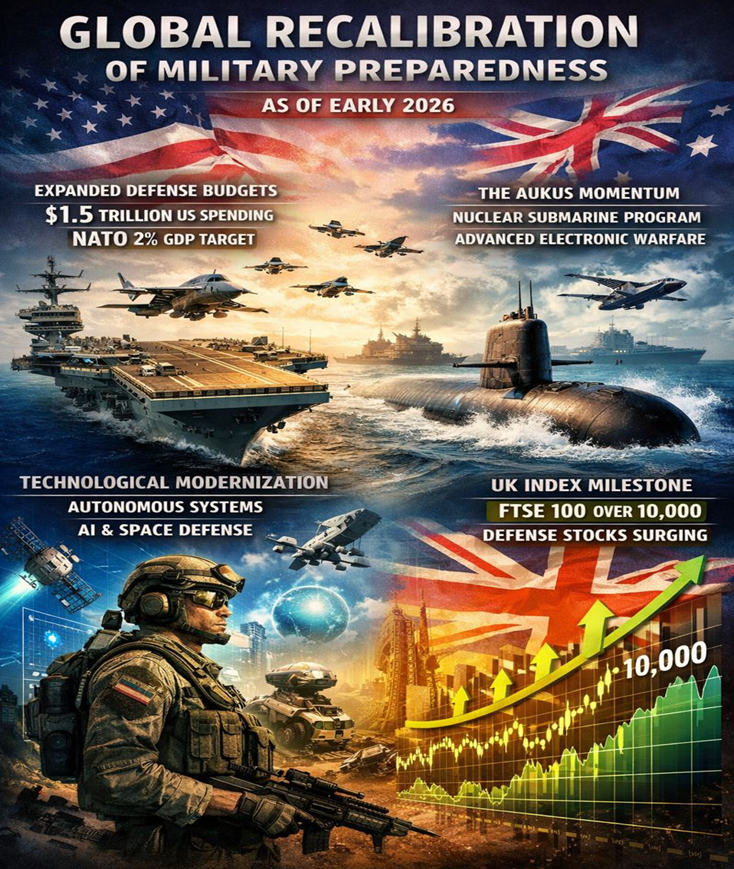
The primary catalyst for the recent performance is a global recalibration of military preparedness. As of early 2026, several specific factors have converged:
- Expanded Defense Budgets: A significant driver has been the "Truth Social" effect and shifts in US policy, where projections suggest US defense spending could scale toward $1.5 trillion. Simultaneously, NATO members are aggressively moving toward or exceeding the 2% GDP spending benchmark.
- The AUKUS Momentum: The tri-lateral security pact between the UK, US, and Australia (AUKUS) has transitioned from policy to high-value execution, providing a decades-long roadmap for nuclear-powered submarine production and advanced electronic warfare.
- Technological Modernization: Demand has pivoted from simple equipment replenishment to "capability-based deterrence," focusing on autonomous systems, AI-driven cyber defense, and space-based assets.
- UK Index Milestone: The FTSE 100’s breach of the 10,000-point mark in January 2026 created a "rising tide" effect, with defense stocks leading the charge as investors rotated out of underperforming retail and consumer sectors.
Current Business Models
BAE Systems operates as a global defense, aerospace, and security prime. Its model is built on high-barrier-to-entry platforms across five segments: Electronic Systems, Platforms & Services (US), Air, Maritime, and Cyber & Intelligence. It relies on a "lifecycle" approach where initial platform sales (like the F-35 or Typhoon) lead to decades of high-margin support and upgrade revenue.
Babcock International has transitioned into a highly focused engineering services and support specialist. Its model centers on the Nuclear, Marine, Land, and Aviation sectors. Unlike BAE, which is a primary manufacturer, Babcock excels in the Maintenance, Repair, and Overhaul (MRO) of complex sovereign assets, ensuring the operational availability of the UK’s nuclear submarine fleet and naval vessels.
Financial, Operational, and Dividend Updates (Latest Company Sources)
BAE Systems
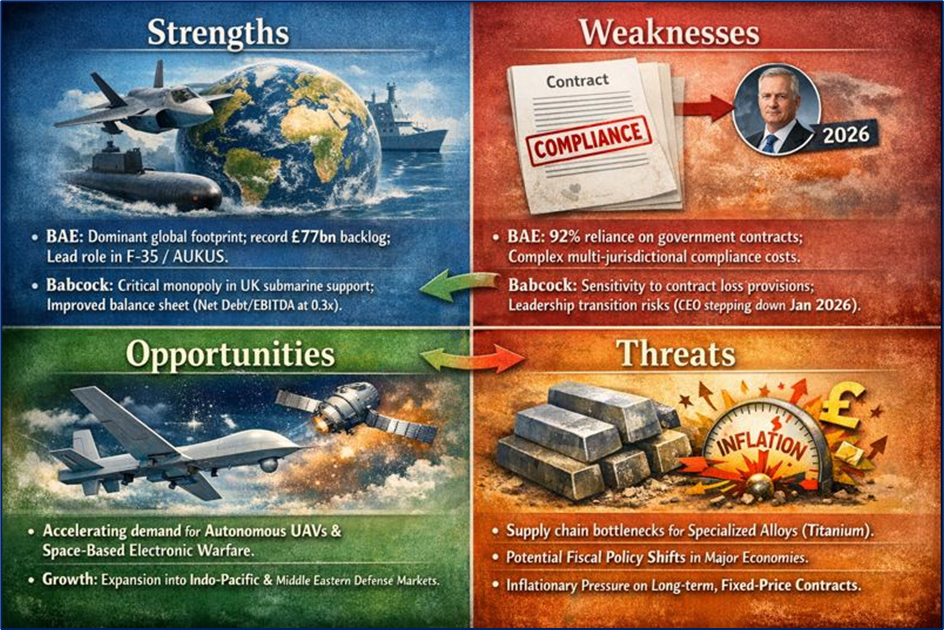
- Financials: In its latest market update (November 2025), BAE reported more than £27 billion in new orders secured, with a total backlog reaching a record £77.8 billion (BAE Systems PLC).
- Operational: Secured a £4 billion contract with Turkey for 20 Eurofighter Typhoon aircraft and a $450 million Danish contract for CV90 vehicles. It is also leading the "Golden Dome" air and missile defense initiative (BAE Systems PLC).
- Dividends: The 2025 interim dividend was set at 0.341p, representing a 10% growth year-on-year, maintaining a payout ratio of approximately 50% (Fidelity/Company Release).
Babcock International
- Financials: The Group reported an 11% organic revenue growth to £4.8 billion in its FY25 results. Statutory operating profit surged by 51% to £364 million (Babcock International Group).
- Operational: Successfully completed the "float-off" of the first Type 31 Frigate, HMS Venturer. Notably, the company launched a £200 million share buyback program in late 2025, the first in its history (Babcock International Group).
- Dividends: Reinstated and increased the dividend, paying a total of 6.5p for the financial year, a 30% increase over the previous period (Babcock International Group).
Latest SWOT Analysis
Source: Kalkine Group
Outlook and Risks
The outlook for both firms remains robust through 2026. BAE Systems projects sales growth of 8% to 10%, while Babcock is targeting an underlying operating margin of 8% by the end of the current fiscal year.
Key Risks:
- Political Volatility: Sudden shifts in government policy or budget reallocations could impact long-term procurement.
- Operational Execution: Any delays in the "fit-out" phase of major naval programs (like the Type 31 or Type 26 frigates) could result in financial penalties.
- Executive Succession: Babcock faces a period of transition following the January 2026 announcement that its CEO will step down.
Compelling Conclusion
The recent double-digit ascent of BAE Systems and Babcock is more than a technical rally; it is a reflection of a world in flux where security has become the ultimate commodity. With order books overflowing and a clear pivot toward high-tech electronic and autonomous warfare, these FTSE 100 giants have moved from defensive hedges to growth engines. As they navigate the complexities of global supply chains and leadership transitions, their status as "sovereign essentials" provides a level of revenue visibility that few other sectors can match in 2026.


 Jun 03, 2026




 Please wait processing your request...