
 AU
AU
 CA
CA
 US
US
 NZ
NZ
 IND
IND

 UK
UK

 Share
Share
 X (Formerly Twitter)
 Whatsapp
 Facebook
 LinkedIn
 Telegram
 Email This Article
 Copy Link
 Summarize with AI
 Chat GPT
 Perplexity
The FTSE 100 index navigating a sea of volatility today, trading the session practically flat at 10,126.78 (-0.03%). After a sharp selloff earlier in the week triggered by renewed geopolitical tensions and U.S. tariff threats, the London market attempted a recovery but was ultimately tethered by hotter-than-expected UK inflation data and a cautious mood across European bourses.
Why the FTSE 100 Stalled Today
Source: Kalkine Group
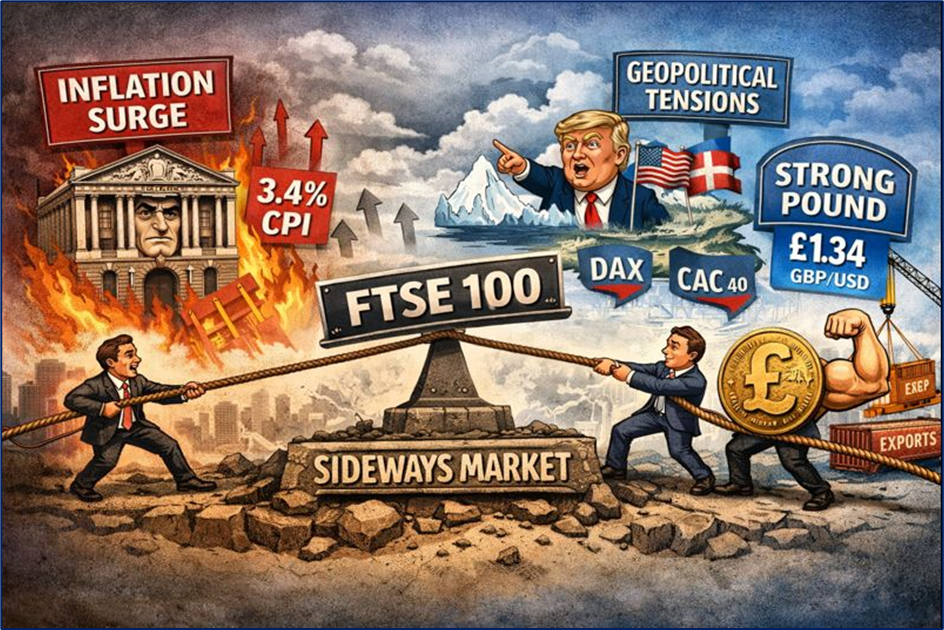
The "sideways" movement of the UK’s blue-chip index was the result of a tug-of-war between strong corporate earnings and macroeconomic headwinds:
- The Inflation Surprise: The Office for National Statistics (ONS) reported that UK CPI inflation rose to 3.4% in December (up from 3.2% in November). This "sticky" inflation has led traders to scale back bets on a February interest rate cut by the Bank of England, putting pressure on rate-sensitive stocks.
- The "Greenland" Geopolitical Ripple: Markets remain on edge following U.S. President Trump’s recent trade rhetoric and the ongoing diplomatic friction regarding Greenland. This has injected a "risk-off" sentiment into European equities, with the DAX and CAC 40 also struggling for momentum.
- Currency Drag: A slightly firmer Pound (GBP/USD at 1.34) acted as a natural brake on the FTSE 100’s many multinational giants, whose overseas earnings are worth less when translated back into sterling.
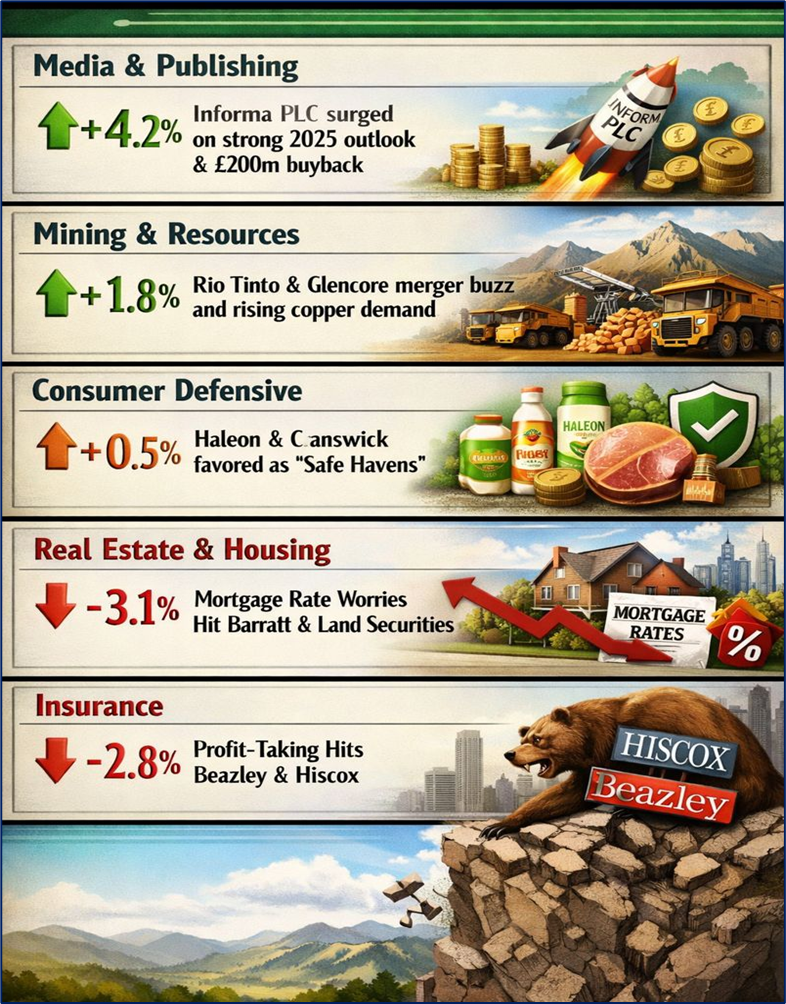
Sector Spotlight: Winners and Losers
Source: Kalkine Group
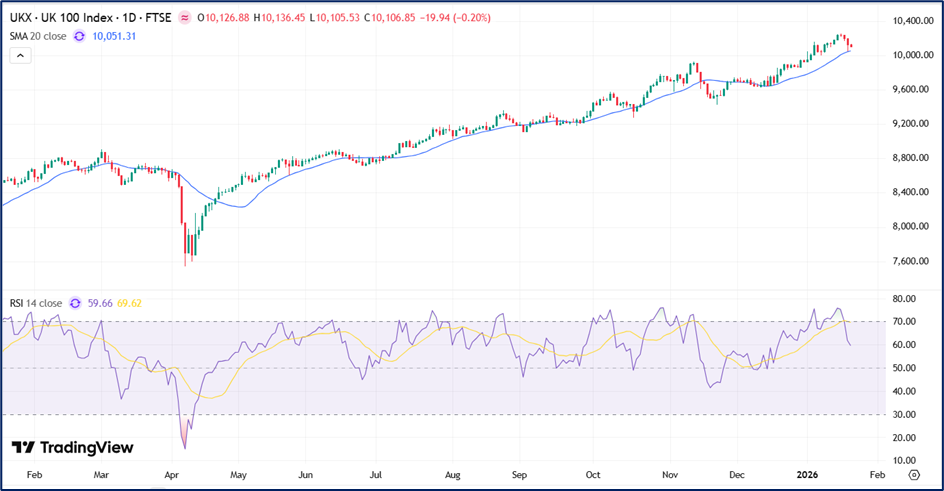
Technical Analysis Summary: The 10,000 Tug-of-War
Source: Trading View
Technically, the FTSE 100 is in a consolidation phase. After smashing through the historic 10,000 level earlier this month, the index is now retesting this psychological support.
- Support Levels: Immediate support sits at 10,050. A break below this could see a slide toward the 50-day moving average near 9,850.
- Resistance Levels: The bulls face a ceiling at 10,250. A clean break above this would open the door for a run toward AJ Bell’s year-end forecast of 10,750.
- RSI Indicator: The Relative Strength Index (RSI) is hovering at 60, suggesting the market is neither overbought nor oversold—purely "neutral" territory.
Conclusion: A "Wait-and-See" Market
The FTSE 100 is currently a "tale of two markets." On one hand, domestic-facing sectors (Builders, Retailers) are feeling the pinch of stubborn inflation. On the other, the index’s heavy weighting in Miners, Energy, and Banks provides a robust buffer that many global peers lack.
For retail investors, the current "flat" trading offers a moment of reflection. With dividend yields for the index projected to hit a record £85.6 billion in 2026, the FTSE remains an income-seeker's paradise, even if the "Greenland Gloom" keeps capital gains in check for the short term.


 Jun 03, 2026




 Please wait processing your request...