
 AU
AU
 CA
CA
 US
US
 NZ
NZ
 IND
IND

 UK
UK

 Share
Share
 X (Formerly Twitter)
 Whatsapp
 Facebook
 LinkedIn
 Telegram
 Email This Article
 Copy Link
 Summarize with AI
 Chat GPT
 Perplexity
_01_22_2026_04_34_28_366618.jpg)

As the FTSE 100 grapples with shifting geopolitical tides and a volatile global trade landscape, two giants in the distribution and services sector, Bunzl and Glencore, have emerged as standout performers, defying broader market caution with significant upward momentum.
On 21 January 2026, both stocks surged as part of a wider rally in industrial and commodity-linked equities, spurred by a sudden de-escalation in transatlantic trade tensions and a renewed appetite for "real-world" value stocks. While one facilitates the essential supply chains of the global service economy and the other powers the industrial transition through raw materials, their concurrent rise signals a tactical shift by institutional investors toward resilient, cash-generative business models capable of weathering the current macroeconomic storm.
Market Dynamics: The 21 January Surge
Source: Kalkine Group
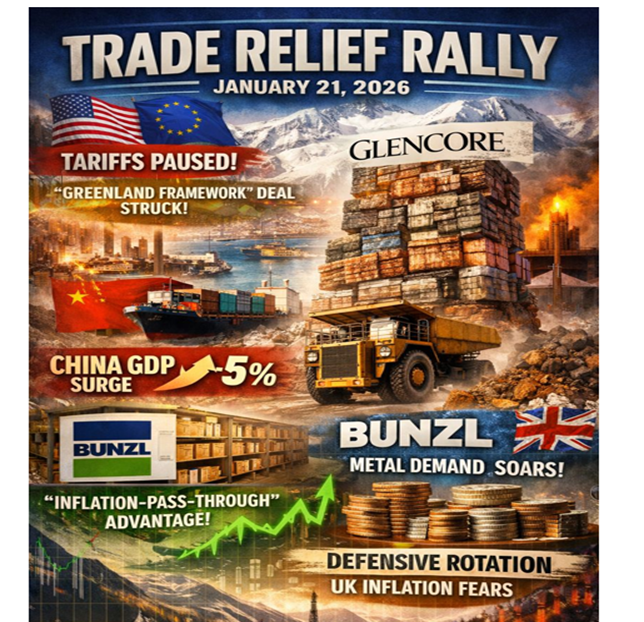
The sudden momentum in Bunzl and Glencore on Wednesday, 21 January 2026, was primarily driven by a dramatic shift in US-European trade relations. Reports from Davos indicated that the US administration had paused proposed tariffs on European nations, easing fears of a prolonged trade war that would have stifled global distribution volumes.
- Global Trade Relief: As major players in international logistics and commodity flow, both companies benefited from the "Greenland Framework" deal, which lowered the risk premium on cross-border trade.
- Industrial Rebound: A 5% growth in China’s 2025 GDP (reported earlier in the week) continued to provide a tailwind for industrial demand, particularly favoring Glencore’s metal distribution.
- Defensive Rotation: Despite an unexpected uptick in UK inflation, investors favored Bunzl for its "inflation-pass-through" business model and Glencore for its hard-asset backing.
Bunzl PLC (BNZL): Resilience in Essential Distribution
Bunzl operates as a specialized international distribution and services group. It does not manufacture products but provides a "one-stop-shop" for non-food consumables like packaging, safety gear, and hygiene supplies.
- Business Model: A highly fragmented acquisition strategy ("bolt-ons") focused on high-margin niches in healthcare, grocery, and safety sectors.
- Latest Financials: Reaffirmed adjusted operating profit guidance for 2025 at approximately £900 million, with an operating margin of 7.6% (Company Announcement, Dec 2025).
- Dividend & Operations: Paid an interim dividend of 20.2p on 5 January 2026. Management has noted a focus on North American business wins to offset margin pressure in Europe (Investegate).
- Technical Analysis: The stock saw a decisive breakout above the 2,000p resistance level on 21 Jan, supported by a volume of 633,453 shares—surpassing its 52-week low of 1,981p and signaling a potential trend reversal after a challenging 2025.
Glencore PLC (GLEN): The Energy & Metals Powerhouse
Glencore is a unique hybrid of a Tier 1 mining house and the world’s largest independent commodity trader (Marketing). It moves millions of tonnes of copper, cobalt, and coal across the globe.
- Business Model: Fully integrated supply chain management—from extraction in the DRC and Australia to global distribution and arbitrage through its marketing division.
- Latest Financials: Preparing to release 2025 Full Year Production Report on 29 January 2026. Current estimates suggest a focus on metallurgical coal recovery and copper volume growth (Glencore PLC).
- Dividend & Operations: Currently yields approximately 1.5%. The company has been optimizing its portfolio, including a significant focus on transition metals required for the 2030 net-zero targets.
- Technical Analysis: Glencore is testing the psychologically critical 500p mark. On 21 Jan, it reached an intraday high of 501.9p, marking a 52-week high and confirming a strong bullish "golden cross" pattern on the daily charts.
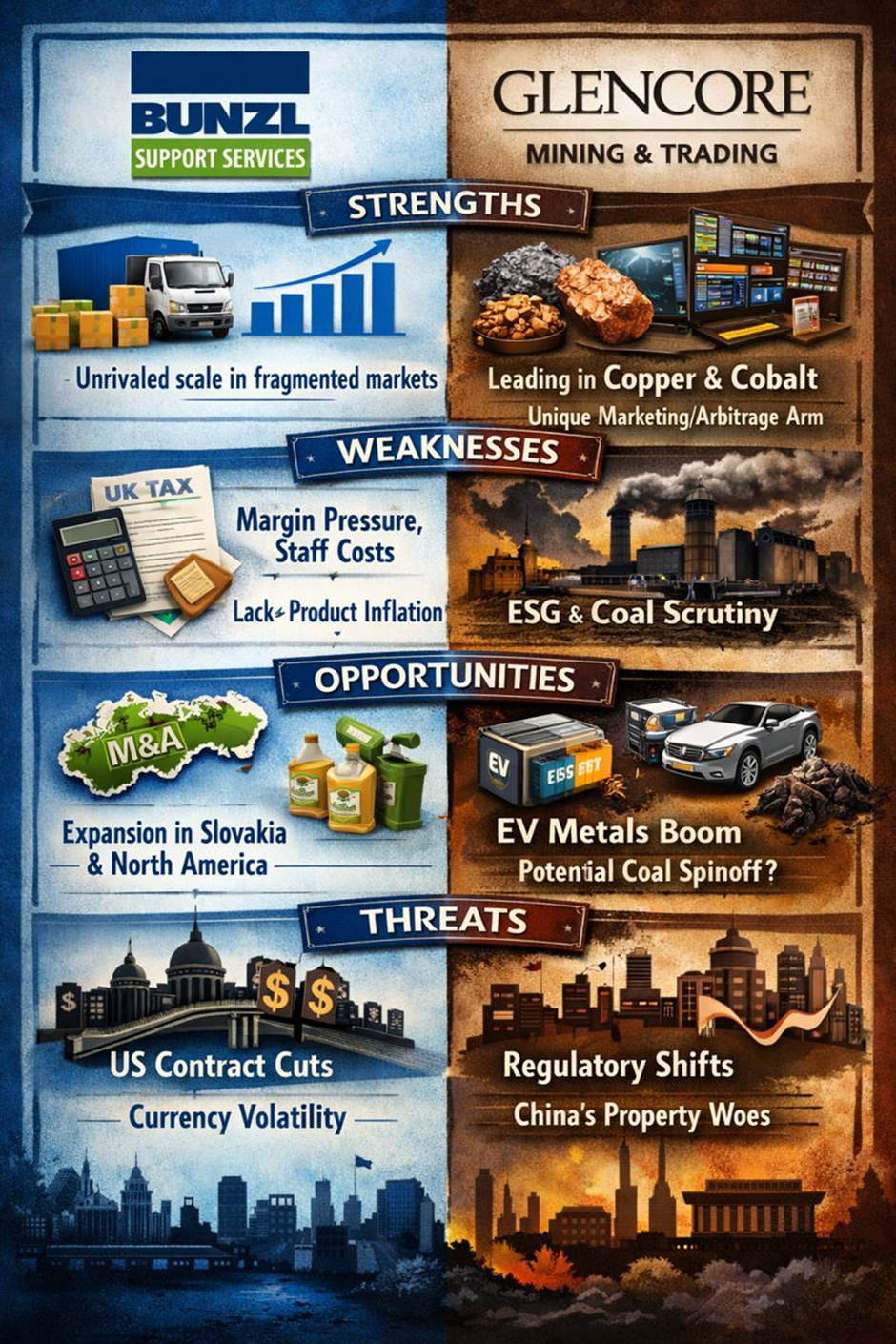
SWOT Analysis
Source: Kalkine Group
Outlook & Risks for 2026
The outlook for both firms is tethered to the "Davos Peace" holding. For Bunzl, 2026 is expected to be a year of "moderate revenue growth" but with slight margin pressure (7.5%-7.6% range) as it absorbs higher operating costs. For Glencore, the focus remains on its production report due next week; a beat in copper guidance could propel the stock well beyond the 500p ceiling.
Primary Risks:
- Macro: A return of trade tariffs if the "Greenland deal" falters.
- Operational: For Bunzl, the inability to find high-quality M&A targets. For Glencore, potential supply chain disruptions in central Africa.
Compelling Conclusion
The concurrent rise of Bunzl and Glencore on 21 January 2026 reflects a market that is increasingly rewarding operational durability and essential service provision. Bunzl’s surge signifies a return to favor for defensive growth, while Glencore’s push toward 52-week highs highlights the indispensable nature of commodity distribution in a stabilizing global economy. As both companies approach pivotal financial updates in the coming days, they remain the primary bellwethers for the FTSE 100’s industrial health.


 Jun 03, 2026




 Please wait processing your request...