
 AU
AU
 CA
CA
 US
US
 NZ
NZ
 IND
IND

 UK
UK

 Share
Share
 X (Formerly Twitter)
 Whatsapp
 Facebook
 LinkedIn
 Telegram
 Email This Article
 Copy Link
 Summarize with AI
 Chat GPT
 Perplexity
London’s blue-chip index took a breather on Friday, January 23, 2026, closing slightly in the red as a "risk-off" sentiment swept through European markets. While UK private sector activity accelerated to a 21-month high and retail sales defied expectations, the gains were overshadowed by a brutal sell-off in the insurance and luxury sectors.
Investors navigated a complex landscape of surging gold prices—flirting with the historic $5,000 mark—and persistent inflation concerns that kept the Bank of England's next move under intense scrutiny. Despite the minor 0.07% dip, the FTSE 100 remains near record territory, reflecting a market that is resilient but increasingly selective.
Market Drivers: Why the FTSE 100 Slipped Today

Source: Kalkine Group
The day's trading was dominated by three primary themes that dictated the flow of capital:
- The Gold & Silver "Blow-off Top": Precious metals stole the spotlight. Gold surged toward $5,017/oz, while Silver surged towards the $101.33/oz barrier. This parabolic move provided a massive tailwind for London’s heavy-weight miners but sucked liquidity out of broader equity sectors.
- Geopolitical Aftershocks: Markets remained on edge following US President Donald Trump’s recent U-turn on Greenland-related tariffs. While the immediate threat of a trade war with Europe eased, the "mercurial nature" of international policy led investors to pause and rotate into defensive stocks like BAE Systems.
- Mixed Economic Signals: UK retail sales rose 0.4% in December, beating expectations of a 0.1% decline. However, this was overshadowed by fears that "sticky" inflation might force the Bank of England to maintain its 0.75% base rate longer than anticipated, weighing on banking stocks and consumer discretionary.
Sector Performance: The Green vs. The Red
The divergence between sectors was the defining theme of the session. While "safe-haven" assets and defensive plays found buyers, consumer-facing and rate-sensitive stocks faced significant headwinds.
In the Green: Mining, Energy, and Defence
- Mining (+1.8%): Precious metal miners dominated as gold surged toward $5,000/oz. Industrial miners also rose on signs of stabilizing global manufacturing demand.
- Energy (+1.2%): Brent crude rose to $65.10/bbl, providing a tailwind for oil majors.
- Aerospace & Defence (+0.9%): Geopolitical tensions and a shift toward defensive positioning supported the sector.
In the Red: Insurance, Luxury, and Travel
- Insurance (-5.5%): The worst-performing sector of the day, hit by a wave of analyst downgrades and concerns over margin compression.
- Luxury Goods (-6.2%): Burberry’s slump dragged the entire sub-sector down as premium demand remained soft.
- Leisure & Travel (-2.5%): Airlines struggled with rising fuel costs and a cautious outlook on consumer discretionary spending for 2026.
Top Gainers & Losers: Key Drivers

Source: Kalkine Group
The Leaders (Top Gainers)
- Beazley (+3.23%): Topped the index as the specialist insurer benefited from a rotation into high-conviction value plays and strong premium growth forecasts.
- Glencore (+2.21%): Lifted by a rebound in copper prices and positive sentiment surrounding its marketing division’s performance.
- Endeavour Mining (+2.15%): Directly tracked the record-breaking rally in gold prices.
- BAE Systems (+2.12%): Seen as a "safety blanket" stock; investors loaded up on the defence giant amid ongoing global security uncertainties.
- Fresnillo (+2.06%): As the world's largest silver producer, it gained on the back of the broader precious metals rally.
The Laggards (Top Losers)
- Burberry (-6.20%): The day's biggest loser. Continued weakness in the Asian market and a broader slowdown in luxury spending left the brand out in the cold.
- Admiral Group (-5.76%): Heavily penalized following a double downgrade by Goldman Sachs and RBC Capital Markets.
- Aviva (-5.17%): Fell in sympathy with Admiral, as investors cooled on the UK life and general insurance sector.
- easyJet (-2.98%): Hit by the combination of rising Brent crude prices and a "softness" in January booking data.
- IAG (-2.79%): The British Airways owner faced profit-taking after recent gains, with analysts citing transatlantic pricing pressure.
Technical Analysis Summary: The 10,143 Pivot
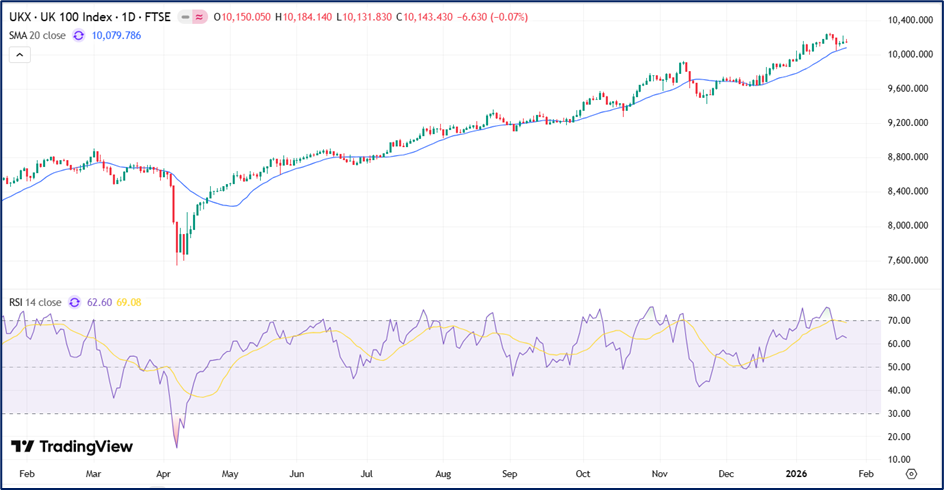
Source: Trading View
As of the close on January 23, 2026, the FTSE 100 is exhibiting a "consolidation at highs" pattern.
- Support & Resistance: The index is currently testing support at the 10,130 level (today’s low). A break below this could see a retracement toward the psychological 10,000 mark. Resistance remains firm at the 10,184-record high hit intraday.
- Indicators: The Relative Strength Index (RSI) is hovering around 62.60, suggesting the market is healthy but approaching "overbought" territory.
- Moving Averages: The index remains comfortably above its 50-day and 200-day moving averages, confirming the primary uptrend is still intact.
Technical Note: The "Doji-like" candle formed today suggests investor indecision. Traders are waiting for the Bank of England's February meeting to provide a clear catalyst.
Conclusion: A Market in Search of Direction
The FTSE 100’s performance on January 23 reflects a market that has "kicked up a gear" in terms of economic fundamentals—thanks to strong PMI data—but remains haunted by cost pressures. While gold miners are reaping the rewards of geopolitical anxiety, the sharp declines in insurance and luxury remind us that the "Goldilocks" scenario for 2026 is far from guaranteed. For retail investors, the current environment favors defensive quality and commodity hedges over high-beta discretionary stocks.


 Jun 03, 2026




 Please wait processing your request...