
 AU
AU
 CA
CA
 US
US
 NZ
NZ
 IND
IND

 UK
UK

 Share
Share
 X (Formerly Twitter)
 Whatsapp
 Facebook
 LinkedIn
 Telegram
 Email This Article
 Copy Link
 Summarize with AI
 Chat GPT
 Perplexity
On January 5, 2026, the London Stock Exchange (LSE: LSEG) and the broader FTSE 100 Shatters 10,000 Milestone: Why the ‘Dinosaur’ Index is Trouncing Wall Street in 2026?
As the global markets shook off the post-holiday lull, a "perfect storm" of geopolitical shifts and commodity surges sent the UK's blue-chip index soaring, briefly breaching the legendary 10,000-point mark for the second time in the new year.
The 3% Surge: Key Drivers on 5 Jan 2026

Source: Kalkine Group
The primary catalyst for the early 2026 rally was a dramatic escalation of geopolitical tension in South America. Over the weekend, U.S. military action in Venezuela triggered a massive rotation into "defensive" and "hard" assets—areas where the London Stock Exchange is structurally dominant.
- The Safe Haven Rotation: While tech-heavy indices like the Nasdaq faced volatility, investors flooded into UK-listed Defense and Mining stocks.
- Gold & Silver "Supernova": Precious metals hit record highs (Gold at $4,423/oz; Silver up 147% year-over-year). This directly pumped the share prices of London giants like Fresnillo and Endeavour Mining.
- The "Boring is Beautiful" Era: After years of being overshadowed by U.S. Tech, the FTSE 100’s "Old Economy" composition—heavy on Banks, Miners, and Energy—became its greatest strength as global inflation remained "sticky" at 3%.
LSEG Business Model: The 2026 Evolution
The London Stock Exchange Group (LSEG) is no longer just a "marketplace." In 2026, it operates as a Global Financial Data & Infrastructure Powerhouse, with its business model pivoting toward three core pillars:
- Data & Analytics (The "Microsoft" Factor): Leveraging its 10-year strategic partnership with Microsoft, LSEG now delivers AI-ready data directly into Excel and Teams. It has moved from selling "screens" to selling "intelligence."
- Capital Formation: Still the premier venue for international listings, though increasingly focused on the Green Economy Mark and Sustainable Bond Markets (SBM), which reached nearly £300 billion in 2026.
- Post-Trade Resilience: With the move to T+1 settlement cycles, LSEG’s clearing and risk management services have become indispensable high-margin revenue streams.
Latest Financial & Operational Updates
- Record Profits: Analysts forecast FTSE 100 aggregate pre-tax profits to hit £260 billion in 2026, a 14% increase from 2025.
- Shareholder Bonanza: Total dividends for 2026 are expected to reach a record £85.6 billion, supplemented by a £56.5 billion share buyback wave.
- AI Integration: LSEG has fully integrated generative AI across its "Corporate Actions" data, reducing latency and allowing traders to react to market events (like the Venezuela news) in near real-time.
- Operational Resilience: On 1 Jan 2026, new UK Corporate Governance rules (Provision 29) went live, forcing LSEG and other boards to formally declare the effectiveness of their operational and reporting controls.
SWOT Analysis: LSEG & The FTSE 100 (2026)
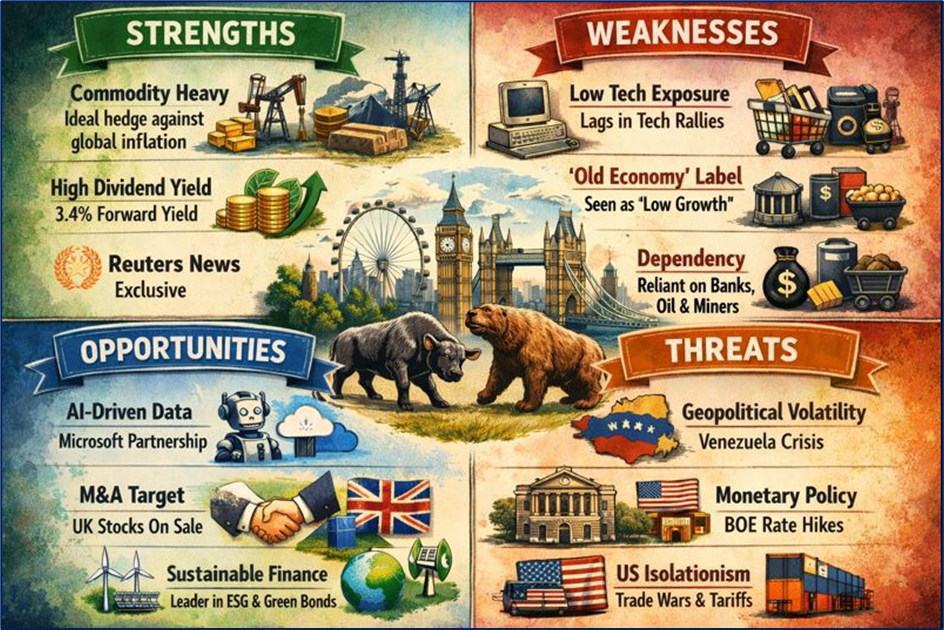
Source: Kalkine Group
Key Risks to the Rally
Despite the euphoria of hitting 10,000, several "bears" remain in the woods:
- Valuation Fatigue: The FTSE 100 now trades at 13.5x earnings. While not expensive by historical standards, it is no longer the "bargain" it was in 2024.
- Central Bank "Hawkishness": If inflation doesn't cool, the Bank of England may keep interest rates at 3.75% or higher, making "cash in the bank" a competitor for equity investment.
- Cyclical Exposure: Because the index is so heavy on financials and miners, an unexpected global recession would hit London harder than more diversified markets.
Conclusion
The 3% jump on January 5, 2026, represents more than just a daily gain; it is a validation of the UK’s "Old Economy" resilience. As geopolitical shocks drive a flight to hard assets, London has transformed from a "forgotten market" into a critical hedge for global portfolios. While the 10,000 level is a milestone, the real story lies in the fundamental shift towards a data-driven, AI-integrated financial ecosystem led by LSEG.


 Jun 29, 2026




 Please wait processing your request...