
 AU
AU
 CA
CA
 US
US
 NZ
NZ
 IND
IND

 UK
UK

 Share
Share
 X (Formerly Twitter)
 Whatsapp
 Facebook
 LinkedIn
 Telegram
 Email This Article
 Copy Link
 Summarize with AI
 Chat GPT
 Perplexity
As of January 28, 2026, the FTSE 250 is witnessing a distinct divergence in sector momentum, with Harbour Energy (HBR) and Pan African Resources (PAF) emerging as standout performers. While the broader market navigates shifting interest rate expectations and geopolitical ripples, these two mid-cap giants are riding a wave of fundamental breakthroughs—Harbour through its aggressive M&A-led global diversification and Pan African via a massive production leap and the initiation of shareholder returns.
Their ascent today reflects a market that is increasingly rewarding operational execution and "de-geared" balance sheets over speculative growth.
Source: Kalkine Group
Latest Key Reasons for the Surge & Drivers
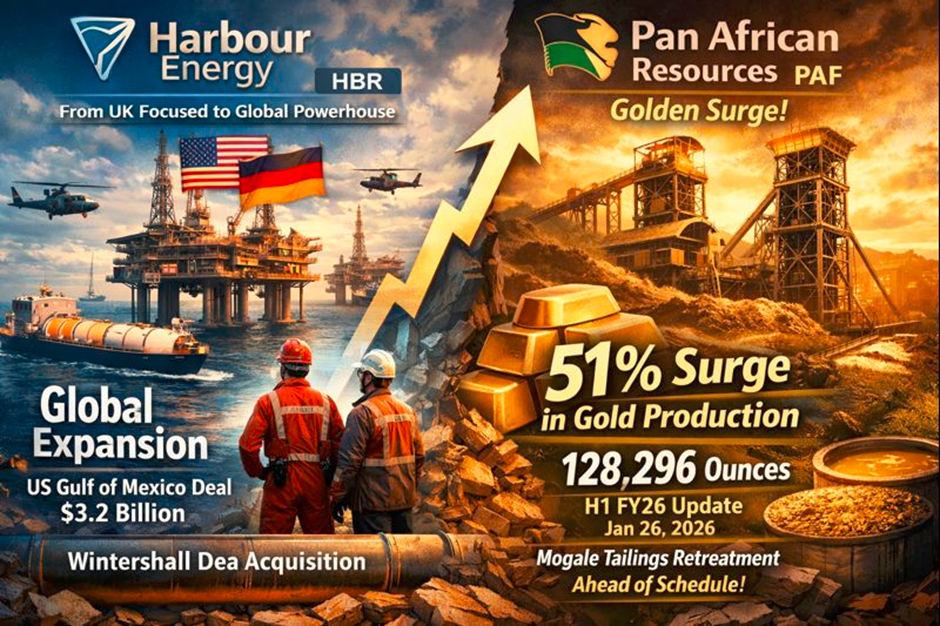
Harbour Energy (HBR) The primary catalyst for Harbour’s current momentum is the successful integration of its massive Wintershall Dea acquisition and the strategic entry into the US Gulf of Mexico via the $3.2 billion LLOG Exploration deal. Markets are reacting to the company's transformation from a UK-centric, windfall-tax-vulnerable producer into a global powerhouse with a diversified, lower-cost production base.
Pan African Resources (PAF) The surge today is directly linked to the H1 FY26 operational update (released Jan 26, 2026), which revealed a staggering 51% increase in gold production to 128,296 ounces. The company’s ability to reach "steady state" at its Mogale Tailings Retreatment operations ahead of schedule has provided a massive boost to investor confidence.
Current Business Models
Harbour Energy Harbour has evolved into one of the world’s largest independent oil and gas producers. Its model focuses on acquiring high-quality, cash-generative assets with long reserve lives. The company is actively shifting its geographic weight away from the UK to higher-margin regions like Norway, Indonesia, and Mexico, while simultaneously investing in Carbon Capture and Storage (CCS) to future-proof its portfolio.
Pan African Resources PAF operates a low-cost, high-margin gold mining model focused on South Africa and Australia. Unlike traditional "deep-level" miners, a significant portion of its production comes from tailings retreatment—recycling old mine dumps using advanced technology. This provides a lower-risk, predictable production profile compared to conventional underground exploration.
Latest Financial, Operational & Dividend Updates
Harbour Energy (Source: Trading & Operations Update, Jan 22, 2026)
- Operational: 2025 production hit the upper end of guidance (460-475 kboepd); 2026 output is projected to climb toward 500 kboepd following deal completions.
- Financial: Unit operating costs dropped 20% to $13.0/boe, significantly beating previous guidance of $16.5/boe.
- Dividends/Returns: Reaffirmed a $455 million annual dividend commitment. Free cash flow for 2026 is projected at $0.6 billion even at conservative $65/bbl Brent prices.
Pan African Resources (Source: H1 FY26 Operational Update, Jan 26, 2026)
- Operational: Gold production surged 51%; the company is on track for full-year guidance of 275,000 to 292,000 ounces.
- Financial: Net debt was slashed by 67% to $49.9 million in just six months; the company expects to be fully de-geared (zero net debt) by the end of February 2026.
- Dividends: Announced a maiden interim dividend of 12 ZA cents (approx. 0.74 US cents) per share, signaling a new era of capital return.
Latest SWOT Analysis
Source: Kalkine Group
Strengths
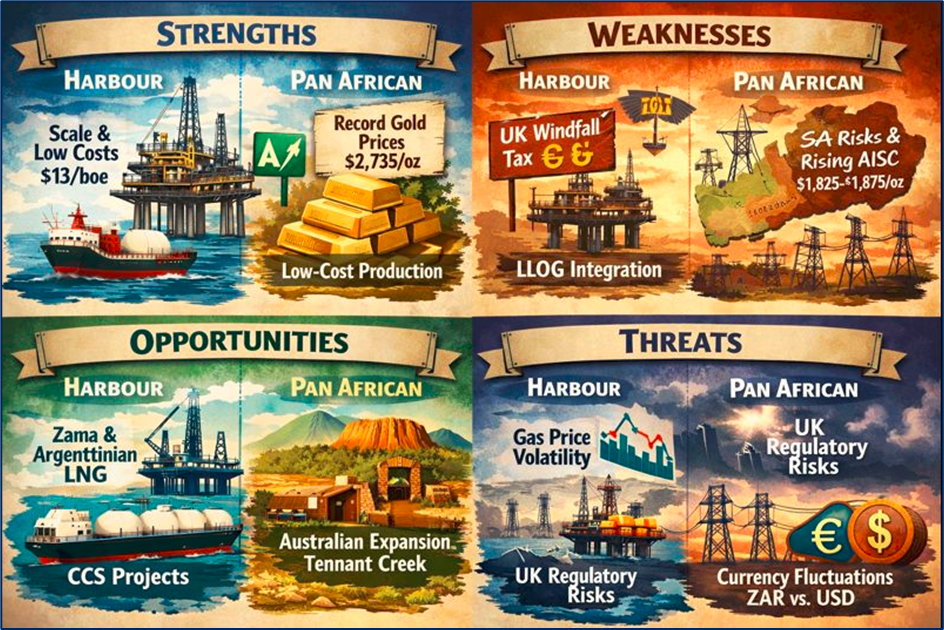
- Harbour: Scale and geographic diversity; investment-grade credit rating; industry-leading unit costs ($13/boe).
- Pan African: Low-cost tailings technology; rapid de-leveraging; high exposure to record gold prices (realized $2,735/oz).
Weaknesses
- Harbour: Residual exposure to UK Energy Profits Levy (windfall tax); high integration complexity of the LLOG acquisition.
- Pan African: Geographic concentration in South Africa (infrastructure/power risks); rising all-in sustaining costs (AISC) expected to reach $1,825–$1,875/oz.
Opportunities
- Harbour: Expansion into the Mexican Zama field and Argentinian LNG; leadership in European CCS (Greensand and Viking projects).
- Pan African: Full exposure to gold price upside as previous hedges have expired; expansion into stable jurisdictions like Australia (Tennant Creek).
Threats
- Harbour: Volatility in European gas prices; potential for further regulatory shifts in the UK North Sea.
- Pan African: South African power grid stability (Eskom); currency fluctuations (ZAR vs. USD).
Outlook & Risks
The outlook for both companies remains tethered to commodity price stability but is increasingly driven by internal growth milestones. Harbour Energy is positioned to become a "cash cow" by 2027 as its deepwater assets begin to contribute material free cash flow. However, its primary risk remains the regulatory environment in the UK and the execution risk of its three simultaneous major transactions (LLOG, Waldorf, and Indonesia divestments).
Pan African Resources enters 2026 with a "clean" balance sheet, allowing it to fund growth through internal cash flow. The outlook is exceptionally bullish if gold remains near record highs, but the company must manage rising inflationary pressures on labor and electricity in its South African operations.
Conclusion
The movement in Harbour Energy and Pan African Resources today marks a critical junction for the FTSE 250. Investors are no longer just looking for "recovery" stories; they are seeking out companies that have successfully navigated debt-heavy cycles and emerged with leaner, more diversified operations. Whether it is Harbour’s pivot to the Americas or Pan African’s technological mastery of tailings, both firms have demonstrated that operational discipline is the ultimate driver of share price resilience in a volatile global economy.


 Jun 29, 2026




 Please wait processing your request...