
 AU
AU
 CA
CA
 US
US
 NZ
NZ
 IND
IND

 UK
UK

 Share
Share
 X (Formerly Twitter)
 Whatsapp
 Facebook
 LinkedIn
 Telegram
 Email This Article
 Copy Link
 Summarize with AI
 Chat GPT
 Perplexity
Goldstone Resources lit up the FTSE AIM leaderboard on 26 January, surging 74% as traders and long-term holders reacted to a sharp inflection in operational momentum, balance-sheet clarity, and near-term production visibility. The move wasn’t a single-headline pop; it reflected a cluster of updates that collectively reframed the company from “early-stage builder” to “emerging producer with cash flow in sight,” a shift that AIM tends to re-rate fast when it lands.
The rally came as the market digested confirmation that Goldstone’s flagship Homase project in Ghana has moved decisively through commissioning into sustained operations, with tangible evidence of recoveries, throughput stability, and funding runway. In a tape hungry for real assets with near-term cash generation, the stock caught a bid—and kept it.
Latest key reasons behind the surge

Source: Kalkine Group
- Clear evidence that commissioning hurdles are largely behind the company, reducing execution uncertainty (Company RNS, January 2026).
• Operational read-throughs pointing to improving plant stability and recoveries at Homase, supporting confidence in steady-state production (Company RNS, January 2026).
• Funding and working-capital updates that eased dilution fears and clarified the path to self-funding operations (Company RNS, January 2026).
• A stronger gold price above $5,000 backdrop amplifying leverage to any incremental operational progress, particularly for low-cap producers on AIM.
• Renewed retail participation as liquidity improved and momentum traders piled in following the initial breakout.
Latest drivers shaping the story now
- Transition from commissioning to routine operations, a psychological and financial milestone for early producers.
• Focus on optimizing recoveries and throughput rather than pure construction spend, shifting the narrative toward margins and cash flow.
• Ongoing pit development at Homase that supports feed consistency and grade control over coming quarters (Company RNS, January 2026).
• Ghana’s established mining framework continuing to attract capital to operating assets rather than greenfield exploration.
Current business model
- Goldstone Resources operates as a gold mining company with assets in Ghana, centered on the Homase open-pit project.
• The model prioritizes near-term production and cash flow from a single core asset, with upside optionality from exploration and optimization rather than portfolio sprawl.
• Ore is mined, processed on site, and sold into international gold markets, giving direct exposure to gold prices without downstream complexity.
• Capital allocation is currently weighted toward operational stability, plant optimization, and sustaining capital rather than aggressive expansion.
Latest company-released financial, operational, and dividend updates
- The company confirmed continued progress in ramp-up activities, highlighting improving operational consistency at the processing plant (Company RNS, January 2026).
• Management reiterated a disciplined approach to costs and working capital during the transition to steady-state production (Company RNS, January 2026).
• Balance-sheet communications emphasized sufficient liquidity to support operations through the ramp-up phase, easing near-term funding concerns (Company RNS, January 2026).
• No dividend has been declared, with capital retained to support operations and optimization during the early production phase (Company RNS, January 2026).
Updated SWOT analysis
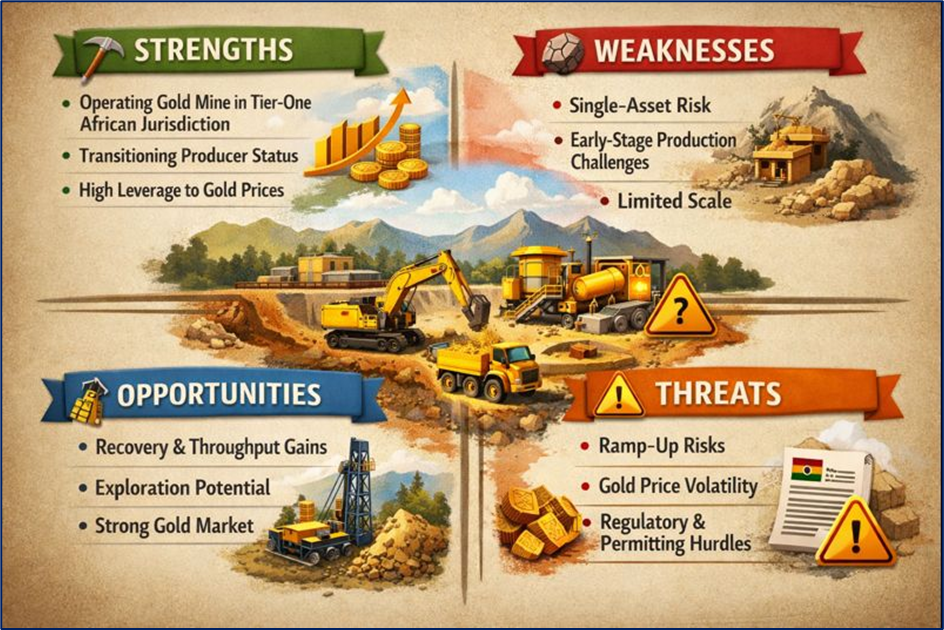
Source: Kalkine Group
Strengths
• Operating gold asset in a tier-one African mining jurisdiction with established infrastructure.
• Transitioning producer status reduces project-execution risk compared with pure developers.
• High operational leverage to gold prices once steady-state production is achieved.
Weaknesses
• Single-asset concentration increases sensitivity to any site-specific operational disruption.
• Early-stage production profile means costs and recoveries are still normalizing.
• Limited scale relative to larger peers restricts diversification benefits.
Opportunities
• Incremental improvements in recoveries and throughput can materially impact cash flow.
• Exploration upside around Homase could extend mine life and enhance asset value.
• Strong gold prices magnify free-cash-flow potential once ramp-up stabilizes.
Threats
• Operational setbacks during ramp-up could reintroduce funding or dilution risk.
• Commodity price volatility remains a constant external variable.
• Regulatory or permitting delays in Ghana, while historically manageable, remain a background risk.
Outlook
The market’s reaction suggests investors are now focusing less on whether Homase can operate and more on how efficiently it can run. The coming quarters are likely to be defined by operational data points—recoveries, throughput consistency, and cost discipline—rather than construction milestones. If the company continues to deliver incremental proof points, attention may increasingly shift toward cash generation and balance-sheet resilience.
Key risks to watch
- Any deviation from expected ramp-up performance could quickly test confidence in the transition narrative.
• Rising input costs or operational inefficiencies could compress margins during early production.
• Broader risk-off sentiment toward AIM or junior miners could overwhelm company-specific progress.
Compelling conclusion
Goldstone Resources’ 74% surge on 26 January wasn’t just a momentum spike—it marked a potential narrative reset. By demonstrating tangible progress at Homase and clarifying its operational footing, the company crossed a psychological line that AIM investors watch closely. Whether the stock consolidates or extends from here will hinge on execution, but the day’s move underscored one thing clearly: the market is now treating Goldstone as an operating gold story, not a promise.


 Jun 03, 2026




 Please wait processing your request...