
 AU
AU
 CA
CA
 US
US
 NZ
NZ
 IND
IND

 UK
UK

 Share
Share
 X (Formerly Twitter)
 Whatsapp
 Facebook
 LinkedIn
 Telegram
 Email This Article
 Copy Link
 Summarize with AI
 Chat GPT
 Perplexity

As we enter 2026, a structural shift is occurring in global capital markets. The "Magnificent Seven" exhaustion in the US and a stabilizing UK macroeconomic backdrop have turned the FTSE 100 into a primary target for "smart money." Institutional fund managers at firms like BlackRock and Schroders are increasingly highlighting the UK’s "valuation gap" compared to the S&P 500.
With the Bank of England entering a shallow easing cycle, the yield spread between UK equities and government gilts is widening, making high-quality dividend payers the cornerstone of compounding strategies. Hedge funds are no longer just looking for growth; they are hunting for "total return" where the dividend floor provides a margin of safety against geopolitical volatility.
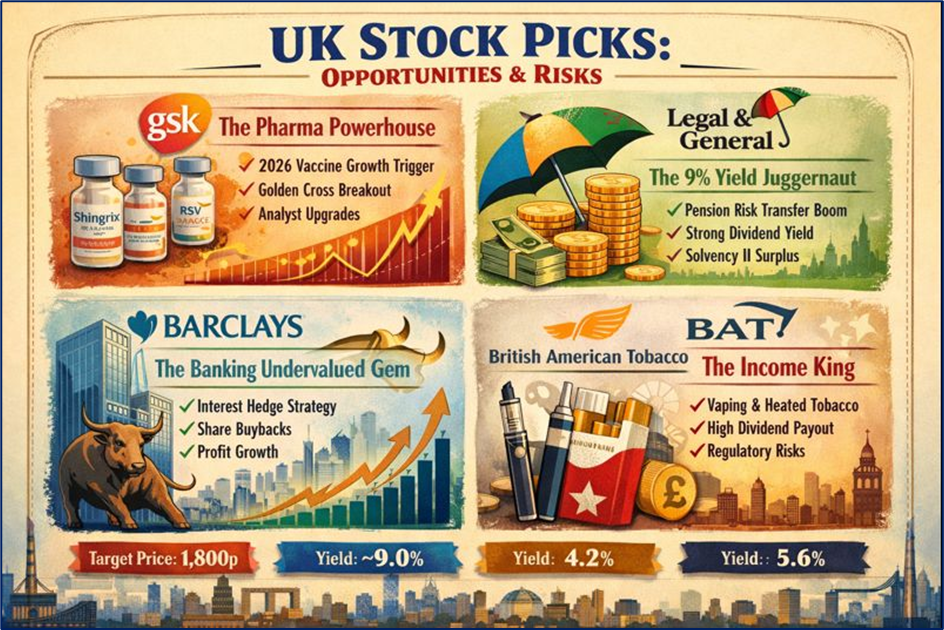
Source: Kalkine Group
GSK (LSE: GSK): The Pharma Powerhouse with a 2026 Growth Trigger
- Key Reasons and Drivers: GSK has successfully transitioned into a pure-play medicines and vaccines giant. The major driver for 2026 is the robust uptake of its Shingrix (shingles) and Arexvy (RSV) vaccines, coupled with a leaner cost structure following the Haleon spin-off.
- Latest Business Model: A focus on four therapeutic areas: Infectious Diseases, HIV, Respiratory/Immunology, and Oncology. The model prioritizes high-margin specialty medicines over primary care.
- Technical Analysis: Currently trading near 1,882p, the stock has broken out of a multi-year consolidation pattern. Technicals show a "golden cross" on the weekly chart, suggesting a long-term bullish trend as it nears 52-week highs.
- Analyst Consensus: Recent upgrades from HSBC (Target: 1,500p to 1,800p) and J.P. Morgan cite a "de-risked" pipeline. 61% of analysts covering the stock now hold a 'Buy' or 'Outperform' rating.
- Financials and Dividends: Latest quarterly data shows revenue growth of 7% CER. The projected 2026 dividend yield is approximately 3.9%, with a payout ratio that remains comfortably covered by free cash flow.
- Outlook and Risks: The outlook remains positive due to 60+ drugs in clinical trials. However, the risk of US drug price legislation and patent expiries on older HIV assets later this decade remain key concerns.
Legal & General (LSE: LGEN): The 9% Yield Juggernaut
- Key Reasons and Drivers: L&G is a direct play on the "pension risk transfer" (PRT) market. As UK corporations look to offload defined benefit pension schemes, L&G’s scale allows it to capture massive institutional flows.
- Latest Business Model: A diversified financial services engine spanning institutional retirement, asset management (LGIM), and retail protection.
- Technical Analysis: The stock has established a firm floor at the 220p level. RSI indicators suggest it is currently in "accumulation territory" as retail and institutional buyers snap up the high yield.
- Analyst Consensus: Citigroup and Barclays remain bullish, citing a Solvency II surplus that supports £5bn in capital returns through 2027. It carries an 'Outperform' rating at most major brokers.
- Financials and Dividends: Boasts a staggering forward dividend yield of ~9.0%. While dividend cover is historically low (around 0.8x - 1.2x), the company’s capital-light model and cash-generation ability support the payout.
- Outlook and Risks: Strong growth in the US PRT market offers an international catalyst. Risks include a sharp downturn in the UK property market (affecting their direct investments) and interest rate volatility impacting annuity margins.
Barclays (LSE: BARC): The Banking Sector's Undervalued Gem
- Key Reasons and Drivers: Barclays is the "only UK bank" making several top-six European lists for 2026. The primary driver is a massive structural hedge that smooths out interest rate income, combined with an aggressive share buyback program.
- Latest Business Model: A "three-pillar" strategy focusing on its UK Retail bank, a global Corporate/Investment bank, and a growing Wealth Management division.
- Technical Analysis: The stock has seen a 25% rally in late 2025. Chartists point to a breakout above the 250p resistance level, with a target of 480p as it closes the gap on its book value.
- Analyst Consensus: Deutsche Bank recently reiterated a 'Buy' with an 18% upside target. Net profit estimates for 2026 were recently bumped by 3% by S&P Global.
- Financials and Dividends: Total capital return yield (dividends + buybacks) is projected to hit 13.5% by 2027. The current dividend yield sits at a healthy 4.2% with exceptional earnings cover.
- Outlook and Risks: Management expects to double dividends by 2027. The main risk is a "hard landing" for the UK economy leading to higher loan impairments, though current data shows a resilient consumer.
British American Tobacco (LSE: BATS): The Value Trap or Income King?
- Key Reasons and Drivers: BATS is undergoing a "New Categories" transformation, moving from combustible cigarettes to vaping and heated tobacco. In 2025, the stock returned 56%, proving that "sin stocks" still have a place in a high-yield portfolio.
- Latest Business Model: Aggressive expansion of the Vuse and Velo brands to offset declining smoking rates in developed markets.
- Technical Analysis: After a period of underperformance, the stock has breached its 200-day moving average. It is currently in a steady uptrend, supported by a £1.3bn share buyback program launching in 2026.
- Analyst Consensus: Morningstar recently raised its fair value estimate to £43.40 (from £41.50). Most analysts view the valuation—at less than 8x forward earnings—as overly discounted.
- Financials and Dividends: Expected dividend yield for 2026 is 5.6%. The company has a multi-decade track record of annual dividend increases, a rare "Dividend Aristocrat" trait in the UK.
- Outlook and Risks: The outlook depends on the speed of the "non-combustible" transition. Regulatory risks, particularly potential bans on flavored vapes in the US and UK, remain the primary threat to the investment case.
Conclusion: The Compounding Roadmap
The UK market in 2026 represents a unique intersection of high starting yields and improving corporate fundamentals. While sectors like Housebuilding (Taylor Wimpey) offer higher raw yields, the most sustainable "wealth compounders" are found in the Pharmaceutical and Financial sectors where dividend cover is robust. For investors, the strategy for 2026 is clear: prioritize companies with "capital return" programs that combine dividends with massive share buybacks. This dual-engine approach to returning cash to shareholders is what separates a simple income stock from a true wealth-compounding machine.


 Jun 03, 2026




 Please wait processing your request...