
 AU
AU
 CA
CA
 US
US
 NZ
NZ
 IND
IND

 UK
UK

 Share
Share
 X (Formerly Twitter)
 Whatsapp
 Facebook
 LinkedIn
 Telegram
 Email This Article
 Copy Link
 Summarize with AI
 Chat GPT
 Perplexity
Key Takeaways
- High dividend yield is not a strategy in itself, but a signal that requires deep analysis.
- Sustainable income comes from strong free cash flow, disciplined capital allocation, and stable earnings, not just high payouts.
- Dividend traps are real—ultra-high yields often indicate underlying financial stress.
- Sector dynamics matter: energy, financials, and real estate dominate high-yield universes but carry specific structural risks.
- The core tradeoff is between current yield vs long-term growth, and investors must balance both for optimal returns.
- Psychological biases like income illusion and yield chasing frequently lead to poor investment decisions.
- A disciplined framework combining valuation, payout sustainability, leverage, and earnings quality is essential.
- Diversification across sectors and yield profiles is critical to avoid concentration and sequence risk.
- In modern low-yield environments, dividend investing remains relevant—but only with rigorous analysis and patience.
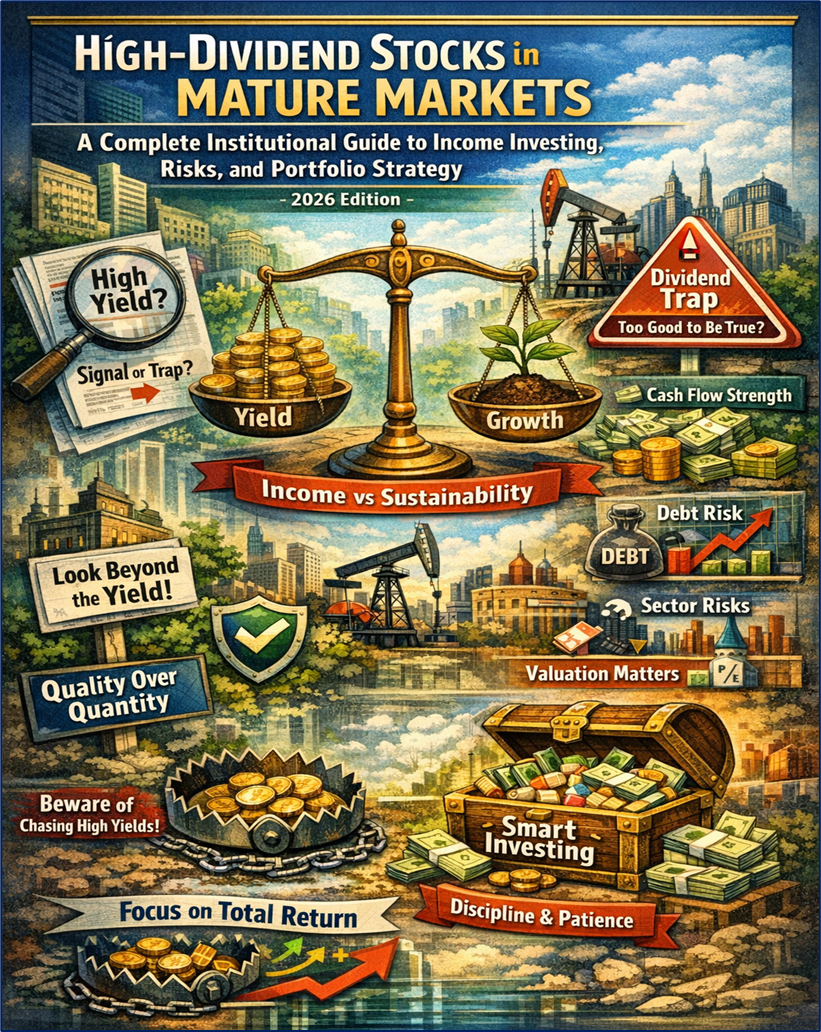
Source: Kalkine Group
Executive Summary
The pursuit of high-dividend stocks remains one of the most enduring and attractive strategies in equity markets. Investors seeking stable income, reduced volatility, and predictable cash flows naturally gravitate toward dividend-paying securities. These investments offer a tangible promise: regular income regardless of market fluctuations. However, beneath this appeal lies a complex and often misunderstood reality—the tradeoff between yield and sustainability.
This analysis of 100 Canadian high-dividend stocks reveals a market characterized by extreme dispersion in both yield and valuation. Dividend yields range from 3.45% to 25.79%, while price-to-earnings ratios span from 2.37 to over 318. These variations highlight a critical truth: yield alone tells you very little about investment quality.
Sector analysis shows:
- Energy dominates with 23% representation and ~5.32% yield
- Real estate leads in yield (~8.77%) due to structural payout requirements
- Financials provide balanced yield (~5.79%) with moderate valuations
A particularly alarming finding is the existence of companies paying dividends despite negative earnings, signaling unsustainable distributions funded by balance sheets rather than operations.
The central conclusion is clear:
High yield is not an opportunity—it is a question.
Investors must determine whether that yield reflects:
- Genuine cash-generating strength
or - A deteriorating business masking risk
Introduction to Dividend Investing: Evolution and Modern Relevance
Dividend investing is rooted in the fundamental principle of equity ownership—sharing in a company’s profits. Historically, dividends were the primary source of stock market returns, especially before modern growth investing became dominant.
In the mid-20th century, strategies like “Dogs of the Dow” emphasized high-yield stocks as safe, reliable investments. Institutional investors favored these strategies because they provided:
- Predictable income
- Lower perceived risk
- Governance discipline
However, the rise of growth investing in the 1980s and 1990s shifted focus toward companies reinvesting earnings for expansion. Dividend investing was temporarily sidelined.
The global financial crisis (2008–09) marked a turning point. As markets collapsed:
- Dividend-paying stocks provided income stability
- Central banks reduced interest rates, making yield scarce
Since then, dividend investing has re-emerged as a core strategy, especially in low-rate environments and aging economies.
Importantly, research shows that 40–50% of long-term equity returns come from dividends and reinvestment. Ignoring dividends means ignoring a major component of wealth creation.
Understanding Dividend Yield: Calculation and Market Signals
Dividend yield is calculated as:
Dividend Yield = Annual Dividend / Stock Price
While simple, interpretation is complex.
Key Variations
- Trailing Yield: Based on past 12 months (backward-looking)
- Forward Yield: Based on expected payouts (forward-looking)
Market Insights from Data
- Median yield: ~5.11%
- Most stocks cluster between 4%–6%
- Only ~3% exceed 15% yield → major warning signal
Interpretation Framework
- 3%–5% → Stable, sustainable
- 5%–7% → Moderate risk, mature businesses
- 7%+ → Requires deep scrutiny
- 10%+ → Likely distress or trap
Yield also depends on interest rates:
- Low-rate environment → lower yields acceptable
- High-rate environment → higher yields required
Crucially:
Yield ≠ Return
A 6% yield with 10% price decline = negative return.
Psychology of Dividend Investing
Dividend investing is not purely rational—it is deeply psychological.
Why Investors Love Dividends
- Tangible income feels more “real” than paper gains
- Reduces anxiety during market downturns
- Creates perception of financial stability
Key Behavioral Biases
- Mental Accounting: Treating dividends as “income” and capital as “wealth”
- Yield Anchoring: Fixating on high yield as value
- Loss Aversion: Dividends soften perceived losses
- Availability Bias: Past crises reinforce dividend preference
Danger: Yield Chasing
Investors often prioritize current income over long-term sustainability, leading to poor decisions.
Conclusion:
Psychology can either enhance discipline—or drive costly mistakes.
Risks of High-Dividend Stocks
- Dividend Traps
High yields often precede dividend cuts.
A stock yielding 8% can quickly fall:
- Dividend cut → price collapse
- Income loss + capital erosion
- Unsustainable Payouts
Some companies:
- Pay dividends despite negative earnings
- Fund payouts through debt or reserves
This is effectively self-liquidation.
- High Payout Ratios
- 80%+ payout → limited flexibility
- Vulnerable during downturns
- Leverage Risk
High debt reduces ability to maintain dividends during stress.
- Sector Concentration Risk
Dividend portfolios often overweight:
- Energy
- Financials
- Real estate
This creates correlated risks.
- Interest Rate Sensitivity
Dividend stocks behave like bonds:
- Rising rates → falling valuations
Key Metrics for Evaluating Dividend Stocks
- Payout Ratio
- Ideal: 40%–70%
- 80% = risk
- Free Cash Flow Coverage
More reliable than earnings.
Dividend should be covered by actual cash, not accounting profits.
- Debt & Interest Coverage
- Low leverage preferred
- Interest coverage >3x
- Earnings Stability
- Predictable earnings = safer dividends
- Volatile earnings = risk
- Valuation Metrics
- P/E ratio context matters
- Low P/E can signal risk, not value
- Dividend Growth History
- Consistent growth = strong signal
- Irregular dividends = warning
Golden Rule
Never start with yield.
Start with business quality → then evaluate yield.
Sector-Level Insights
Energy (23%)
- Yield: ~5.32%
- Highly cyclical
- Sensitive to commodity prices
Financial Services (17%)
- Yield: ~5.79%
- Stable but rate-sensitive
Real Estate (REITs)
- Yield: ~8.77%
- High due to structural payout rules
- Sensitive to interest rates
Telecom & Media
- Yield: ~6.08%
- Low growth, regulatory pressures
Utilities
- Yield: ~5.02%
- Extremely stable, high valuations
Consumer Sector
- Yield: ~5.12%
- Balanced income + moderate growth
Industrials
- Yield: ~4.84%
- Lower income, higher growth potential
Yield vs Growth: The Core Tradeoff
This is the most important concept in dividend investing.
Reality
- High dividends = less reinvestment
- Less reinvestment = slower growth
Two Scenarios
- High Yield (8%)
- Low growth
- Limited upside
- Moderate Yield (4%)
- Higher growth
- Better long-term returns
Total Return Formula
Total Return = Yield + Growth + Valuation Change
Markets generally balance this:
- High yield → low growth
- Low yield → higher growth
Investor Decision
- Income-focused → choose yield
- Long-term wealth → balance both
Portfolio Construction Strategy
- Diversification
Avoid concentration in:
- One sector
- One yield range
- Blend Strategy
- Core: Stable 3–5% yield stocks
- Satellite: Select higher-yield opportunities
- Risk Allocation
- Limit exposure to >7% yield stocks
- Use them selectively
- Reinvestment Discipline
Reinvest dividends intelligently:
- During downturns → higher yield capture
- Avoid overpaying during bull markets
Common Mistakes Investors Make
- Chasing highest yield without analysis
- Ignoring payout sustainability
- Overconcentrating in one sector
- Confusing yield with return
- Blindly trusting dividend history
Conclusion: The Truth About Dividend Investing
Dividend investing remains one of the most powerful and enduring strategies in financial markets—but only when executed with discipline, intelligence, and a deep understanding of risk.
The allure of steady income can easily seduce investors into complacency. A high dividend yield feels safe, predictable, and comforting. It creates the illusion of control and stability in an otherwise volatile market environment. But beneath this surface lies a complex reality: not all income is created equal.
A 10% yield is not necessarily a gift—it is often a warning.
Markets are efficient enough to price risk into yield. When a stock offers unusually high income, it is usually compensating investors for:
- Business deterioration
- Financial stress
- Structural decline
- Or impending dividend cuts
The disciplined investor understands that yield is not the destination—it is the starting point of analysis.
True success in dividend investing comes from identifying companies that:
- Generate consistent free cash flow
- Maintain conservative balance sheets
- Operate in stable or moderately growing industries
- Allocate capital rationally
These businesses may not always offer the highest yields. In fact, the most successful dividend investments often begin with moderate yields that grow steadily over time, compounding wealth quietly but powerfully.
Another critical realization is that dividend investing is not just about income—it is about total return. A portfolio delivering 5% yield but losing 10% in capital value is fundamentally flawed. Conversely, a portfolio yielding 3–4% but growing earnings consistently can outperform significantly over time.
The optimal approach lies in balance:
- Combining income with growth
- Stability with opportunity
- Discipline with flexibility
Investors must also remain aware of their own psychological biases. The desire for immediate income, the comfort of cash payouts, and the fear of capital loss can all distort decision-making. Recognizing these tendencies allows investors to remain rational in environments where emotion often dominates.
Looking ahead, dividend investing will remain highly relevant. Aging populations, low-yield environments, and the need for income will continue to drive demand. However, this demand will also create more traps, more overvalued yield plays, and more opportunities for mispricing.
Ultimately, dividend investing is not about chasing yield—it is about owning quality businesses that reward shareholders sustainably over time.
The difference between success and failure lies in one principle:
Discipline over temptation.


 Jun 08, 2026




 Please wait processing your request...