
 AU
AU
 CA
CA
 US
US
 NZ
NZ
 IND
IND

 UK
UK

 Share
Share
 X (Formerly Twitter)
 Whatsapp
 Facebook
 LinkedIn
 Telegram
 Email This Article
 Copy Link
 Summarize with AI
 Chat GPT
 Perplexity
Generating a £500 weekly income from the stock market is a classic financial milestone. In the UK, where the "dividend culture" is more ingrained than in almost any other global market, this goal is achievable—but the capital required depends heavily on your risk appetite and the yield environment of 2026.
As of January 2026, with the FTSE 100 recently crossing the historic 10,000-point mark, the landscape for income seekers has shifted toward "quality and cover."
1. The Math: How Much Capital is Needed?
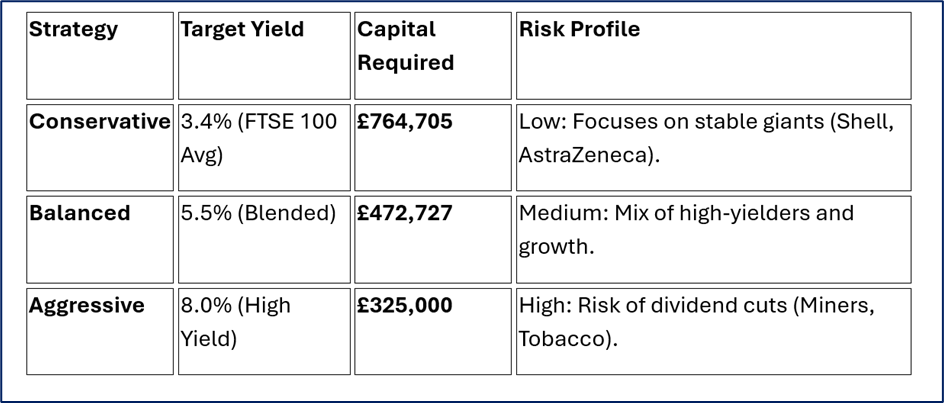
To earn £500 a week, you need an annual dividend income of £26,000. The amount of capital required is determined by the Dividend Yield of your portfolio.
Source: Kalkine Group Analysis
2. 2026 Market Analysis: Where the Bankers are Looking
Current sentiment among City analysts (as of mid-January 2026) is surprisingly bullish. With UK inflation settling around 2.5%, the "real yield" on UK stocks is at its most attractive level in a decade.
The "Banker's Favorites" for 2026
- The "Cash Cows" (Financials): Analysts at AJ Bell and Goldman Sachs have highlighted Legal & General (LGEN) and M&G (MNG). With yields forecasted between 7.2% and 8.7% for 2026, these are the heavy lifters for any income portfolio.
- The Defensive Fortress: National Grid (NG) remains a top pick. In early 2026, it confirmed a dividend policy linked to CPI inflation, making it a favorite for those worried about late-cycle price spikes.
- The Value Play: Lloyds Banking Group (LLOY)- After hitting a 17-year high of 101p this month, analysts suggest the bank is still "mispriced" relative to its capital return potential.
3. Top UK Stock Picks for a £500/Week Goal
Source: Kalkine Group
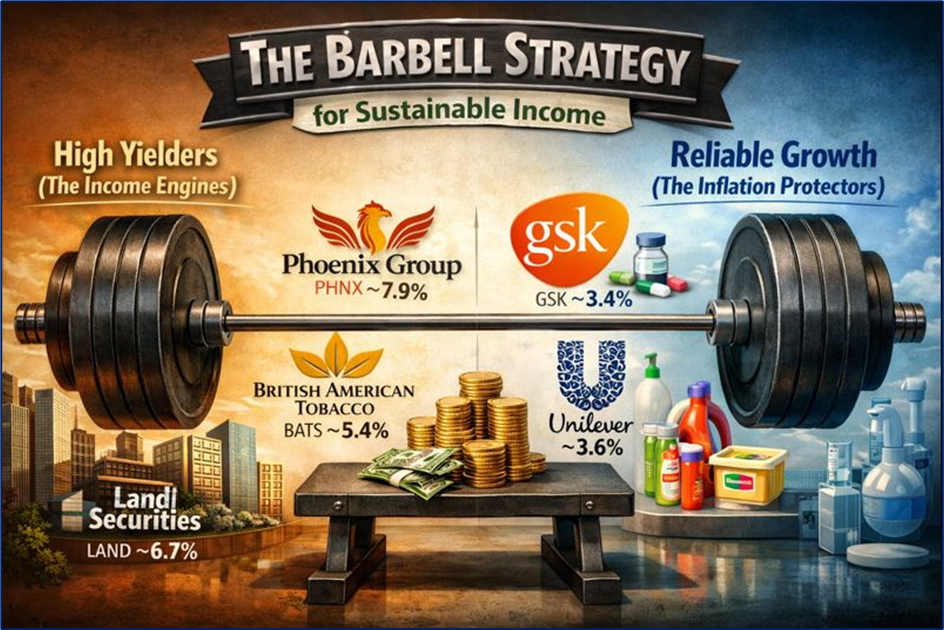
To achieve a sustainable income, a "Barbell Strategy"—combining ultra-safe low yielders with high-risk high yielders—is recommended.
High Yielders (The Income Engines)
- Phoenix Group (PHNX): Yielding ~7.9%. As a consolidator of closed life insurance funds, its cash flow is highly predictable.
- British American Tobacco (BATS): Yielding ~5.4%. Despite the "sin stock" label, its transition to "New Categories" has stabilized cash flows for 2026.
- Land Securities (LAND): Yielding ~6.7%. A recovery in prime London office and retail space has bolstered REIT distributions.
Reliable Growth (The Inflation Protectors)
- GSK: Yielding ~3.4%. With a massive drug pipeline (66 drugs in trials), it offers safety and modest growth.
- Unilever: Yielding ~3.6%. Its "power brands" allow it to pass on costs to consumers, ensuring the dividend grows even if the economy stutters.
4. Key Risks to Your Strategy
- Dividend Cover: Always check if a company's earnings are at least 1.5x–2x their dividend payout. A yield of 10% is useless if the company has to borrow money to pay it.
- The "ISA" Advantage: To keep your £500/week tax-free, you should maximize your Stocks & Shares ISA (£20,000 annual limit). Outside an ISA, you may face dividend tax rates of up to 39.35% for additional-rate taxpayers.
- Concentration Risk: Avoid putting more than 10% of your capital into a single sector (e.g., don't just buy banks).
Conclusion
Ultimately, building a £500 weekly income in 2026 is less about finding a "get rich quick" ticker and more about engineering a private pension that thrives on the FTSE 100’s current 10,000-point momentum. As the City shifts its focus from the high-valuation fatigue of US tech toward the "unloved" value of UK financials and miners, the opportunity for a 5.5% to 7% blended yield has rarely been more tangible.
By diversifying across high-yield engines like Legal & General and defensive stalwarts like National Grid, you aren't just buying stocks—you are buying a claim on the resilient cash flows of the UK’s most established giants. In an era of "sticky" inflation and shifting global alliances, a well-structured UK income portfolio remains one of the most sophisticated tools for achieving genuine financial sovereignty.


 Jun 29, 2026




 Please wait processing your request...