
 AU
AU
 CA
CA
 US
US
 NZ
NZ
 IND
IND

 UK
UK

 Share
Share
 X (Formerly Twitter)
 Whatsapp
 Facebook
 LinkedIn
 Telegram
 Email This Article
 Copy Link
 Summarize with AI
 Chat GPT
 Perplexity
If you had invested £10,000 into Nvidia (NVDA) exactly five years ago in January 2021, your investment would be worth approximately £143,700 today. This represents a staggering total return of roughly 1,337%. While the S&P 500 has seen respectable gains, Nvidia has operated in a different stratosphere, evolving from a "gaming chip company" into the undisputed sovereign of the Artificial Intelligence era.
Key Reasons & Growth Drivers
Source: Kalkine Group
The meteoric rise of Nvidia is not merely a product of market hype but a fundamental shift in the global computing architecture.
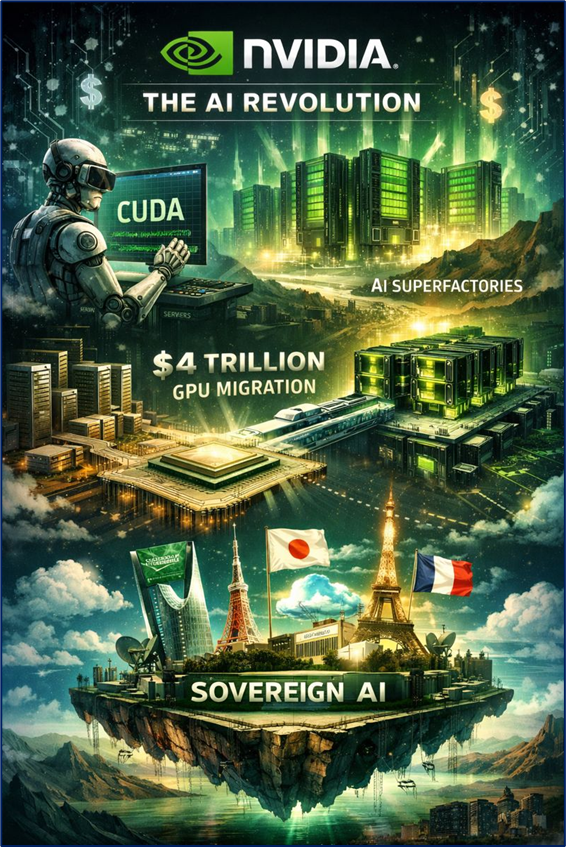
- The AI Monoculture: Nvidia’s CUDA software platform has created a "moat" so deep that competitors find it nearly impossible to displace. Most AI developers are trained on CUDA, making Nvidia the default language of modern computing.
- Generational Infrastructure Shift: We are witnessing a $4 trillion migration from traditional CPUs to accelerated GPUs. Every major "hyperscaler"—Microsoft, Amazon, and Google—is locked in an arms race to build AI superfactories.
- The Sovereign AI Trend: Beyond Big Tech, nation-states like Saudi Arabia, Japan, and France are now purchasing Nvidia chips to build "Sovereign AI" clouds, ensuring their data and intelligence remain within domestic borders.
Current Technical Analysis: The $185 Pivot
Source: Trading View
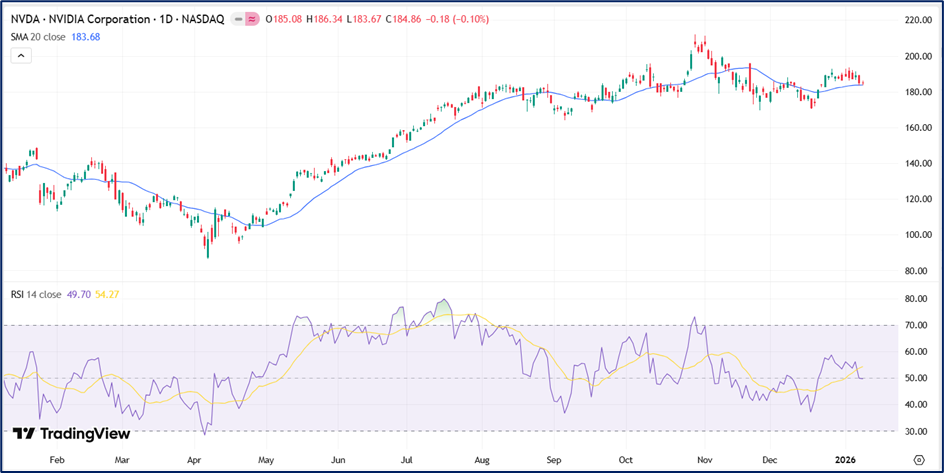
As of early 2026, Nvidia is trading in a consolidation phase following its record-breaking 2025. Technically, the stock is hovering near its $185 support level, having successfully digested the massive gains from the "Blackwell" launch. The Relative Strength Index (RSI) suggests a neutral-to-bullish stance, indicating the stock is neither overbought nor oversold at current levels. Traders are watching the $190 resistance closely; a clean break above this could trigger a run toward the $212 all-time high. The 50-day moving average remains sloped upward, acting as a dynamic safety net for long-term holders.
Latest Analyst Updates: Upgrades & Price Targets
Wall Street remains overwhelmingly bullish, even at these elevated valuations.
- Mizuho: Recently reiterated Nvidia as a "Top Pick" for 2026, citing the transition from copper to optical connectivity as a massive hidden catalyst.
- Bank of America: Maintained a Buy rating with a price target of $275, emphasizing that Nvidia’s "Rubin" architecture will slash inference costs by 10x, making AI affordable for smaller enterprises.
- Consensus View: Out of 63 major analysts, over 92% maintain a "Buy" or "Strong Buy" rating. The average 12-month price target currently sits near $264, implying a potential upside of nearly 40% from current prices.
The 2026 Business Model: Hardware-as-a-Service
Nvidia is no longer just selling "parts." Its latest business model focuses on Full-Stack Integration.
- The Rubin Platform: Launched at CES 2026, the Rubin platform integrates six different types of chips (CPUs, GPUs, and Networking) into a single, cohesive AI supercomputer.
- Recurring Software Revenue: Through "Nvidia AI Enterprise," the company is charging per-GPU-hour for software licenses, creating a high-margin recurring revenue stream that mimics a SaaS (Software-as-a-Service) model.
- Omniverse & Robotics: Nvidia is aggressively expanding into "Physical AI," using its chips to power humanoid robots and autonomous "superfactories" for companies like Tesla and Mercedes-Benz.
Latest Financial & Operational Updates
The fiscal 2026 results have shattered all previous records, proving that the demand for AI compute remains insatiable.
- Record Revenue: Third-quarter fiscal 2026 revenue hit $57 billion, a 62% increase year-over-year.
- Data Centre Dominance: Data centre revenue alone accounted for $51.2 billion, as the "Blackwell" chip ramp-up exceeded even the most optimistic supply chain forecasts.
- Shareholder Returns: Nvidia returned $37 billion to shareholders in the first nine months of the fiscal year through aggressive share repurchases and dividends, signaling management's confidence in future cash flows.
The Risks: What Could Derail the Train?
No investment is without peril, and Nvidia faces unique challenges in 2026.
- Geopolitical Friction: Continued US export controls have largely locked Nvidia out of the Chinese market, which was once its second-largest revenue source.
- CapEx Fatigue: There is growing scrutiny on the "Return on Investment" (ROI) for Big Tech companies. If Microsoft or Meta don't see clear profits from their AI spending, they may slash future GPU orders.
- Antitrust Scrutiny: Regulators in the US and EU are investigating whether Nvidia’s bundling of networking hardware with GPUs unfairly stifles competition from smaller chipmakers.
Conclusion
Nvidia has transitioned from a cyclical semiconductor play into the fundamental infrastructure of the 21st century. While the "easy money" of the 1,300% return may be in the past, the company's shift toward the Rubin architecture and Inference-based AI suggests it remains the primary beneficiary of the intelligence revolution. For the investor who put in £10,000 five years ago, the question is no longer about "if" Nvidia will grow, but how high the ceiling for a $4 trillion company can truly go.


 Jun 29, 2026




 Please wait processing your request...