
 AU
AU
 CA
CA
 US
US
 NZ
NZ
 IND
IND

 UK
UK

 Share
Share
 X (Formerly Twitter)
 Whatsapp
 Facebook
 LinkedIn
 Telegram
 Email This Article
 Copy Link
 Summarize with AI
 Chat GPT
 Perplexity
Views Expressed Disclaimer:
You are reading a free article with opinions that may differ from the recommendation given by Kalkine in its paid research reports. Become a Kalkine member today to get access to our research reports, in-depth technical and fundamental research.
Airtel Africa is benefiting from rising mobile adoption and digital payments growth across emerging markets. Discover whether this telecom stock is a smart investment now.
Key Takeaways — February 2026
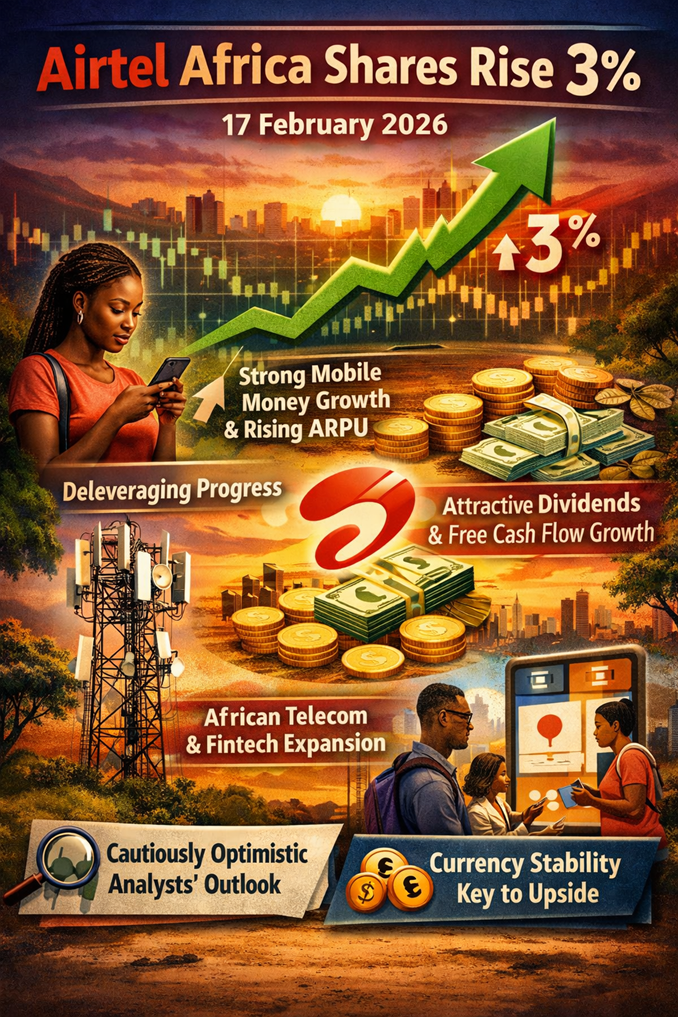
- Airtel Africa shares rose around 3% on 17 February 2026 amid improving emerging-market telecom sentiment and currency tailwind expectations.
• Strong mobile money growth, rising ARPU, and deleveraging progress continue supporting investor confidence (Company disclosures FY2025–2026).
• Dividend outlook remains attractive with progressive payout potential supported by free cash flow expansion.
• African telecom penetration growth and fintech monetisation remain key long-term catalysts.
• Analysts remain cautiously optimistic with valuation upside linked to execution and currency stability.
Source: Kalkine Group
Why Is Airtel Africa Stock Rising Today and What Is Driving Investor Optimism in February 2026?
Airtel Africa stock is gaining attention across the FTSE 100, UK stock market, and global telecom investment community after rising approximately 3% on 17 February 2026, with investors increasingly searching for high-dividend FTSE stocks, emerging market telecom growth stocks, passive income shares UK, and undervalued FTSE 100 opportunities. The rally appears driven by a combination of strong operational momentum, improving African currency outlook, fintech expansion potential, and renewed investor appetite for defensive telecom stocks amid global market volatility.
The stock’s move higher also coincides with broader FTSE 100 resilience, GBP stability, and global rotation toward cash-generative companies, particularly those offering dividend yield, recurring revenue, and structural growth exposure. Airtel Africa, with its mobile money ecosystem, subscriber growth, and margin expansion initiatives, is increasingly being viewed as both a growth and income hybrid investment — a rare combination that attracts institutional and retail investors.
Importantly, the surge comes as investors reassess emerging market telecom valuations, especially companies with strong free cash flow conversion, deleveraging balance sheets, and scalable digital financial services platforms. Airtel Africa sits directly at the intersection of these themes, which explains the recent buying momentum.
How Are Global Market Dynamics Influencing FTSE 100 Telecom Stocks Right Now?
Global markets in early 2026 are shaped by several macro drivers:
- Moderating inflation across developed economies
• Expectations of gradual interest rate cuts in late 2026
• Stronger USD stabilisation benefiting emerging markets
• Rotation toward defensive sectors with predictable earnings
Telecom stocks typically outperform during uncertain macro cycles because of:
- Recurring subscription revenues
• Essential service nature
• Strong cash flow visibility
• Dividend reliability
This environment creates a supportive backdrop for Airtel Africa’s investment thesis.
What Is the Current UK Economy and FTSE 100 Environment Telling Investors?
The UK economy in 2026 shows mixed but stabilising conditions:
- Inflation trending lower compared to 2023–2024 peaks
• Consumer demand stabilising
• Bank of England maintaining cautious policy stance
• GBP relatively stable versus emerging market currencies
FTSE 100 performance has been supported by:
- Global earnings exposure rather than domestic UK demand
• Commodity and defensive sector strength
• Dividend-focused investor flows
FTSE 250 remains more sensitive to UK domestic growth, whereas FTSE 100 companies like Airtel Africa benefit from international revenue streams.
How Does GBP Movement Impact Airtel Africa Stock Performance?
Currency dynamics are crucial because Airtel Africa earns revenue in multiple African currencies while reporting in USD.
Positive catalysts include:
- African currency stabilisation
• Reduced FX volatility
• USD strength moderation
Currency tailwinds can significantly improve:
- Reported revenue growth
• EBITDA margins
• Dividend capacity
What Is Airtel Africa’s Current Business Model and Growth Strategy?
Airtel Africa operates across multiple high-growth African markets focusing on:
- Mobile voice and data services
• Mobile money and digital payments
• Enterprise connectivity solutions
Key growth pillars include:
- Mobile data penetration expansion
• Smartphone adoption growth
• Fintech monetisation through Airtel Money
• Network infrastructure investment
• Cost optimisation and margin improvement
Mobile money remains the most important long-term value driver, often compared to fintech platforms in emerging markets.
What Are the Latest Financial and Operational Updates Supporting the Rally?
Recent company disclosures highlight:
- Subscriber growth across key markets
• Rising Average Revenue Per User (ARPU)
• Mobile money transaction growth
• EBITDA margin improvement
• Net debt reduction trajectory
The company continues targeting:
- Strong free cash flow generation
• Progressive dividend policy
• Balance sheet deleveraging (Company reports FY2025–2026)
How Does Airtel Africa Compare With Telecom Peers Globally?
Peer benchmarking versus emerging market telecom companies shows:
Strengths:
- Faster mobile money growth than many peers
• Higher long-term demographic growth exposure
• Improving margins
• Attractive dividend yield
Weaknesses:
- Currency volatility risk
• Political and regulatory exposure
• Infrastructure investment requirements
Compared with European telecom operators, Airtel Africa offers higher growth but also higher risk.
What Is the Sector Outlook for Telecom and Emerging Market Connectivity?
Short term outlook:
- Stable demand
• Investor rotation toward defensive sectors
• Currency-driven volatility possible
Medium term outlook:
- 5G rollout and data consumption growth
• Fintech integration into telecom ecosystems
• Digital financial inclusion expansion
Long term outlook:
- Structural growth from demographics
• Smartphone penetration expansion
• Financial services monetisation opportunity
Africa remains one of the fastest-growing telecom markets globally.
Is Airtel Africa Stock Bullish, Bearish, or Neutral Right Now?
Short-term view:
Neutral to mildly bullish due to:
- Positive momentum
• Improving sentiment
• Currency expectations
Risks include:
- Profit-taking after rallies
• FX volatility
Long-term view:
Bullish bias supported by:
- Structural growth markets
• Fintech optionality
• Improving leverage profile
• Dividend growth potential
What Forward Strategies Could Investors Consider Across Time Horizons?
Short term strategies:
- Momentum-based positioning during telecom sector strength
• Monitoring currency movements
• Watching earnings announcements
Medium term strategies:
- Accumulation during volatility
• Dividend reinvestment
• Tracking mobile money growth metrics
Long term strategies:
- Holding for demographic growth exposure
• Compounding through dividends
• Benefiting from fintech valuation re-rating
What Are the Analyst Forecasts and Valuation Perspectives?
Consensus broker sentiment (various investment bank research 2025–2026):
- Generally positive with moderate upside expectations
• Valuation supported by EBITDA growth and cash flow
Common valuation approaches include:
- EV/EBITDA multiple comparison
• Dividend yield attractiveness
• Emerging market growth premium
Analysts highlight mobile money valuation potential as a key upside catalyst.
What Are the Key Risks Investors Should Consider?
Major risks include:
- Currency depreciation
• Political instability in operating regions
• Regulatory intervention
• Competitive pricing pressure
• Infrastructure cost escalation
Telecom investments in emerging markets always carry macro sensitivity.
What Does the Bull vs Bear Scenario Analysis Look Like?
Bull Case:
- Strong mobile money monetisation
• Currency stabilisation
• Margin expansion
• Deleveraging success
• Fintech valuation rerating
Bear Case:
- FX depreciation
• Regulatory challenges
• Slower subscriber growth
• Capital expenditure pressure
• Competitive intensity
Base Case:
- Steady growth with moderate volatility
Could Airtel Africa Dividend Growth Become a Major Investment Catalyst?
Dividend investment appeal is significant because:
- Telecom cash flows are predictable
• Debt reduction improves payout capacity
• Emerging market growth supports earnings
Income investors often prioritise companies combining yield and growth — Airtel Africa fits this profile if execution continues.
Frequently Asked Questions About Airtel Africa Stock
Is Airtel Africa a good dividend stock?
It has attractive dividend potential supported by cash flow growth and deleveraging progress.
Why did the stock rise in February 2026?
Improving sentiment, operational momentum, and currency expectations contributed to the rally.
Is Airtel Africa a growth or value stock?
It combines both — growth through fintech and demographics, value through dividend yield.
What is the biggest risk?
Currency volatility remains the most significant external risk factor.
Final Investment Conclusion — What Should Investors Do Now?
Airtel Africa presents a compelling but nuanced investment case.
Positives:
- Exposure to high-growth African markets
• Strong mobile money optionality
• Improving financial profile
• Dividend growth potential
Challenges:
- Currency risk
• Political exposure
• Execution dependency
For long-term investors seeking emerging market growth plus dividend income, Airtel Africa may offer an attractive risk-reward profile. Short-term volatility should be expected, but structural growth drivers remain intact.


 Jun 29, 2026




 Please wait processing your request...