
 AU
AU
 CA
CA
 US
US
 NZ
NZ
 IND
IND

 UK
UK

 Share
Share
 X (Formerly Twitter)
 Whatsapp
 Facebook
 LinkedIn
 Telegram
 Email This Article
 Copy Link
 Summarize with AI
 Chat GPT
 Perplexity
Barclays stock is gaining investor attention due to strong earnings, dividends, and improving profitability. Here’s whether it’s a buy now.
Key Takeaways — February 2026
- Barclays share price volatility driven mainly by interest rate expectations and global banking sentiment
• Investment banking cyclicality creating short-term uncertainty despite strong fundamentals
• Dividend outlook remains attractive supported by capital strength and buybacks
• UK macro environment and GBP movement key drivers for near-term performance
• Long-term thesis supported by diversification, digital strategy, and cost efficiency
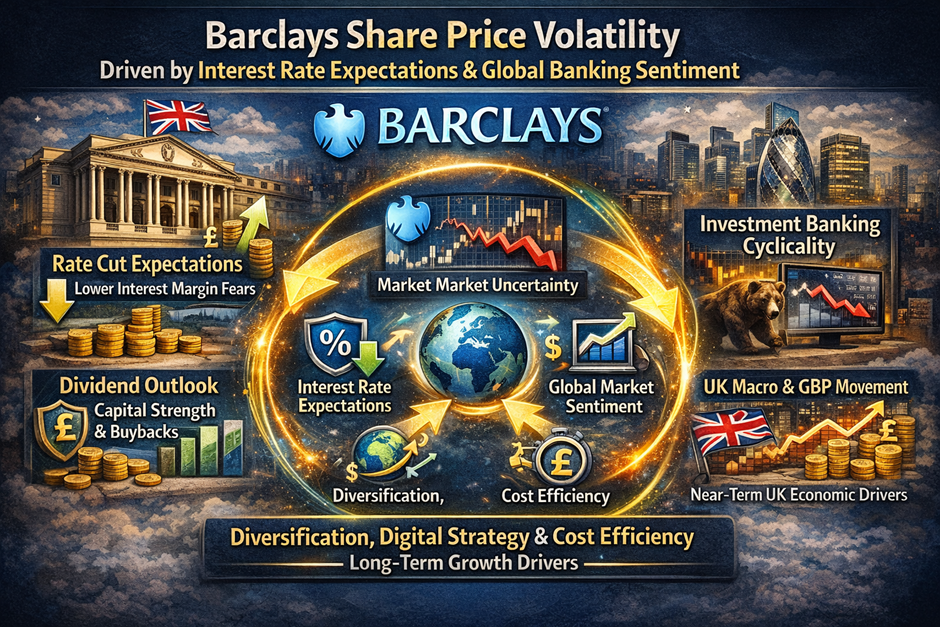
Source: Kalkine Group
Why Is FTSE 100 Barclays Stock Moving Lower on 13 February 2026?
Barclays share price performance in February 2026 reflects a complex combination of global macroeconomic forces, UK interest rate expectations, banking sector sentiment, and investor positioning rather than company-specific deterioration. Investors searching for “Barclays share price forecast 2026,” “FTSE 100 bank outlook,” “UK banking stocks dividend,” “Is Barclays undervalued,” and “Barclays investment analysis February 2026” are reacting to changing expectations around Bank of England policy, bond yields, and global financial market momentum.
As Barclays lowered 2.07% on 13 February 2026, broader market narratives about future interest rate cuts have created uncertainty around bank profitability. Lower interest rates typically compress net interest margins, which directly impacts banking earnings expectations. Markets are forward-looking, meaning anticipated changes often influence share prices before they occur.
Another major factor is Barclays’ exposure to global investment banking and capital markets activity. Compared with more domestically focused UK banks, Barclays earnings are more sensitive to trading volumes, deal activity, and market sentiment. When investors anticipate slower global growth or reduced capital markets activity, Barclays tends to experience higher volatility.
How Are Global Market Dynamics Influencing Barclays in February 2026?
Global financial markets are currently shaped by several dominant themes:
- Expectations of monetary policy easing across major economies
• Moderating inflation but persistent economic uncertainty
• Geopolitical tensions affecting investor confidence
• Slower merger and acquisition activity impacting investment banks
• Sector rotation between cyclical and defensive industries
Banks sit at the center of these forces because profitability is closely tied to interest rates, economic growth, and credit demand.
What Is the Current UK Economic Outlook and Why Does It Matter for Barclays?
The UK economy entering 2026 shows mixed but stabilizing signals:
- Moderate GDP growth with improving business confidence
• Inflation trending downward toward central bank targets
• Labour market resilience supporting consumer spending
• Housing market stabilization after previous weakness
• Wage growth remaining elevated
For banks like Barclays, a stable or improving economy supports loan demand and credit quality, while recession fears could increase loan losses and reduce profitability expectations.
How Do FTSE 100, FTSE 250, and GBP Trends Affect Barclays Share Price?
Barclays performance is closely linked to broader UK market dynamics:
FTSE 100 influence:
- Global investor flows into UK equities affect large financial stocks
• Sector rotation toward or away from banks impacts valuation
FTSE 250 signals:
- Domestic economic confidence trends
• Mid-cap performance often predicts economic direction
GBP movement:
- Currency strength influences overseas earnings translation
• Weak GBP can boost multinational profits
• Currency volatility impacts foreign investor sentiment toward UK assets
What Is Barclays’ Business Model and Latest Company Update?
Barclays operates through diversified segments:
- UK retail banking and mortgages
• Consumer credit and payments
• Corporate banking services
• Global investment banking and markets division
This diversification creates multiple revenue streams but also introduces earnings cyclicality linked to global financial markets.
Recent company communications highlight:
- Continued cost discipline initiatives
• Investment in digital platforms and technology
• Strong capital ratios above regulatory requirements
• Ongoing shareholder returns through dividends and buybacks
(Company reports and investor releases 2025–2026)
How Does Barclays Compare With Other UK Banks?
Peer benchmarking shows Barclays occupies a unique strategic position:
- Higher investment banking exposure than Lloyds or NatWest
• Greater global diversification than domestic-focused peers
• Higher earnings volatility but stronger upside potential in market recoveries
• Competitive capital return profile relative to European banking peers
This positioning means Barclays often outperforms during global market expansions but underperforms during uncertainty.
What Is the Outlook for the UK Banking Sector in 2026?
Short-term outlook:
- Margin pressure concerns due to expected interest rate cuts
• Market volatility linked to economic data releases
• Earnings normalization after peak rate cycle
Medium-term outlook:
- Stabilizing credit conditions
• Efficiency improvements and cost reduction
• Digital transformation benefits
Long-term outlook:
- Structural profitability improvement
• Increased fee-based revenue streams
• Potential sector consolidation
What Strategies Could Investors Consider Based on Time Horizon?
Short term (3–6 months):
- Monitor interest rate expectations and central bank signals
• Track quarterly earnings momentum
• Consider gradual accumulation during volatility
Medium term:
- Focus on dividend yield sustainability
• Observe cost efficiency progress
• Evaluate investment banking recovery trends
Long term:
- Hold for dividend compounding potential
• Benefit from valuation normalization
• Capture cyclical banking recovery upside
Is Barclays Stock Bullish, Bearish, or Neutral Right Now?
Short-term outlook:
Neutral to slightly bearish due to macro uncertainty and interest rate expectations.
Long-term outlook:
Moderately bullish supported by:
- Strong capital position
• Attractive valuation metrics
• Diversified global operations
• Consistent shareholder return strategy
What Are the Latest Key Drivers Behind Barclays Share Price Movements?
Recent drivers include:
- Shifting interest rate expectations
• Investment banking revenue outlook
• Global financial sector sentiment
• Capital return announcements
• Economic data influencing recession probability
What Do Analysts and Brokers Forecast for Barclays?
Major broker consensus suggests potential upside if macro conditions stabilize.
Common themes from analyst research (2026):
- Attractive valuation relative to European banking peers
• Strong capital returns through dividends and buybacks
• Earnings sensitivity to interest rate path
• Investment banking recovery potential
What Are the Main Risks Investors Should Know?
Key risks include:
- Rapid interest rate cuts compressing margins
• Economic slowdown increasing credit losses
• Regulatory changes affecting capital requirements
• Global market volatility impacting investment banking revenue
• Negative investor sentiment toward financial stocks
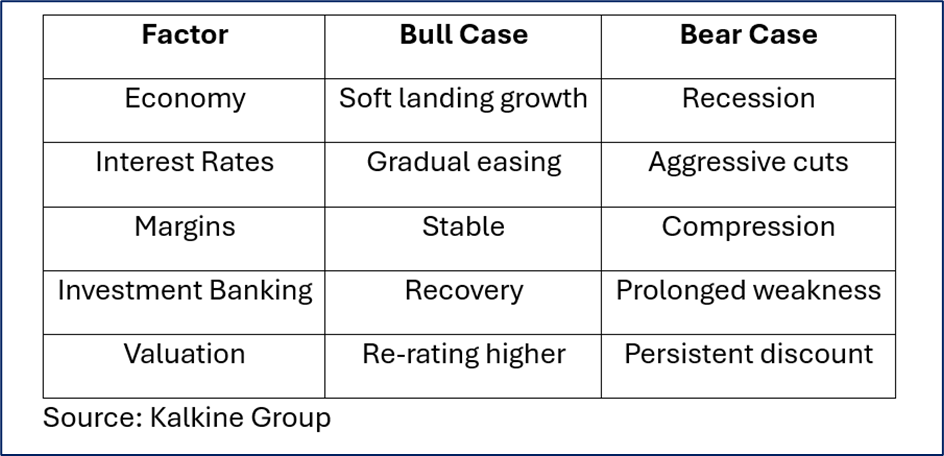
What Does the Bull vs Bear Scenario Matrix Show?
What Is the Barclays Dividend Outlook for 2026 and Beyond?
Dividend prospects remain one of the strongest investment attractions:
- Healthy capital buffers support payouts
• Share buybacks enhance shareholder returns
• Yield remains competitive within FTSE 100 financial sector
Dividend sustainability depends primarily on profitability stability and credit quality.
Frequently Asked Questions About Barclays Stock
Is Barclays undervalued in 2026?
Many investors believe valuation appears attractive compared with historical levels and peers.
Is Barclays a good dividend investment?
The bank’s capital strength supports ongoing shareholder returns.
Will interest rate cuts hurt Barclays?
Potentially in the short term, but long-term effects may be manageable depending on economic growth.
Is Barclays riskier than other UK banks?
Higher investment banking exposure increases volatility but also upside potential.
Final Investment Conclusion — Is Barclays a Smart Investment Opportunity Now?
Barclays represents a cyclical value opportunity within the FTSE 100 banking sector. Short-term volatility driven by macroeconomic uncertainty and interest rate expectations may continue, but the long-term investment case remains supported by diversified operations, strong capital returns, and potential valuation re-rating as market conditions normalize.
For long-term investors seeking dividend income and recovery potential, periods of weakness may provide strategic entry opportunities, provided portfolio diversification and risk management are maintained.


 Jun 29, 2026




 Please wait processing your request...