
 AU
AU
 CA
CA
 US
US
 NZ
NZ
 IND
IND

 UK
UK

 Share
Share
 X (Formerly Twitter)
 Whatsapp
 Facebook
 LinkedIn
 Telegram
 Email This Article
 Copy Link
 Summarize with AI
 Chat GPT
 Perplexity
Views Expressed Disclaimer:
You are reading a free article with opinions that may differ from the recommendation given by Kalkine in its paid research reports. Become a Kalkine member today to get access to our research reports, in-depth technical and fundamental research.
BP shares are attracting income investors. Discover dividend outlook, valuation, risks, and growth catalysts before investing in 2026.
Why Did BP Stock Fall Around 2.3% on 20 February 2026?
Key Takeaways — February 2026
- BP shares declined amid oil price volatility and broader energy sector profit-taking
• Global demand uncertainty and macroeconomic sentiment influenced investor positioning
• Dividend yield remains attractive relative to many FTSE 100 income stocks (company disclosures)
• Strong operating cash flow continues to support shareholder returns
• Analysts remain broadly constructive despite short-term risks
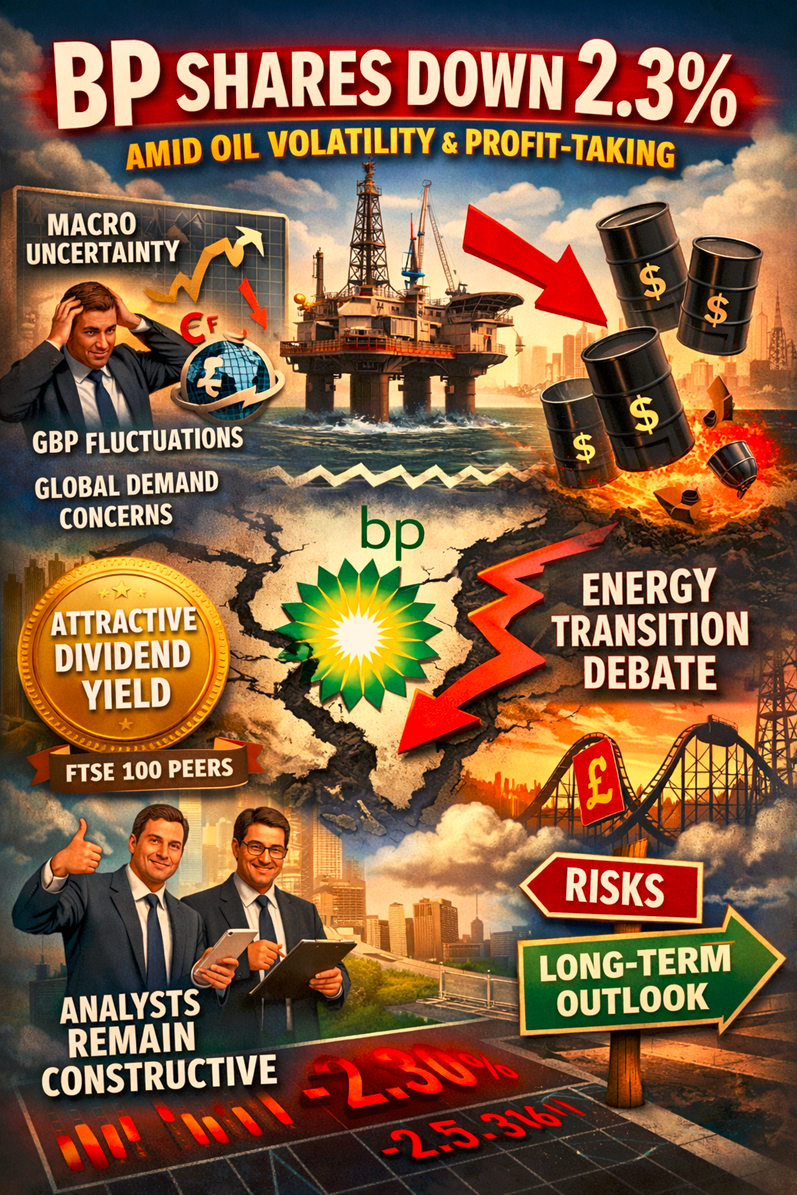
Source: Kalkine Group
Could BP Still Be One of the Best FTSE 100 Dividend Stocks to Buy in 2026?
BP stock, FTSE 100 dividend stocks, UK oil shares, energy sector outlook 2026, oil price forecast, high dividend yield UK stocks, passive income investing, and global energy demand trends are among the most searched financial keywords worldwide in February 2026. Investors are increasingly analysing whether BP shares represent a compelling buying opportunity following the recent decline, especially as dividend income strategies, inflation protection assets, and commodity exposure regain popularity amid uncertain macroeconomic conditions. The combination of strong cash flow generation, shareholder return programmes, and long-term energy demand continues to place BP at the centre of global investor attention.
The recent weakness in BP’s share price coincides with broader market movements involving oil prices, interest rate expectations, geopolitical developments, and currency fluctuations. As investors search for “best oil stocks to buy,” “FTSE 100 high dividend shares,” “BP dividend forecast 2026,” and “energy stocks outlook,” the company remains a prominent candidate due to its global scale, diversified operations, and income potential. With energy security and supply dynamics continuing to dominate economic discussions worldwide, integrated oil majors remain strategically important assets within diversified portfolios.
From a global SEO perspective, keywords such as BP share price forecast, oil stocks investment strategy, FTSE 100 market outlook, UK blue-chip dividend shares, energy transition investing, and commodity cycle investing are trending across search engines and social platforms, reflecting sustained interest from retail and institutional investors alike.
What Global Market Dynamics Are Currently Influencing BP Shares?
Several global factors contributed to the share price decline:
- Short-term softness in crude oil prices driven by demand concerns in major economies
• Currency movements, particularly US dollar strength affecting commodity pricing
• Investor rotation toward defensive sectors after prior energy stock gains
• Profit-taking following strong performance earlier in the year
Energy companies are highly cyclical, and commodity price movements often create short-term volatility even when fundamentals remain stable.
How Is the UK Economy Affecting FTSE 100 Energy Stocks?
The UK macroeconomic backdrop continues to influence investor sentiment:
- Expectations surrounding future Bank of England interest rate decisions
• GBP currency volatility impacting multinational earnings translation
• Gradual economic stabilisation after inflation pressures
• Improving investor confidence toward UK equities compared with previous periods
Because BP generates most of its revenue internationally, global economic conditions often have a larger impact than domestic UK trends.
What Does FTSE 100 and FTSE 250 Market Sentiment Indicate?
Market trends in February 2026 show:
- Renewed demand for dividend-paying blue-chip companies
• Sector rotation between cyclical and defensive stocks
• FTSE 250 benefiting from domestic recovery expectations
• Commodity-heavy FTSE 100 experiencing volatility linked to oil and metals prices
Large-cap energy stocks remain closely tied to global macroeconomic sentiment rather than purely domestic conditions.
What Is BP’s Current Business Model and Strategy?
BP operates across the entire energy value chain with diversified revenue streams:
- Upstream oil and gas exploration and production
• Downstream refining, fuels marketing, and petrochemicals
• Global energy trading operations
• Investments in low-carbon energy including EV charging, hydrogen, and renewable fuels
The company is pursuing a balanced strategy that aims to deliver shareholder returns while gradually expanding into transition energy markets. This dual approach remains a major discussion point among investors evaluating long-term valuation potential.
Recent company updates highlight:
- Strong operating cash flow and financial resilience (company reports)
• Continued share buybacks alongside dividend distributions (company disclosures)
• Portfolio optimisation and disciplined capital allocation initiatives
How Attractive Is BP’s Dividend Outlook for Investors?
Dividend income remains one of BP’s primary investment attractions:
- Competitive dividend yield compared with FTSE 100 averages
• Cash flow coverage supported by energy prices
• Share buyback programmes enhancing total shareholder returns
• Management focus on disciplined capital allocation
Dividend sustainability largely depends on commodity price trends and operational efficiency, but current coverage metrics remain supportive.
How Does BP Compare With Its Global Energy Peers?
Compared with other integrated oil majors:
- Dividend yield remains competitive within the sector
• Valuation metrics appear relatively attractive
• Transition strategy introduces both opportunity and execution risk
• Operational scale and trading expertise provide competitive advantages
Peers include Shell, ExxonMobil, Chevron, and TotalEnergies, all influenced by similar macroeconomic factors.
What Is the Outlook for the Energy Sector in 2026 and Beyond?
Short-term outlook:
- Oil price volatility likely due to macro uncertainty
• Geopolitical developments potentially supporting commodity prices
• Investor sentiment sensitive to economic data releases
Medium-term outlook:
- Structural global energy demand remains strong
• Supply constraints supporting commodity pricing
• Industry capital discipline improving profitability
Long-term outlook:
- Energy transition reshaping the industry landscape
• Hydrocarbon demand expected to persist for decades
• Diversification into low-carbon energy creating new growth opportunities
What Strategies Could Investors Consider Across Different Time Horizons?
Short-term investors (3 to 6 months):
- Monitor oil price momentum and macroeconomic indicators
• Track earnings announcements and capital return updates
• Expect volatility-driven trading opportunities
Medium-term investors:
- Focus on valuation relative to historical ranges
• Evaluate dividend sustainability and free cash flow generation
• Monitor capital allocation decisions
Long-term investors:
- Assess energy transition strategy credibility
• Prioritise total shareholder return potential
• Consider diversification benefits within portfolios
Is BP Stock Currently Bullish, Bearish, or Neutral?
Short-term outlook: Neutral to slightly bearish
Reasons:
- Commodity price fluctuations
• Market rotation dynamics
• Near-term sentiment uncertainty
Long-term outlook: Moderately bullish
Reasons:
- Strong cash generation potential
• Attractive dividend yield
• Long-term energy demand resilience
• Shareholder-friendly return policies
What Key Catalysts Could Drive BP Shares Next?
Positive catalysts:
- Rising oil and gas prices
• Strong earnings performance
• Increased share buybacks
• Improved profitability from transition investments
Negative catalysts:
- Oil price declines
• Regulatory or taxation changes
• Execution risks in new energy projects
• Global economic slowdown
What Are Analysts Saying About BP Stock?
Major broker sentiment as of February 2026 remains broadly constructive:
- Goldman Sachs — Positive rating with focus on cash flow strength
• JPMorgan — Overweight outlook based on sector fundamentals
• Barclays — Balanced view reflecting risk and reward
• UBS — Positive stance highlighting valuation attractiveness
Analysts generally emphasise shareholder returns and commodity leverage as key strengths.
What Bull and Bear Scenarios Should Investors Consider?
Bull case factors include sustained strong commodity prices, successful energy transition execution, continued capital discipline, and higher shareholder distributions.
Bear case factors include prolonged oil price weakness, rising operational costs, regulatory pressures, and global economic slowdown impacting demand.
What Are the Key Risks Investors Should Monitor?
- Commodity price volatility
• Political and regulatory risks
• ESG and transition execution challenges
• Currency fluctuations
• Macroeconomic slowdown
What Is the Final Investment Outlook for BP Stock?
BP remains a classic cyclical dividend stock with strong income appeal and long-term strategic optionality. The recent share price decline appears primarily driven by macroeconomic sentiment and commodity market movements rather than structural deterioration in fundamentals. For income-focused investors seeking FTSE 100 exposure, BP continues to offer an attractive yield profile with potential for long-term total returns, although price volatility should be expected due to commodity sensitivity.
Long-term investors may find the risk-reward balance appealing, particularly if global energy markets remain structurally tight and capital discipline continues. Short-term investors should remain aware of oil-driven price swings and macroeconomic developments.


 Jun 29, 2026




 Please wait processing your request...