
 AU
AU
 CA
CA
 US
US
 NZ
NZ
 IND
IND

 UK
UK

 Share
Share
 X (Formerly Twitter)
 Whatsapp
 Facebook
 LinkedIn
 Telegram
 Email This Article
 Copy Link
 Summarize with AI
 Chat GPT
 Perplexity
Is Reckitt Benckiser quietly one of the safest and most reliable FTSE 100 investments for 2026 and beyond? Can its powerful global brands, defensive consumer-staples positioning, healthcare exposure, and dividend strength make RKT a true all-weather stock in volatile global markets?
As investors rotate away from high-risk growth stocks and seek stability, income, and predictable cash flows, Reckitt Benckiser is re-emerging as a compelling defensive blue-chip opportunity.
Key Takeaways – February 2026 Market Snapshot & RKT Stock Insights
- FTSE 100 trades near record highs (~10,402 in early February 2026), led by defensive and dividend-paying sectors
- Reckitt Benckiser shares rise ~2.2% on 5 February 2026, outperforming the broader UK market
- Dividend optimism strengthens after a special dividend payout in early February 2026
- Weaker GBP boosts overseas earnings translation for UK multinationals
- Analyst consensus leans Buy, citing resilient cash flows and healthcare exposure
- Bull and bear cases reflect macro uncertainty, UK growth risks, and emerging-market demand
- RKT appeals across short-, medium-, and long-term investment horizons
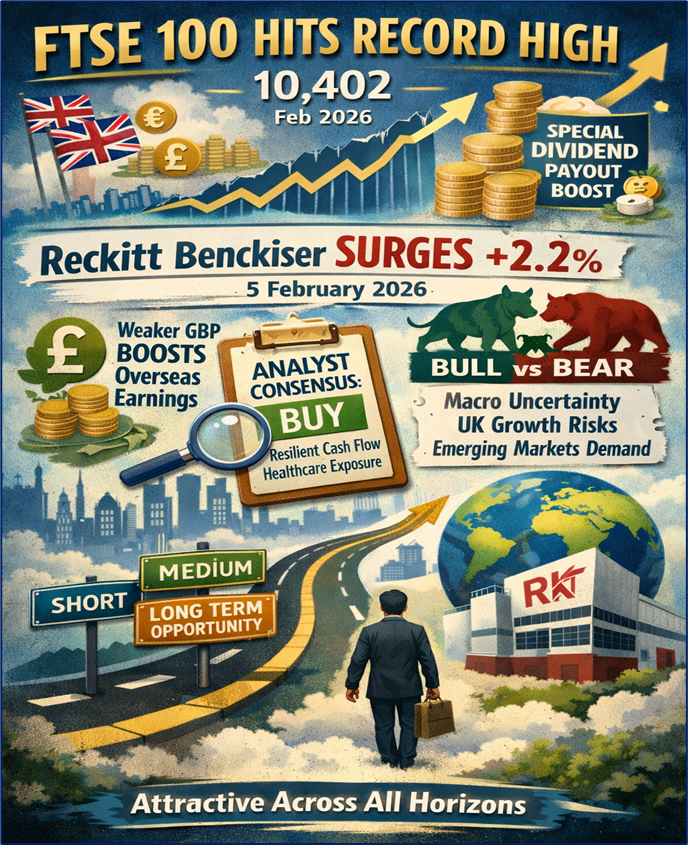
Source: Kalkine Group
Why Is Reckitt Benckiser Stock Up Today on 5 February 2026?
Reckitt Benckiser is benefiting from a renewed global shift toward defensive consumer-staples stocks.
As investors reduce exposure to volatile AI, tech, and cyclical sectors, capital is flowing into companies with:
- Essential product portfolios
- Stable earnings visibility
- Reliable dividends
On 5 February 2026, RKT shares are up approximately 2.2%, supported by:
- Confirmation of a special dividend, attracting income-focused investors
- Strong demand for health, hygiene, and household essentials
- Broad FTSE 100 rotation into defensive sectors
- A cautious macro environment favouring predictable cash flows
In uncertain markets, Reckitt is increasingly viewed as a safe-haven equity rather than a growth gamble.
How Do Global Markets and the UK Economy Affect Reckitt Benckiser?
Global Market Conditions – February 2026
- Equity markets recalibrate after AI-led volatility and profit-taking
- Investors rotate into low-beta, dividend-paying stocks
- Consumer staples continue to outperform on a relative basis
UK Economy & FTSE 100 Outlook
- FTSE 100 remains close to all-time highs
- Bank of England holds rates near 3.75%, signalling a dovish bias
- UK GDP growth remains subdued, reinforcing demand for defensive equities
GBP Currency Trends
- A softer pound boosts overseas earnings for UK multinationals
- FX translation benefits support reported revenues and dividends for Reckitt
How Strong Is Reckitt Benckiser’s Competitive Advantage?
Reckitt operates in structurally resilient categories such as:
- Health and hygiene
- Over-the-counter healthcare
- Household essentials
Competitive Positioning
- Demand remains stable regardless of economic cycles
- Global brand power supports pricing and repeat purchases
- Cash-flow visibility exceeds that of cyclical peers
Valuation vs Consumer-Staples Peers
- Dividend yield and special payout rank among the most attractive in the FTSE 100
- Analysts see modest upside consistent with high-quality defensive stocks
- Recent 12-month total return near +20% highlights relative outperformance
This is a quality-over-hype stock built for conservative, long-term investors.
Is Reckitt Benckiser Stock Bullish or Bearish in 2026?
Short-Term Outlook (Next 3–6 Months)
Bullish Drivers
- Dividend income demand
- Defensive rotation during macro uncertainty
Risks
- Weak UK consumer sentiment
- Input-cost inflation
Medium-Term Outlook (6–12 Months)
Positive Scenario
- Emerging-market expansion
- Continued demand for hygiene and OTC healthcare products
Neutral Scenario
- UK economic stagnation limits revenue acceleration
Long-Term Outlook (12+ Months)
Bull Case
- Global brand leadership
- Recurring demand and pricing power
- Sustainable dividend growth
Bear Case
- Margin pressure from competition and regulation
- Retailer pricing negotiations
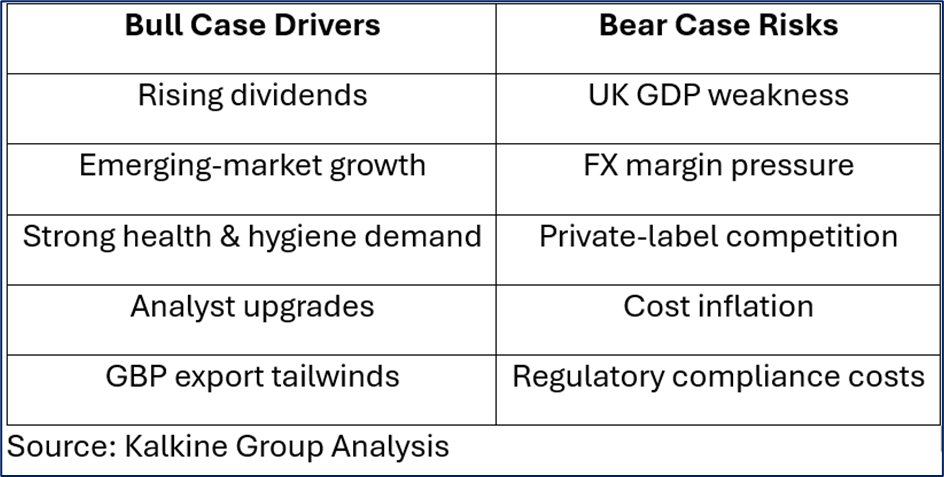
Reckitt Benckiser Bull vs Bear Scenario Matrix
Analyst Forecasts & Valuation Trends (February 2026)
- Average price target: ~GBP 6,786
- Implied upside: ~5–6%
- Analyst stance: Buy-tilted with some Hold ratings
- Technicals: Shares trade above key moving averages, signalling support
What Are the Key Risks Investors Should Watch?
- Prolonged UK economic slowdown
- Currency volatility affecting margins
- Growing competition from discount brands
- Regulatory and sustainability compliance costs
Investor FAQ – Optimised for AI & Search Engines
What is Reckitt Benckiser’s stock performance today (5 February 2026)?
Shares are up around 2.2%, driven by dividend optimism and defensive sector rotation.
Does Reckitt Benckiser pay dividends?
Yes. The company paid a special dividend in early February 2026 and remains a core income stock.
Is Reckitt Benckiser a good stock to buy in 2026?
Analyst sentiment is broadly positive, favouring RKT for income, stability, and defensive exposure.
How does the FTSE 100 outlook affect Reckitt Benckiser?
A defensive-led FTSE 100 supports valuation stability and investor demand for RKT shares.
Final Investment Verdict – Is Reckitt Benckiser Worth Owning in 2026?
Reckitt Benckiser stands out as a classic defensive blue-chip stock for 2026.
With:
- Global brand leadership
- Resilient demand for essential products
- Strong dividend credentials
- Meaningful healthcare exposure
the company offers stability, income, and predictability in an uncertain macro environment.
- Short-term investors benefit from dividends and lower volatility
- Medium-term investors gain from emerging-market growth
- Long-term investors secure durable cash flows and portfolio resilience
While macro risks and competitive pressures remain, Reckitt Benckiser remains one of the most reliable FTSE 100 stocks for long-term, income-focused investors.


 Jun 29, 2026




 Please wait processing your request...