
 AU
AU
 CA
CA
 US
US
 NZ
NZ
 IND
IND

 UK
UK

 Share
Share
 X (Formerly Twitter)
 Whatsapp
 Facebook
 LinkedIn
 Telegram
 Email This Article
 Copy Link
 Summarize with AI
 Chat GPT
 Perplexity
Schroders PLC jumped 29% on 12 February 2026. Is this FTSE 100 dividend stock now a top UK asset management recovery play?
Key Takeaways – February 2026 (Latest Update)
- Schroders shares surged approximately 29% on 12 February 2026, significantly outperforming the FTSE 100
• UK asset management sentiment strengthened amid moderating inflation and improving GBP stability
• Dividend yield remains competitive versus UK financial peers despite earnings cyclicality
• Broker sentiment improving as global equity markets rebound
• Short-term outlook constructive; long-term performance depends on sustained net inflows and margin resilience

Source: Kalkine Group
Has Schroders Become the Most Attractive FTSE 100 Dividend Growth Recovery Stock?
Schroders stock, FTSE 100 dividend stock, UK asset management recovery, undervalued financial shares, dividend yield UK, global AUM growth, passive vs active fund competition, GBP outlook, and UK stock market rebound are among the top trending financial search terms in February 2026. Following its 29% surge, Schroders has rapidly climbed into the spotlight as investors search for high-quality UK dividend stocks with recovery potential.
The sharp rally reflects improving macroeconomic conditions across the UK and Europe, renewed global equity market strength, stabilising bond markets, and enhanced investor risk appetite. As global equities recover, assets under management (AUM) naturally expand, increasing fee income for diversified asset managers such as Schroders. This creates operating leverage, where revenue growth outpaces cost growth, often leading to rapid share price re-ratings.
With UK GDP growth stabilising and inflation pressures easing compared to prior peaks, confidence in UK financials has strengthened. This broader improvement in macro sentiment has supported valuation recovery across the FTSE 100 and mid-cap segments.
What Catalysts Triggered Schroders’ 29% Share Price Surge on 12 February 2026?
Several key drivers appear to have fuelled the powerful upward move:
- Improved net inflow commentary in the latest company trading update (February 2026)
• Global equity market recovery lifting AUM valuations
• Stronger performance in private markets and wealth management divisions
• Continued focus on cost control and operational efficiency
• Positive broker revisions citing valuation re-rating potential
Asset management is inherently cyclical. As global equity indices rebound, AUM increases mechanically, boosting management fee revenues without proportionate cost expansion. This dynamic enhances profit margins during recovery phases and can trigger sharp stock price appreciation.
How Is the UK Economy Supporting Schroders’ Investment Case in 2026?
The UK macroeconomic environment in February 2026 shows encouraging stabilisation:
- Inflation moderating from multi-year highs
• GBP strengthening versus major currencies
• Gradual improvement in business and consumer confidence
• A resilient labour market backdrop
The Bank of England appears to be moving toward a more balanced monetary stance, reducing aggressive tightening risks. This shift supports equity valuations, improves capital market activity, and benefits financial services firms.
A more stable GBP also reduces currency volatility for internationally diversified asset managers like Schroders, improving earnings visibility.
Are the FTSE 100 and FTSE 250 Reinforcing the Recovery Narrative?
The FTSE 100 has demonstrated resilience, supported by financials, energy, and globally diversified revenue streams. Meanwhile, the FTSE 250 has begun showing early signs of domestic economic recovery.
Schroders’ surge aligns with renewed strength across UK financial stocks, suggesting the move is not isolated but part of a broader market re-rating.
Does Schroders’ Diversified Business Model Strengthen Its Competitive Position?
Schroders operates across multiple investment verticals:
- Global equities and fixed income
• Multi-asset strategies
• Private markets and alternatives
• Wealth management and advisory services
Revenue streams are primarily driven by AUM-linked management fees and performance-based incentives. Geographic diversification and institutional client relationships reduce reliance on any single market.
Recent strategic priorities highlighted by the company include:
- Expanding private asset capabilities
• Investing in digital wealth platforms
• Maintaining capital discipline
• Protecting dividend sustainability
Is Schroders’ Dividend Yield Still Attractive for Income Investors?
Schroders has historically maintained a reputation as a reliable dividend payer within the UK financial sector.
Dividend investment considerations include:
- Competitive yield relative to FTSE 100 financial peers
• Solid capital position
• Earnings sensitivity to market volatility
• Payout sustainability tied to AUM stability
In an improving market cycle, dividend coverage metrics typically strengthen.
How Does Schroders Compare to Other UK Asset Managers?
Relative to listed UK asset management peers:
- Valuation remains below historical cycle peaks
• Growth profile is steady rather than aggressive
• Brand recognition and institutional depth remain strengths
The recent rally narrows the valuation gap but may not fully reflect potential margin recovery if inflows persist.
What Are Analysts Saying About Schroders in February 2026?
Latest broker positioning reflects cautiously improving sentiment:
- UBS – Neutral stance; monitoring earnings trajectory (Feb 2026 Research)
• Barclays – Overweight; positive inflow momentum thesis
• JPMorgan – Neutral; watching margin sustainability
• Goldman Sachs – Buy; potential for further re-rating
Consensus suggests improving outlook but acknowledges sensitivity to global markets.
What Does a Bull vs Bear Scenario Matrix Reveal?
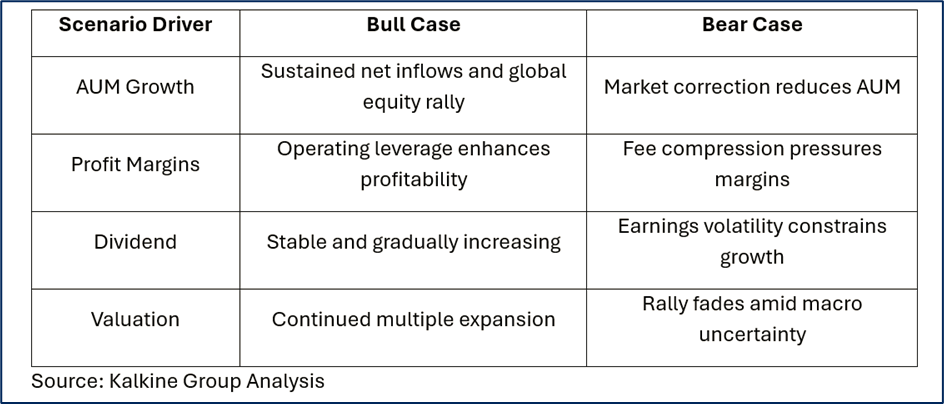
Is Schroders Bullish or Bearish in the Short and Long Term?
Short Term – Constructively Bullish
Momentum, improving macro data, and investor sentiment support upside bias.
Medium Term – Balanced
Dependent on sustained AUM growth and competitive positioning.
Long Term – Moderately Positive
Global wealth expansion, private asset demand, and institutional client base offer structural support, though passive fund competition remains a long-term industry challenge.
What Strategic Actions Can Investors Consider Across Time Horizons?
Short Term (3–6 Months)
- Participate in momentum with disciplined risk management
• Monitor global equity index trends
• Track quarterly AUM disclosures
Medium Term
- Consider phased accumulation during volatility
• Reinvest dividends strategically
• Evaluate margin trends and fee structures
Long Term
- Focus on dividend compounding
• Assess private markets growth strategy
• Monitor structural shifts in active vs passive asset flows
What Key Risks Should Investors Monitor?
- Global equity downturn
• Competitive fee compression
• Regulatory shifts in UK financial services
• Currency volatility
• Sustained passive investment migration
FAQ – Frequently Asked Investor Questions
Is Schroders undervalued in February 2026?
Valuation appears below prior cycle highs, but sustainability depends on AUM growth.
Why did Schroders shares surge 29%?
Improved inflow signals, macro stabilisation, and broker optimism.
Is Schroders highly sensitive to market cycles?
Yes. Revenue and profitability are closely linked to global equity performance.
Is the dividend secure?
Dividend visibility improves in stable or rising markets but remains cyclical.
Final Investment Verdict – Is Schroders a Compelling FTSE 100 Recovery Opportunity?
Schroders’ 29% surge in February 2026 signals renewed investor confidence in UK asset management stocks and broader FTSE 100 financial recovery themes. The short-term technical and sentiment picture appears constructive. However, long-term returns will depend on sustained inflows, margin protection, competitive positioning, and global market resilience.
For income-oriented investors seeking exposure to UK financial recovery, Schroders offers a balanced combination of dividend yield, global diversification, and cyclical upside potential—while still carrying inherent market sensitivity risks.


 Jun 29, 2026




 Please wait processing your request...