
 AU
AU
 CA
CA
 US
US
 NZ
NZ
 IND
IND

 UK
UK

 Share
Share
 X (Formerly Twitter)
 Whatsapp
 Facebook
 LinkedIn
 Telegram
 Email This Article
 Copy Link
 Summarize with AI
 Chat GPT
 Perplexity
Introduction and Overview of the FTSE All-World High Dividend Yield Index
The FTSE All-World High Dividend Yield Index is a globally recognised benchmark created by FTSE Russell, part of the London Stock Exchange Group. It is designed to reflect the performance of companies offering relatively higher dividend yields across developed and emerging markets.
This index plays a critical role in global investing by helping investors track income-generating equities while maintaining diversified exposure. It is widely used for benchmarking, portfolio construction, and as the foundation for passive investment products.
The index follows a transparent, rules-based methodology, ensuring consistency and ease of replication. It is particularly attractive for income-focused investors seeking stable dividend returns alongside global diversification.
History and Evolution of the FTSE All-World High Dividend Yield Index
Origins and Launch
The index was introduced to meet rising demand for income-focused strategies. Institutional investors required a reliable benchmark that could capture dividend-oriented opportunities globally.
Its development involved extensive consultation with asset managers and institutional stakeholders, ensuring practicality and robustness.
Key Milestones and Evolution
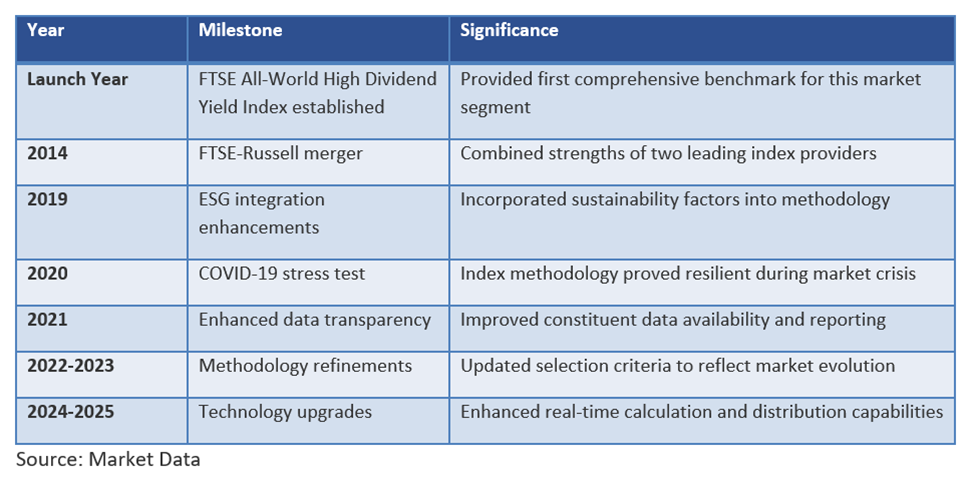
Over time, the index has evolved through methodology refinements, ESG integration, and technological upgrades. A major milestone was the 2014 merger of FTSE and Russell, enhancing global coverage and analytical capabilities.
The FTSE Russell Legacy
FTSE Russell has built a reputation for transparent and rules-driven index construction. The High Dividend Yield Index reflects these principles, ensuring reliability and widespread adoption.
Index Methodology and Construction of the FTSE All-World High Dividend Yield Index
Foundational Principles
The methodology underpinning the FTSE All-World High Dividend Yield Index is built upon several foundational principles that ensure the index accurately reflects the investment opportunity set it is designed to capture. These principles include transparency, where all methodology rules are publicly available and consistently applied; investability, where the index only includes securities that can be practically acquired by institutional investors; and representativeness, where the index composition faithfully reflects the characteristics of the underlying market or segment it is designed to measure.
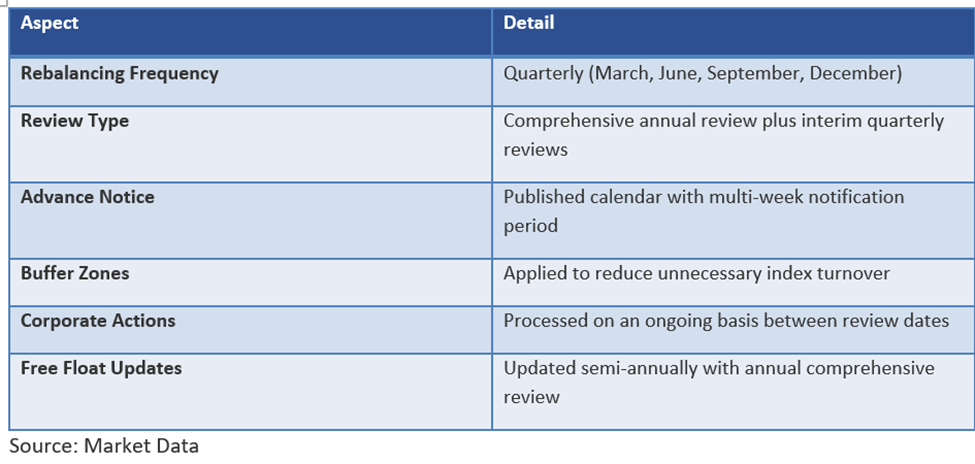
The index uses a dividend yield-based selection methodology combined with quality screens to ensure dividend sustainability. The weighting methodology is based on free float market capitalisation, and the index is rebalanced semi-annually to update the constituent list based on current dividend yield rankings. The methodology is documented in the FTSE Russell Ground Rules, which serve as the definitive reference for all aspects of index construction and maintenance. These ground rules are updated periodically to reflect methodology changes, and all updates are subject to a formal consultation process that allows stakeholders to provide feedback before changes are implemented.
A critical aspect of the FTSE All-World High Dividend Yield Index methodology is its rules-based approach. Unlike discretionary indices, where constituent selection and weighting may be influenced by subjective judgement, the FTSE All-World High Dividend Yield Index follows a set of predetermined rules that are applied consistently at each review point. This rules-based approach eliminates the potential for bias in index construction and ensures that the index can be replicated by market participants, which is essential for the creation of passive investment products.
Eligibility Universe
The starting point for the construction of the FTSE All-World High Dividend Yield Index is the definition of the eligible universe of securities. This universe encompasses all securities that meet the basic criteria for inclusion, including listing requirements, market capitalisation thresholds, and liquidity standards. The eligible universe for the FTSE All-World High Dividend Yield Index is derived from the FTSE Global Equity Index Series (FTSE GEIS), which provides comprehensive coverage of equity markets worldwide and serves as the foundational framework for many FTSE Russell indices.
Securities must meet several requirements to be included in the eligible universe. These typically include being listed on a recognised stock exchange in the relevant market, meeting minimum free float requirements to ensure that a sufficient portion of the company's shares are available for trading, and meeting minimum liquidity standards to ensure that the securities can be bought and sold without excessive market impact. The specific thresholds for these criteria are calibrated to the characteristics of the market or segment that the FTSE All-World High Dividend Yield Index is designed to capture.
The eligible universe is reviewed on a regular basis to account for new listings, delistings, corporate actions, and changes in market conditions. This ongoing maintenance ensures that the FTSE All-World High Dividend Yield Index continues to accurately reflect the current state of the market and includes all securities that meet the eligibility criteria. The process is managed by FTSE Russell's dedicated index management team, which applies the published methodology rules consistently and without discretion.
Free Float Methodology
The FTSE All-World High Dividend Yield Index employs a free float methodology for determining the weight of each constituent. Under this approach, each company's weight in the index is determined by its free float market capitalisation, which is calculated by multiplying the company's share price by the number of shares that are freely available for trading in the market. Shares that are held by strategic investors, government entities, or other locked-up holders are excluded from the free float calculation, as these shares are not available for purchase by general market participants.
The free float methodology is widely regarded as best practice in index construction, as it ensures that the index weights reflect the actual investment opportunity available to market participants. By excluding restricted shares from the weighting calculation, the FTSE All-World High Dividend Yield Index provides a more accurate measure of the investable market and reduces the potential for tracking error in index-replicating investment products. FTSE Russell applies its proprietary free float methodology, which classifies shareholdings based on publicly available ownership data and assigns each company a free float factor that is updated at regular intervals.
Constituent Selection and Screening for the FTSE All-World High Dividend Yield Index
Selection Criteria
Stocks are ranked by forecast dividend yield. Only those above a defined threshold are included, with additional checks to ensure dividend sustainability.
Screening and Exclusion Policies
The index may exclude companies based on governance or ESG concerns, depending on methodology updates and investor requirements.
Weighting and Rebalancing of the FTSE All-World High Dividend Yield Index
Weighting Methodology
The index uses free float market capitalisation weighting, giving larger companies more influence.
Rebalancing Schedule and Process
Rebalancing occurs quarterly, with ongoing adjustments for corporate actions. Advance notice helps minimise market disruption.
Composition and Sector Analysis of the FTSE All-World High Dividend Yield Index
Sector Breakdown
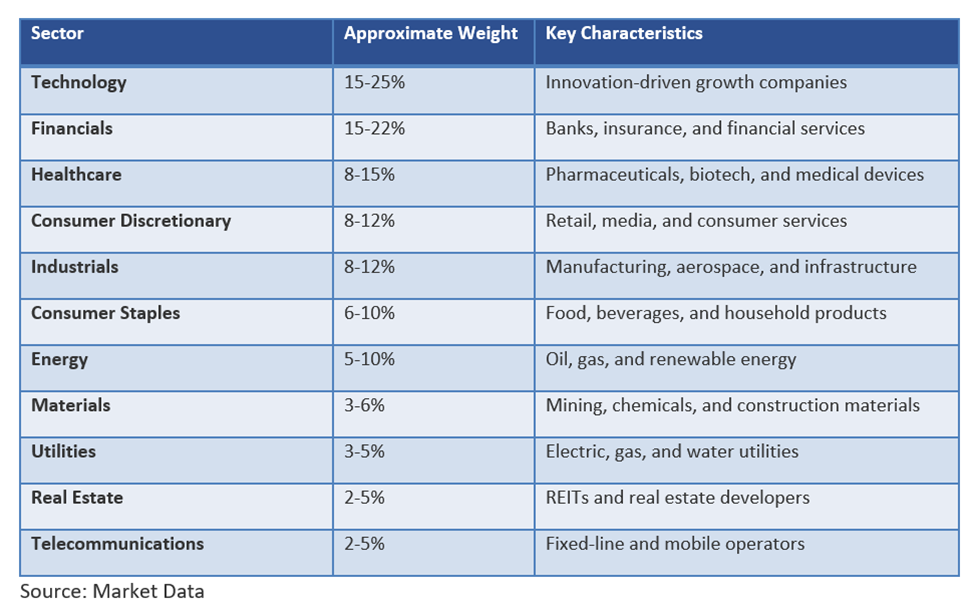
The index typically has higher exposure to sectors like financials, utilities, and consumer staples, which are known for stable dividend payouts.
Top Constituents Analysis
The largest constituents of the FTSE All-World High Dividend Yield Index typically represent some of the most significant companies in the global developed and emerging markets market by market capitalisation. These companies often have a disproportionate influence on the index's performance due to the market capitalisation weighting methodology. Understanding the concentration risk associated with the top constituents is important for investors who use the index as a benchmark or who invest in index-tracking products, as performance may be significantly influenced by the fortunes of a relatively small number of large companies.
The concentration of the FTSE All-World High Dividend Yield Index in its top constituents varies over time based on market conditions and the relative performance of large-cap versus small-cap stocks. During periods when large-cap stocks outperform, the concentration tends to increase, while periods of small-cap outperformance generally lead to a more evenly distributed index. FTSE Russell monitors concentration levels and may implement capping rules or other mechanisms to manage excessive concentration where this is part of the index methodology.
Geographic Breakdown of the FTSE All-World High Dividend Yield Index
The index provides global exposure across developed and emerging markets. Geographic allocation reflects economic conditions, regulatory environments, and market accessibility.
Performance Analysis of the FTSE All-World High Dividend Yield Index
Historical Returns
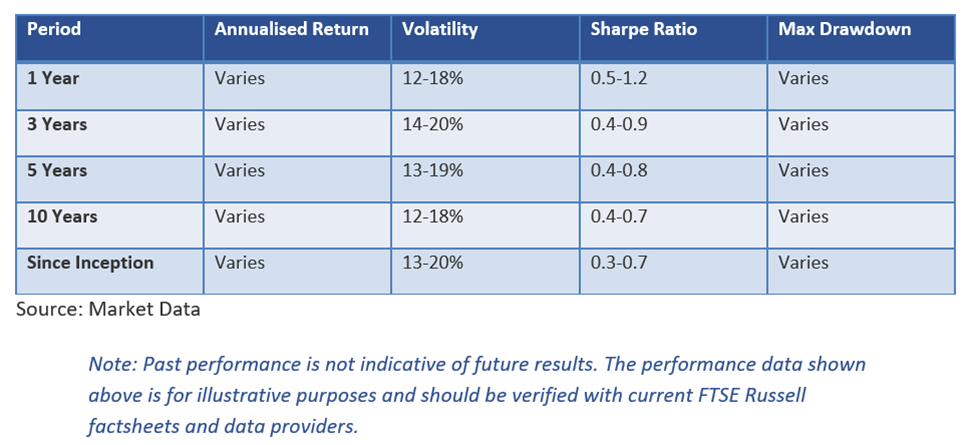
The historical performance of the FTSE All-World High Dividend Yield Index provides valuable insights into the return characteristics of the underlying market segment. Over the long term, the index has delivered returns that reflect the economic growth, corporate profitability, and market dynamics of global developed and emerging markets equity markets. Performance analysis is typically conducted using total return indices, which include both capital gains and dividend income, as well as price return indices that capture only capital appreciation.
It is important for investors to evaluate index performance over multiple time horizons to gain a comprehensive understanding of the return profile. Short-term performance can be heavily influenced by market sentiment, geopolitical events, and macroeconomic data releases, while long-term performance tends to reflect the fundamental growth trajectory of the underlying economy and corporate sector. The FTSE All-World High Dividend Yield Index has demonstrated different performance characteristics across various market environments, including periods of economic expansion, recession, and recovery.
Performance Attribution
Performance attribution analysis provides insights into the drivers of the FTSE All-World High Dividend Yield Index's returns over different time periods. This analysis can decompose total returns into contributions from different sectors, countries, or individual securities, helping investors understand why the index performed as it did. Attribution analysis is particularly valuable for active managers who are measured against the FTSE All-World High Dividend Yield Index, as it allows them to identify the sources of their outperformance or underperformance relative to the benchmark.
The sector contribution to the FTSE All-World High Dividend Yield Index's returns can vary significantly across different market environments. During technology-driven bull markets, the technology sector may contribute a disproportionate share of the index's total return, while defensive sectors such as healthcare and consumer staples may provide relative stability during market downturns. Understanding these dynamics is essential for investors who are using the FTSE All-World High Dividend Yield Index as the basis for factor tilts or sector rotation strategies.
Dividend Yield and Income Characteristics
For income-oriented investors, the dividend yield of the FTSE All-World High Dividend Yield Index is an important consideration. The index's dividend yield is determined by the collective dividend payments of its constituent companies, and it fluctuates based on changes in share prices and dividend policies. The dividend yield of the FTSE All-World High Dividend Yield Index can serve as a useful reference point for assessing the income potential of global developed and emerging markets equity markets relative to other asset classes and regions.
The total return version of the FTSE All-World High Dividend Yield Index incorporates dividend income, providing a more complete picture of investor returns than the price-only version. For tax-sensitive investors, a net total return version may also be available, which accounts for the withholding taxes that may be applied to dividend payments received by international investors. The choice between price, gross total return, and net total return versions depends on the investor's specific circumstances and objectives.
Risk and Volatility Assessment of the FTSE All-World High Dividend Yield Index
Volatility Profile
Volatility fluctuates with market conditions, increasing during crises and stabilising during growth periods.
Risk-Adjusted Performance Metrics
Metrics like Sharpe ratio help evaluate returns relative to risk.
Concentration and Liquidity Risk
Risks arise from large constituent weightings and varying liquidity across markets.
Comparison of the FTSE All-World High Dividend Yield Index with Peer Indices
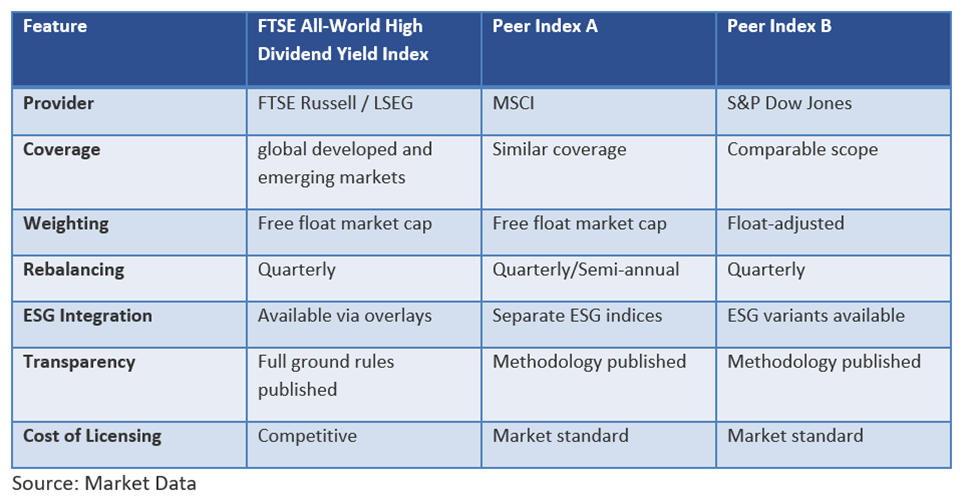
The index competes with benchmarks from MSCI and S&P. Differences lie in methodology, coverage, and ESG integration.
Investment Vehicles and Products Linked to the FTSE All-World High Dividend Yield Index
Exchange-Traded Funds (ETFs)
ETFs provide cost-efficient access with liquidity and transparency.
Index Mutual Funds
These offer an alternative for long-term investors with periodic contributions.
Derivatives and Structured Products
Used by institutional investors for hedging and advanced strategies.
Use Cases and Applications of the FTSE All-World High Dividend Yield Index
Portfolio Benchmarking
Widely used to measure performance of dividend-focused portfolios.
Asset Allocation
Serves as a building block for diversified portfolios.
Academic and Market Research
Used extensively for financial research and policy analysis.
ESG and Sustainability Considerations for the FTSE All-World High Dividend Yield Index
FTSE Russell offers ESG variants, enabling investors to align income strategies with sustainability goals. ESG integration continues to gain importance among institutional investors.
Market Impact and Global Significance of the FTSE All-World High Dividend Yield Index
The index influences capital allocation and market dynamics, especially during rebalancing events. It is widely adopted by global institutional investors.
Technical Specifications and Data Access for the FTSE All-World High Dividend Yield Index
Index Calculation
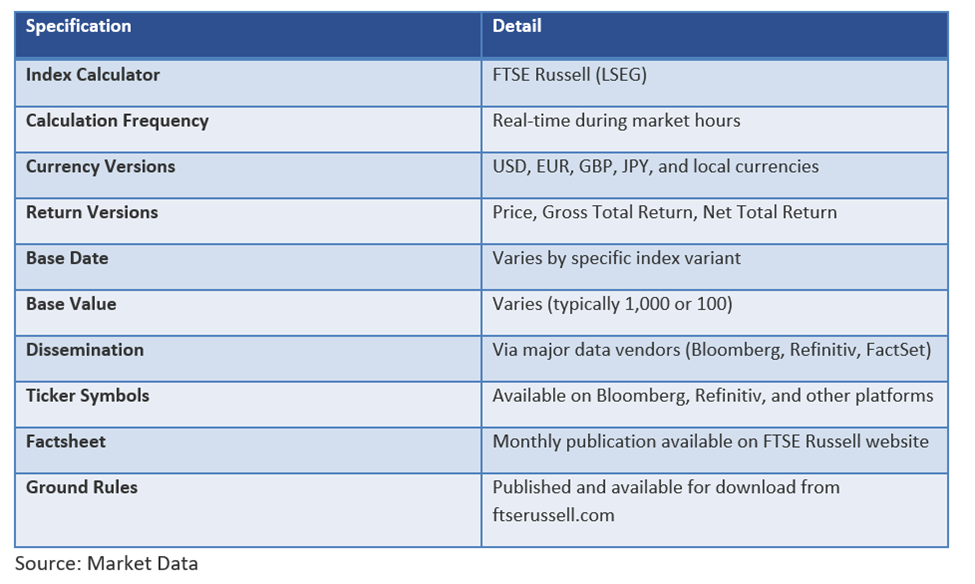
The FTSE All-World High Dividend Yield Index is calculated in real-time during market hours and is disseminated through a global network of data vendors and financial information platforms. The index is calculated using a modified Laspeyres formula, which measures the change in total market value of the index constituents relative to a base period. The calculation takes into account share prices, free float factors, and any corporate actions that may affect the index level, ensuring that the index accurately reflects the true performance of the underlying market.
FTSE Russell calculates multiple versions of the FTSE All-World High Dividend Yield Index to serve different user requirements. The price return version measures only capital appreciation, while the total return version incorporates both capital gains and gross dividend income. A net total return version, which accounts for withholding taxes on dividends, is also available for investors who need to measure after-tax returns. Each version is calculated in multiple currencies, allowing investors to assess performance in their local currency or in a common base currency for comparison purposes.
Data Access and Licensing
Access to data for the FTSE All-World High Dividend Yield Index is available through multiple channels, including FTSE Russell's own data delivery platforms and third-party data vendors such as Bloomberg, EODHD/Others, FactSet, and others. Institutional investors typically access index data through their existing data infrastructure, using standardised feeds that integrate with portfolio management and risk management systems. Retail investors and researchers can access summary-level data through the FTSE Russell website, which provides free factsheets, methodology documents, and performance charts for the FTSE All-World High Dividend Yield Index.
The use of index data for commercial purposes, such as the creation of investment products or the licensing of index names and trademarks, requires a formal licensing agreement with FTSE Russell. Licensing fees vary depending on the specific use case, the assets under management of the product, and the geographic scope of the distribution. FTSE Russell's licensing team works with product issuers to structure appropriate arrangements that align with the specific requirements of each product and market.
Regulatory and Compliance Considerations for the FTSE All-World High Dividend Yield Index
The index complies with global benchmark regulations, including EU BMR and IOSCO principles, ensuring transparency and governance.
Frequently Asked Questions About the FTSE All-World High Dividend Yield Index
What is the FTSE All-World High Dividend Yield Index?
It is a global benchmark tracking high dividend-paying stocks.
How often is it rebalanced?
Quarterly, with annual comprehensive reviews.
Can investors invest directly?
No, but exposure is available via ETFs and funds.
What is the difference between price and total return?
Price return excludes dividends, while total return includes them.
Is it ESG-compliant?
Standard index is not, but ESG variants are available.
Future Outlook and Emerging Trends for the FTSE All-World High Dividend Yield Index
Growth of Passive Investing
Demand for index-based strategies continues to rise globally.
Technology and Innovation
Advancements in analytics and AI are improving index construction.
Sustainability and Climate Transition
Climate-focused investing is shaping future index development.
Conclusion and Key Takeaways About the FTSE All-World High Dividend Yield Index
The index remains a cornerstone benchmark for dividend-focused investing. Its transparent methodology, global coverage, and adaptability make it highly relevant for modern portfolios.
Glossary of Key Terms
- Benchmark: Performance comparison standard
- Free Float: Tradable shares
- Market Cap: Total company value
- Rebalancing: Periodic adjustment
- ETF: Exchange-traded fund
- ESG: Sustainability criteria
References and Further Reading
- FTSE Russell methodology documents
- Financial data platforms
- Academic research on indices and investing


 Jun 08, 2026




 Please wait processing your request...