
 AU
AU
 CA
CA
 US
US
 NZ
NZ
 IND
IND

 UK
UK

 Share
Share
 X (Formerly Twitter)
 Whatsapp
 Facebook
 LinkedIn
 Telegram
 Email This Article
 Copy Link
 Summarize with AI
 Chat GPT
 Perplexity
Views Expressed Disclaimer:
You are reading a free article with opinions that may differ from the recommendation given by Kalkine in its paid research reports. Become a Kalkine member today to get access to our research reports, in-depth technical and fundamental research.
Alternative asset managers are gaining investor interest. See whether Intermediate Capital Group deserves a place in your portfolio.
Why Did FTSE 100 Intermediate Capital Group (ICG) Shares Fall 4.9% on 23 February 2026?
Key Takeaways — February 2026
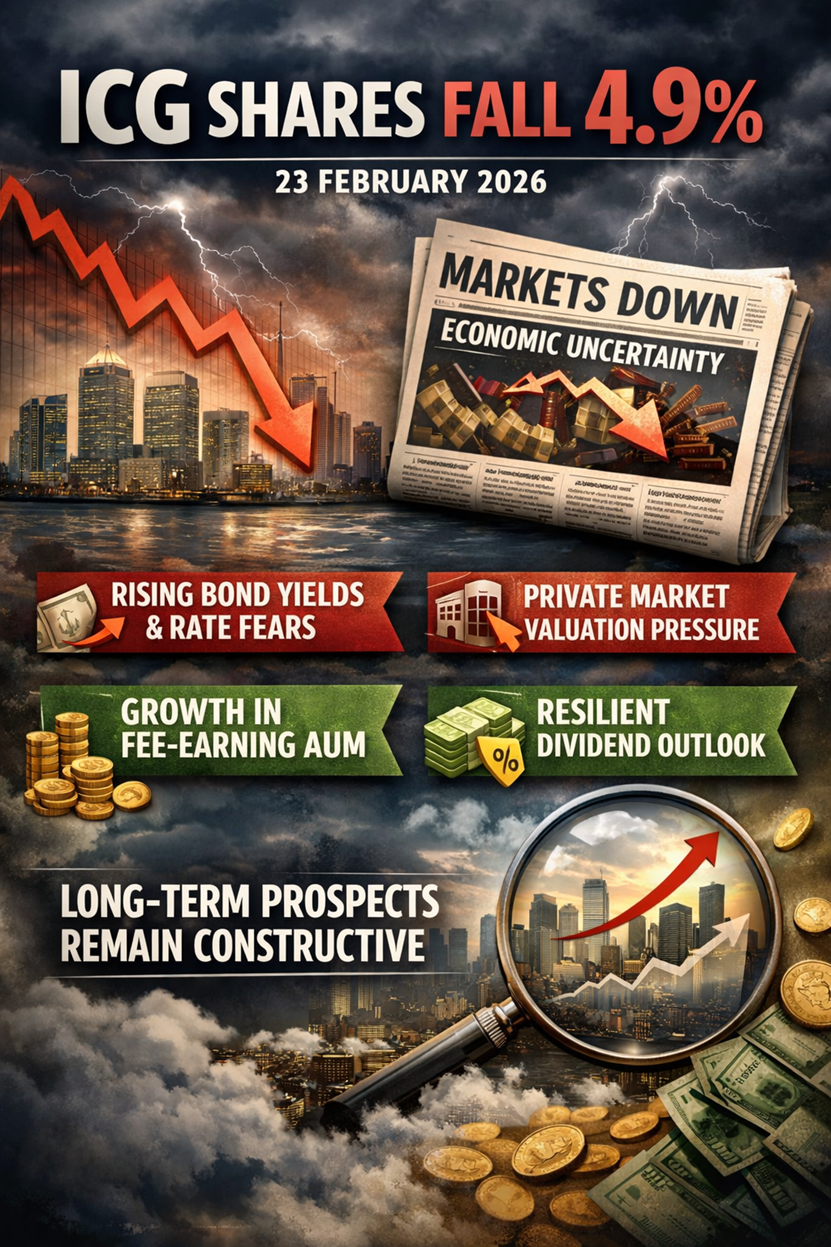
- Intermediate Capital Group (ICG) shares declined around 4.9% on 23 February 2026 amid broader financial sector weakness and macroeconomic uncertainty.
• Rising bond yields, interest rate expectations, and sentiment around private markets valuations pressured asset management stocks globally.
• Core fundamentals remain supported by growth in fee-earning assets under management (AUM) and recurring management fee income (company disclosures).
• Dividend outlook continues to appear resilient due to strong margins and cash generation.
• Analysts broadly remain constructive over the long term despite short-term volatility.
Source: Kalkine Group
Why Are Investors Searching for “ICG Share Price Forecast 2026”, “FTSE 100 Dividend Stocks”, and “Best UK Asset Manager Shares to Buy Now”?
The sudden share price drop has triggered strong search interest across financial media, retail investor forums, and social platforms, with trending keywords including FTSE 100 dividend stocks, Intermediate Capital Group outlook, ICG share price forecast 2026, UK asset management shares, private equity stocks UK, passive income stocks UK, and best dividend shares to buy now.
The decline appears primarily driven by macro sentiment rather than any major deterioration in company fundamentals. Investors are reassessing whether the fall represents a temporary valuation reset, sector rotation, or a potential buying opportunity.
Intermediate Capital Group remains widely viewed as a structural growth story due to its exposure to private credit markets, institutional capital inflows, alternative investments expansion, and long-term fee-earning AUM growth, which continue to expand globally.
How Are Global Market Dynamics Affecting Asset Management Stocks in February 2026?
Asset managers are highly sensitive to macroeconomic trends, particularly:
- Global interest rate expectations
• Bond yield movements and liquidity conditions
• Private equity exit environments
• Capital market activity and risk appetite
• Currency volatility and geopolitical sentiment
Higher interest rates can reduce valuation multiples and delay exits, affecting performance fees. However, they also increase demand for private credit financing, which represents a key structural opportunity for firms like ICG.
What Role Do the UK Economy, FTSE 100, FTSE 250, and GBP Play in the Share Price Movement?
UK Economic Environment
- Inflation is moderating but still above central bank targets
• Interest rates remain relatively restrictive in early 2026
• Economic growth expectations are modest
• Institutional capital allocation trends remain stable
FTSE 100 Trends
- Financial stocks facing valuation compression
• Defensive dividend sectors attracting investors
• Global earnings exposure supporting multinational firms
FTSE 250 Sentiment
- Domestic economic concerns affecting mid-caps
• Private equity-linked stocks experiencing volatility
GBP Currency Dynamics
- Sterling strength or weakness impacts global revenue translation
• Currency fluctuations influence investor positioning
Because ICG operates globally, macro and currency factors significantly influence investor sentiment.
What Is Intermediate Capital Group’s Business Model and Competitive Advantage?
ICG operates as a global alternative asset manager focusing on:
- Private debt and direct lending strategies
• Structured capital solutions
• Private equity investments
• Infrastructure and real assets
• Secondaries and capital solutions
Revenue is generated through recurring management fees, performance fees linked to investment outcomes, and investment income from its balance sheet.
The long-term growth strategy centres on expanding fee-earning AUM, which provides earnings visibility and scalability (company reports).
What Are the Latest Financial and Dividend Signals?
Recent company disclosures indicate:
- Continued growth in fee-earning AUM
• Stable trajectory in management fee income
• Performance fees dependent on investment exit timing
• Strong operating margins relative to traditional asset managers
ICG has historically maintained progressive dividend growth supported by earnings expansion and disciplined capital allocation.
How Does ICG Compare With Global Peers?
Strengths
- High margins compared with traditional asset managers
• Strong positioning in private credit markets
• Diversified investment platform
• Attractive return on equity metrics
Challenges
- Smaller scale compared with major US alternative asset managers
• Performance fee variability
• Sensitivity to fundraising cycles
Despite competition, ICG maintains a strong niche position within alternative assets.
What Is the Sector Outlook for Alternative Asset Managers?
Short-Term Outlook
- Market volatility linked to interest rate expectations
• Fundraising pace uncertainty
• Investor sentiment swings
Medium-Term Outlook
- Increasing institutional allocations to private markets
• Strong demand for private credit financing
• Banks retreating from certain lending segments
Long-Term Outlook
- Structural expansion of global alternative assets industry
• Pension funds increasing exposure to private markets
• Infrastructure financing demand globally
The long-term growth trajectory remains favourable.
Is ICG Stock Bullish, Bearish, or Neutral?
Short-Term View — Neutral to Slightly Bearish
Drivers include interest rate uncertainty, sector rotation, and profit-taking after prior gains.
Long-Term View — Bullish
Drivers include recurring fee growth, structural expansion in private markets, institutional demand, and management execution track record.
This divergence between short-term volatility and long-term growth is typical for asset management stocks.
What Strategies Could Investors Consider Across Time Horizons?
Short Term (3–6 Months)
- Monitor central bank policy signals
• Watch fundraising announcements and earnings updates
• Consider phased entry strategies during volatility
Medium Term (1–3 Years)
- Focus on AUM growth trajectory
• Evaluate margin stability and earnings mix
• Assess dividend growth sustainability
Long Term (3–10 Years)
- Benefit from compounding fee income growth
• Dividend reinvestment opportunities
• Exposure to alternative assets megatrend
What Are the Bull and Bear Case Scenarios?
Bull Case
- Strong fundraising momentum
• Interest rate stabilisation or cuts
• Private credit demand surge
• Earnings growth acceleration
Base Case
- Moderate AUM growth
• Stable margins and dividends
• Gradual share price appreciation
Bear Case
- Prolonged high interest rates
• Weak private equity exits
• Fundraising slowdown
• Valuation compression
What Do Analysts Currently Expect?
Broker consensus sentiment remains generally constructive, with several analysts maintaining positive ratings based on AUM growth potential and long-term structural opportunities. Valuation estimates suggest potential upside over the medium term, although forecasts vary depending on macroeconomic assumptions.
Dividend growth expectations also remain favourable based on current earnings trends.
What Key Risks Should Investors Monitor?
- Interest rate volatility
• Private market liquidity risks
• Fundraising environment deterioration
• Currency fluctuations
• Regulatory changes
• Market downturn affecting performance fees
Understanding cyclical risks is essential when investing in asset managers.
Could Dividends Continue Growing?
Dividend sustainability depends primarily on growth in fee-earning AUM, stable management fee income, and cash generation from investments. ICG’s diversified revenue streams provide relative resilience compared with more cyclical asset management models.
What Catalysts Could Drive a Share Price Recovery?
Potential positive drivers include:
- Interest rate stabilisation or reductions
• Strong fundraising updates
• Large performance fee realisations
• Positive earnings surprises
• Improved global investor sentiment
These catalysts could significantly influence valuation.
What Is the Final Investment Perspective for Investors?
Intermediate Capital Group remains a high-quality FTSE 100 alternative asset manager with exposure to long-term structural growth trends, particularly private credit and institutional investment demand.
The February 2026 share price decline appears primarily linked to macroeconomic sentiment and sector movements rather than deterioration in core fundamentals.
For investors seeking dividend growth potential, exposure to alternative assets, and long-term compounding opportunities, ICG may continue to represent an attractive consideration, although short-term volatility should be expected given the macroeconomic environment.


 Jun 29, 2026




 Please wait processing your request...