
 AU
AU
 CA
CA
 US
US
 NZ
NZ
 IND
IND

 UK
UK

 Share
Share
 X (Formerly Twitter)
 Whatsapp
 Facebook
 LinkedIn
 Telegram
 Email This Article
 Copy Link
 Summarize with AI
 Chat GPT
 Perplexity
Key Takeaways (Latest: February 2026)
- Tullow Oil shares surged ~6.5% on 10 February 2026, decisively beating the wider UK equity market
- The rally reflects higher Brent crude prices, improving risk appetite, and short covering across UK-listed energy stocks
- No dividend is paid, with management firmly focused on debt reduction, free cash flow resilience, and balance-sheet repair
- The stock remains high-beta, cyclical, and sentiment-driven, best suited to risk-tolerant investors and traders
- Short-term momentum is constructive, while long-term returns depend on oil prices, deleveraging progress, and African asset performance

Source: Kalkine Group
Why Did Tullow Oil Stock Jump 6.5% on 10 February 2026?
Tullow Oil shares rallied sharply as Brent crude prices stayed elevated and global investors rotated back into cyclical and value stocks. In early 2026, oil markets are being supported by OPEC+ supply discipline, resilient Asian demand, and ongoing geopolitical risk premia—a powerful combination for leveraged upstream producers.
At the same time, renewed inflows into UK mid-cap energy names have amplified moves in stocks with high operational leverage. Tullow Oil, long viewed as a turnaround play, has become a prime short-term beneficiary of this shift in sentiment.
How Do Oil Prices and Global Markets Influence Tullow Oil in 2026?
The macro backdrop in 2026 is increasingly favourable for commodity-linked equities. Cooling inflation and easing interest-rate expectations are encouraging selective risk-taking, while firm oil prices directly lift Tullow’s cash generation per barrel.
Given Tullow’s concentrated West African offshore portfolio, even modest improvements in crude prices can materially boost free cash flow—magnifying equity upside in rallies and downside during pullbacks.
What Is the UK Economy and FTSE Backdrop for Energy Stocks Right Now?
The UK economy in February 2026 remains slow-growing but stable, with easing financial conditions providing incremental support. Commodity exposure has helped the FTSE indices stabilise, while the FTSE 250 has begun to recover as risk appetite improves.
Energy stocks are benefiting from:
- A softer but stabilising GBP, enhancing USD-denominated revenues
- Improved global growth visibility
- Renewed interest in UK value and turnaround opportunities
This mix is particularly supportive for oil-exposed names like Tullow Oil in the near term.
How Does GBP Currency Movement Affect Tullow Oil Shares?
Tullow Oil earns and reports primarily in US dollars, while its shares trade in sterling. When the pound weakens, reported revenues and cash flows translate higher in GBP terms. In February 2026, currency volatility has added an extra tailwind to UK-listed oil producers, reinforcing share price momentum.
What Is Tullow Oil’s Business Model and Strategy Today?
Tullow Oil is a pure-play upstream producer, centred on Ghana’s Jubilee and TEN fields, with selective asset disposals across the rest of Africa. Its current strategy is deliberately conservative, focusing on:
- Maximising production efficiency
- Accelerating net debt reduction
- Extending asset life through disciplined capex
- Avoiding high-risk expansion
Management has repeatedly prioritised cash discipline over growth, reflecting hard lessons from previous commodity cycles.
Does Tullow Oil Pay a Dividend in 2026?
No. Tullow Oil does not pay a dividend in 2026, and there is no near-term guidance suggesting reinstatement. Available cash flow is being channelled into:
- Debt repayment
- Lower interest costs
- Strengthening liquidity buffers
A future dividend remains conditional on sustained oil prices, lower leverage, and stable production, positioning Tullow firmly as a capital appreciation story rather than an income stock.
How Does Tullow Oil Compare with UK Energy Peers?
Relative to integrated majors and diversified independents, Tullow Oil stands out for its:
- High sensitivity to oil prices
- Smaller, more concentrated asset base
- Greater upside in bullish oil markets
- Sharper downside during commodity sell-offs
This profile makes the stock attractive for tactical traders and momentum investors, but less suitable for conservative, income-focused portfolios.
Is the Outlook Bullish or Cautious Across Time Horizons?
Short term (3–6 months):
Momentum is bullish, supported by oil prices, technical factors, and improving sentiment.
Medium term (6–24 months):
The outlook is balanced, hinging on operational delivery, production stability, and continued deleveraging.
Long term (3+ years):
The view remains speculative, as energy transition pressures and asset concentration create structural uncertainty.
What Strategies Can Investors Consider in 2026?
- Short-term traders: Track oil price trends, momentum indicators, and earnings catalysts
- Medium-term investors: Look for confirmation of debt reduction milestones and operational consistency
- Long-term investors: Size positions conservatively and monitor ESG, geopolitical, and transition risks closely
Is Tullow Oil Bullish, Bearish, or Neutral Right Now?
- Short term: Bullish sentiment dominates
- Long term: Neutral-to-cautious due to volatility and structural challenges
This reflects an analytical market view, not investment advice.
What Are the Main Drivers Behind the February 2026 Rally?
- Rising Brent crude prices
- Improved risk appetite for UK energy stocks
- Continued balance-sheet repair narrative
- Short covering and trading-driven inflows
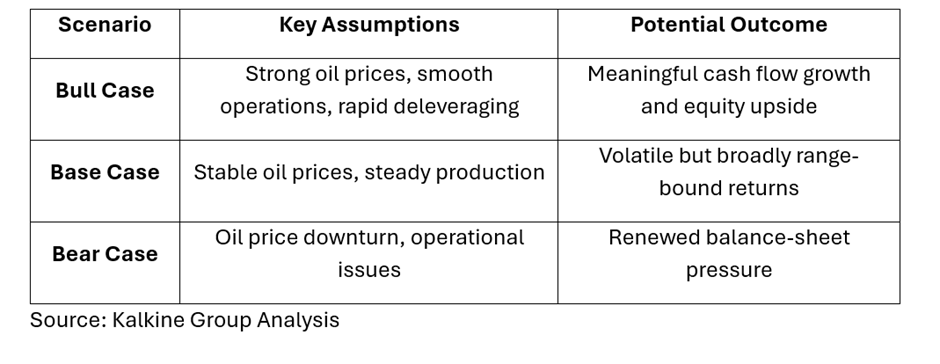
Bull, Base, and Bear Case Scenarios
What Are Analysts Saying About Valuation?
Broker commentary from firms including Jefferies, Shore Capital, Peel Hunt, and JPMorgan highlights wide valuation ranges, reflecting uncertainty. Consensus views typically point to:
- Significant upside in favourable oil markets
- Elevated downside risk if macro or oil conditions weaken
Price targets vary substantially, underscoring Tullow’s speculative, high-torque profile.
Key Risks Investors Should Monitor
- Oil price volatility
- Concentrated African asset exposure
- Geopolitical risk
- Energy transition and ESG pressures
- Refinancing and interest-rate sensitivity
Final Verdict: Is Tullow Oil Worth Watching in February 2026?
Tullow Oil’s 6.5% jump on 10 February 2026 shows how quickly sentiment can turn in high-beta energy stocks. For traders and speculative investors, it offers powerful leverage to oil prices and macro momentum. For long-term investors, it remains a high-risk turnaround story that demands discipline, patience, and careful position sizing.


 Jun 29, 2026




 Please wait processing your request...