
 AU
AU
 CA
CA
 US
US
 NZ
NZ
 IND
IND

 UK
UK

 Share
Share
 X (Formerly Twitter)
 Whatsapp
 Facebook
 LinkedIn
 Telegram
 Email This Article
 Copy Link
 Summarize with AI
 Chat GPT
 Perplexity
The global financial landscape is navigating a "higher bar" for execution. While the FTSE 100 has recently breached the historic 10,000 mark, volatility remains elevated due to geopolitical realignments in South America, shifts in US trade policy under the Trump administration, and a cooling of the initial AI euphoria.
In this environment, "Smart Money" has pivoted toward high-quality defensive stalwarts that offer earnings visibility and robust balance sheets. Below are the top 3 defensive FTSE 100 stocks as of today.
Source: Kalkine Group
1. AstraZeneca PLC (AZN)
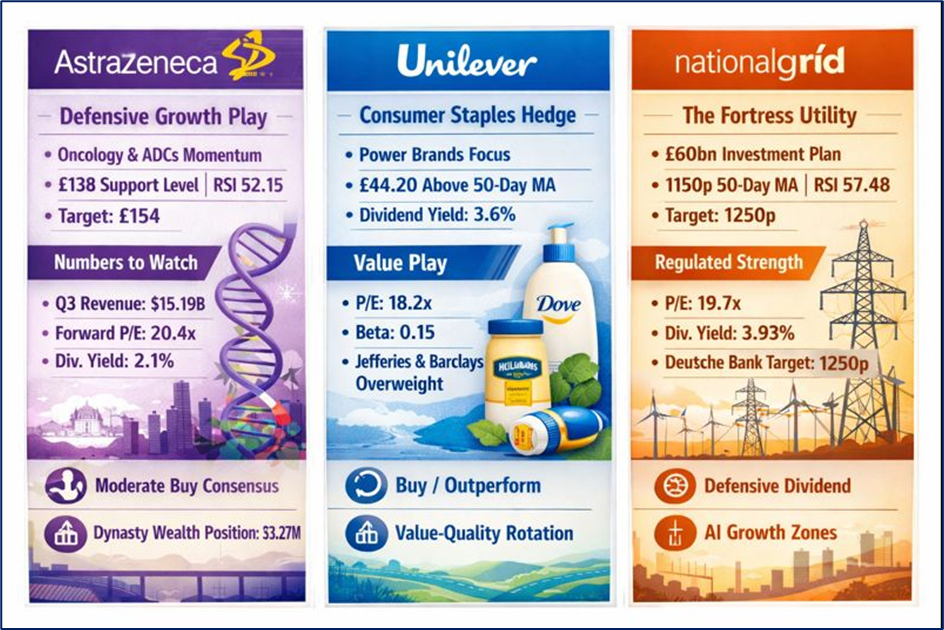
Latest Drivers & Key Reasons: AstraZeneca remains the premier defensive growth play in the UK. As of today, the primary driver is the market’s premium valuation of its Oncology franchise, specifically the continued label expansion of Imfinzi and the rapid adoption of its antibody-drug conjugates (ADCs) like Enhertu. Unlike cyclical sectors, healthcare demand is largely decoupled from GDP fluctuations, making AZN a "safe haven" during the current January market jitters.
Technical Analysis: Technically, AstraZeneca is trading near its all-time highs, supported by a strong 200-day moving average of £122.19. As of today, the RSI (Relative Strength Index) sits at 52.15, suggesting a neutral, healthy consolidation phase rather than an overbought state. The stock has successfully tested support at the £138 level this week. While the MACD is slightly negative in the short term, the long-term trendline remains bullish, with analysts eyeing a breakout toward the £154 median target.
Analyst Sentiment & Smart Money Coverage
- Recent Activity: Dynasty Wealth Management established a new $3.27M position as of today’s filings.
- Upgrades: Institutional ownership has ticked up to 20.35%, with major increases from Fisher Asset Management and Franklin Resources.
Business Model & Financials: AZN operates a global biopharmaceutical model focused on Oncology, Rare Diseases, and BioPharmaceuticals.
- Latest Operational Update: Q3 revenue hit $15.19bn (up 19.8% YoY).
- Valuation: Forward P/E of 20.4x, which reflects a premium but is supported by a PEG ratio of 1.6, notably lower than the sector average.
- Dividends: Current yield is approx 2.1%, with a 2026 forecast payout of $3.24, a 5.3% increase over 2025.
Outlook & Risks
- Guidance: Management expects high single-digit to low double-digit growth through 2026.
- Risks: Drug pipeline setbacks, clinical trial failures, and potential US pricing regulations.
2. Unilever PLC (ULVR)
Latest Drivers & Key Reasons: Unilever is the quintessential "Consumer Staples" defensive bet. Today’s sentiment is driven by the company’s pricing power in an environment where food inflation has re-accelerated to 3.3%. By shedding non-core assets and focusing on its "Power Brands" (Dove, Hellmann’s), Unilever has improved its operating margins. Global fund managers favor ULVR today as a hedge against a potential US labor market softening.
Technical Analysis: Unilever exhibits a classic defensive "low-beta" profile. The stock is currently trading above its 50-day moving average of £44.20. It has faced resistance at the £48 mark, but today's volume indicates steady accumulation by pension funds. With a beta of 0.15, it is significantly less volatile than the broader FTSE 100, providing a "cushion" during the current 10,200-level resistance in the index.
Analyst Sentiment & Smart Money Coverage
- Brokers: Jefferies and Barclays have recently reiterated overweight ratings, citing the "GAP" (Growth Action Plan) efficiency gains.
- Hedge Funds: Increased positioning in "Value-Quality" names has benefited Unilever as a rotation play out of expensive US Tech.
Business Model & Financials: Unilever’s model relies on a massive global footprint (190+ countries) across Personal Care, Home Care, and Nutrition.
- Latest Operational Update: Maintained a healthy dividend payout of 101% of earnings, emphasizing shareholder returns.
- Valuation: Trading at a P/E of 18.2x, which is historically attractive compared to its 5-year average.
- Dividends: Quarterly payout of £0.3928 ($0.5258 for ADRs), yielding approximately 3.6%.
Outlook & Risks
- Guidance: Continued margin expansion and 3-5% underlying sales growth for 2026.
- Risks: Sharp decline in emerging market currencies and rising raw material costs (cocoa/palm oil).
3. National Grid PLC (NG.)
Latest Drivers & Key Reasons: National Grid is the "Fortress" stock of 2026. Its status as a regulated utility makes it an essential holding during volatility. Today’s specific driver is the massive £60bn five-year investment plan to support the UK's AI Growth Zones and the energy transition. As a "bond proxy," it becomes increasingly attractive if the Bank of England maintains a dovish tilt during market turbulence.
Technical Analysis: National Grid is currently trading at the upper end of its 52-week range (919p - 1201p). The 50-day moving average sits at 1150.97p, providing a strong technical floor. An RSI of 57.48 today confirms steady upward momentum without being overextended. The MACD signal line of 9.14 supports a neutral-to-bullish technical position, favored by low-volatility algorithmic traders.
Analyst Sentiment & Smart Money Coverage
- Investment Banks: Deutsche Bank recently raised its target to 1250p.
- Smart Money: Infrastructure funds have been increasing weightings as the company secures supply chains for its RIIO-T3 regulatory period.
Business Model & Financials: National Grid owns and operates electricity and gas transmission networks in the UK and US.
- Latest Operational Update: Underlying EPS for H1 2026 grew by 6%, showing resilience against inflation.
- Valuation: P/E of 19.7x. While it appears high, it reflects the "Quality Premium" investors are paying for regulated cash flows.
- Dividends: Current yield is 3.93%, supported by a payout ratio of 78.26%.
Outlook & Risks
- Guidance: Underlying EPS CAGR of 6-8% through 2029.
- Risks: High debt-to-equity ratio (157%) and potential regulatory changes to allowed returns in the next price control period.
Conclusion
As of today, January 20, 2026, the FTSE 100’s stability at the 10,000+ level is largely anchored by its defensive heavyweights. AstraZeneca provides the growth engine through medical innovation; Unilever offers a global inflation hedge with essential brands; and National Grid acts as the portfolio's bedrock with regulated, predictable income. Global fund managers are increasingly looking toward these "quality-value" plays as the US market faces higher hurdles for AI-driven growth.


 Jun 03, 2026




 Please wait processing your request...