
 AU
AU
 CA
CA
 US
US
 NZ
NZ
 IND
IND

 UK
UK

 Share
Share
 X (Formerly Twitter)
 Whatsapp
 Facebook
 LinkedIn
 Telegram
 Email This Article
 Copy Link
 Summarize with AI
 Chat GPT
 Perplexity
What Is the L100 ETF?
The Amundi Core FTSE 100 Swap UCITS ETF (L100) is a low-cost, swap-based exchange-traded fund listed on the London Stock Exchange, offering investors efficient exposure to the FTSE 100 Index — the benchmark of the UK's 100 largest listed companies by market capitalisation. Managed by Amundi, Europe's largest asset manager by assets under management, L100 is a strong competitor in the crowded FTSE 100 ETF space, often distinguished by its highly competitive pricing and synthetic replication methodology.
Trading at GBX 1,949.80 with a daily gain of +0.48% on closing of 26 February2026, L100 is tracking closely alongside peer FTSE 100 ETFs, reflecting positive UK equity market sentiment on the day.
L100 ETF Key Facts and Specifications
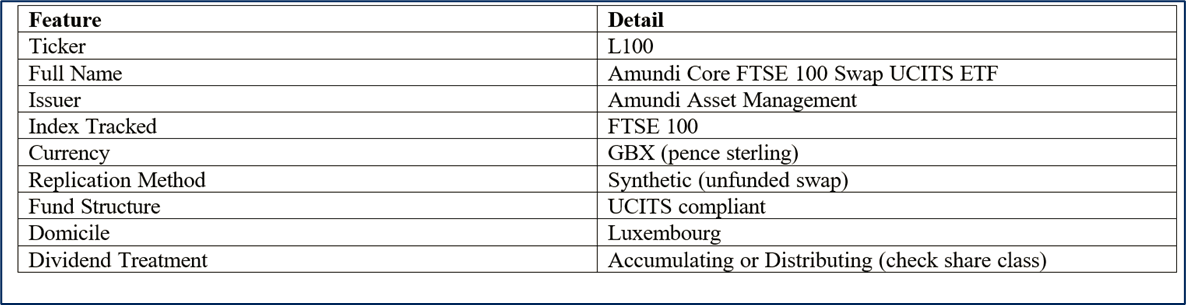
Source: Market Data
Amundi: Europe's Largest Asset Manager
Before diving deeper into L100's structure, it's worth understanding the organisation behind it. Amundi was
formed from the merger of the asset management divisions of Crédit Agricole and Société Générale and has grown to become the largest asset manager in Europe and one of the top ten globally by AUM. Amundi manages over €2 trillion in assets across passive and active strategies.
Amundi's scale gives it significant advantages in ETF management, including the ability to negotiate competitive swap terms with counterparties, pass cost savings to investors through low Ongoing Charges Figures (OCFs), and maintain robust compliance and operational infrastructure. For investors choosing between similarly structured FTSE 100 ETFs, Amundi's institutional credibility is a meaningful factor.
What Makes L100 Different: Synthetic (Swap-Based) Replication Explained
Unlike physical ETFs that directly hold the shares comprising the FTSE 100, L100 uses synthetic replication via an unfunded swap. This is a key distinction investors must understand:
How Swap-Based Replication Works
In a swap-based ETF, the fund does not hold the actual FTSE 100 shares. Instead, Amundi enters into a total return swap agreement with one or more counterparties (typically large investment banks). Under this arrangement:
The ETF holds a substitute basket of securities (which may differ from the FTSE 100).
The swap counterparty agrees to pay the ETF the total return of the FTSE 100 index.
In exchange, the ETF pays the counterparty the return on the substitute basket.
Benefits of Synthetic Replication
Lower tracking error: Swap-based ETFs can theoretically deliver closer-to-perfect index replication because the return is contractually guaranteed by the counterparty.
Cost efficiency: Swaps can be cheaper to execute than purchasing hundreds of individual stocks, which can translate into lower OCFs.
Tax efficiency: In some jurisdictions, synthetic ETFs can be more tax-efficient in handling dividend withholding taxes.
Risks of Synthetic Replication
Counterparty risk: If the swap counterparty defaults, the ETF may not receive the promised index return. UCITS regulations cap this risk at 10% of NAV, and in practice Amundi actively manages collateral to keep exposure well below this threshold.
Complexity: Some investors prefer the simplicity and transparency of physical ownership.
Collateral basket opacity: The substitute basket may contain securities unrelated to the FTSE 100, which some investors find counterintuitive.
For sophisticated investors comfortable with swap mechanics, these trade-offs are typically acceptable given
the cost and tracking advantages.
The FTSE 100: What L100 Is Designed to Track
The FTSE 100 represents approximately 80% of the total market capitalisation of the London Stock Exchange. Despite its UK listing, the majority of revenues generated by FTSE 100 constituents come from international operations, giving the index a naturally global character.
The index's heavy weighting toward energy, mining, financials, and consumer staples means it behaves differently from technology-heavy indices like the S&P 500 or NASDAQ. The FTSE 100 tends to be:
More value-oriented than growth-oriented
Higher yielding in dividend terms (historically 3–4% yield)
Sensitive to global commodity cycles given the weight of energy and materials companies
Inversely correlated with sterling in many periods, as a weaker pound boosts the sterling-translated value of foreign earnings
These characteristics mean L100 and all FTSE 100 ETFs behave as a distinct asset class from US or European equity ETFs, and play a specific role in a diversified portfolio.
L100 ETF Pricing: Understanding GBX 1,949.80
L100's current price of GBX 1,949.80 (approximately £19.50 per share) is notably higher than some peers like VUKE (£47.33 in GBP) or ISF (GBX 1,061). This reflects historical pricing decisions and NAV accumulation rather than any fundamental difference in the underlying exposure. All three ETFs track the same FTSE 100 index - the per-share price is simply a function of how many units have been issued relative to total AUM.
Investors should focus on the total cost of ownership (OCF + trading spread) and tracking difference
rather than the nominal share price when comparing FTSE 100 ETFs.
Cost Comparison: Is L100 the Cheapest FTSE 100 ETF?
Amundi has positioned L100 aggressively on cost. The ETF industry has seen relentless fee compression over the past decade, and Amundi has been at the forefront of this trend in Europe. Investors should check the current OCF directly with Amundi or via their brokerage platform, as fees are periodically adjusted.
When comparing costs, also consider:
- Trading spread: The bid-ask spread on the LSE can vary between ETFs depending on market-maker competition and liquidity.
- Tracking difference: The actual return differential between the ETF and the index over a year — sometimes more informative than the OCF alone.
Who Should Consider L100?
Cost-conscious passive investors looking for the lowest-cost FTSE 100 exposure will find L100 a compelling option alongside Vanguard's VUKE and iShares' ISF.
Accumulation-focused investors who prefer dividends to be automatically reinvested rather than distributed in cash — allowing compound growth without requiring action — should confirm whether the share class held is accumulating.
Sophisticated investors comfortable with synthetic replication mechanics who prioritise tracking precision and cost efficiency over physical ownership.
Institutional and professional investors who regularly use swap-based structures and are comfortable evaluating counterparty risk.
Key Risks
Counterparty risk from the swap structure, mitigated by UCITS regulations and active collateral management.
FTSE 100 concentration risk in energy, materials, and financials.
Currency risk for non-sterling investors.
Regulatory risk: Changes to UCITS rules or tax treatment of synthetic ETFs could impact the fund's structure or cost advantages.
How to Buy L100
L100 is accessible through major UK investment platforms including Hargreaves Lansdown, Interactive Investor, AJ Bell, Saxo, and most European brokers offering LSE-listed ETFs. It is eligible for inclusion in a Stocks and Shares ISA and SIPP.
Frequently Asked Questions: L100 ETF
What is the L100 ETF? L100 is the Amundi Core FTSE 100 Swap UCITS ETF, a synthetic ETF listed on the London Stock Exchange that tracks the FTSE 100 Index.
Is L100 a physical or synthetic ETF? L100 is a synthetic ETF using swap-based replication rather than directly holding FTSE 100 shares.
Who manages the L100 ETF? L100 is managed by Amundi Asset Management, Europe's largest asset manager.
What is L100's price today? As of February 27, 2026, L100 is trading at GBX 1,949.80, up 0.48% on the day.
Is L100 suitable for an ISA? Yes, L100 is a UCITS-compliant ETF eligible for inclusion in a UK Stocks and Shares ISA.
What is counterparty risk in L100? Counterparty risk refers to the possibility that the swap counterparty in L100's synthetic structure defaults. UCITS regulations limit this exposure to 10% of NAV, and Amundi actively manages collateral to minimise the risk.
This article is for informational and educational purposes only and does not constitute financial advice. Investing involves risk. Always consult a qualified financial adviser before making investment decisions.


 Jun 29, 2026




 Please wait processing your request...