
 AU
AU
 CA
CA
 US
US
 NZ
NZ
 IND
IND

 UK
UK

 Share
Share
 X (Formerly Twitter)
 Whatsapp
 Facebook
 LinkedIn
 Telegram
 Email This Article
 Copy Link
 Summarize with AI
 Chat GPT
 Perplexity
The final trading week of 2025 is starting with a bang for real estate investors. On December 29, 2025, Land Securities Group PLC (LSE: LAND) surged by over 7% (significantly outperforming the broader FTSE 100), reaching price levels near GBX 623.
While the "Santa Rally" is lifting some boats, Landsec’s move is powered by a fundamental shift in its business model and a series of high-conviction "insider buys" that have retail investors paying close attention.
The December 29 Catalyst: Why the Spike?
The 7% jump isn't just holiday spirit. Several specific drivers are coalescing:
Source: Kalkine Group
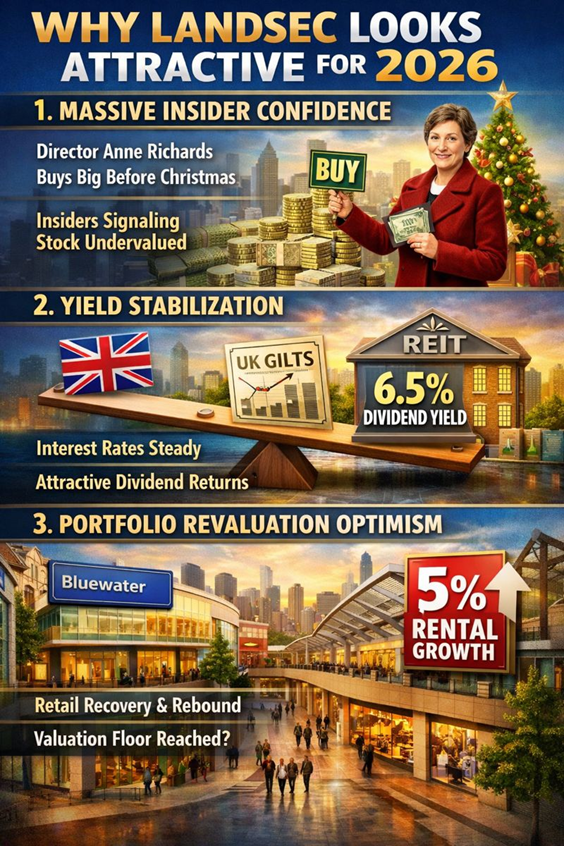
- Massive Insider Confidence: Just before the Christmas break, Non-Executive Director Anne Richards acquired shares worth nearly £100,000. This follows a pattern of insider buying throughout December, signaling to the market that those with the best view of the books see the stock as undervalued.
- Yield Stabilization: As we head into 2026, UK gilt yields have stabilized. For a REIT (Real Estate Investment Trust) like Landsec, lower volatility in interest rates makes their 6.5% dividend yield look incredibly attractive compared to cash.
- Portfolio Revaluation Optimism: Markets are front-running the 2026 recovery. With Landsec's retail portfolio (like Bluewater and Liverpool ONE) showing 5% rental growth, investors are betting that the "valuation floor" has finally been hit.
Latest Business Model: The "Fewer, Bigger, Better" Pivot
Landsec has shed its skin as a traditional "office landlord." The 2025 business model is built on three aggressive pillars:
- Retail Destinations: Moving away from high-street shops to "Mega-Malls." They recently invested £610m into Liverpool ONE and Bluewater, targeting an accretive 7.7% income yield.
- Central London Growth: Focusing exclusively on "Green" high-spec offices. They are disposing of £2bn in older assets to fund a £1bn development pipeline in the West End.
- The Residential Pivot: Landsec is building a £2bn residential platform, transforming underused urban space into 9,000+ homes to create a "recession-proof" income stream.
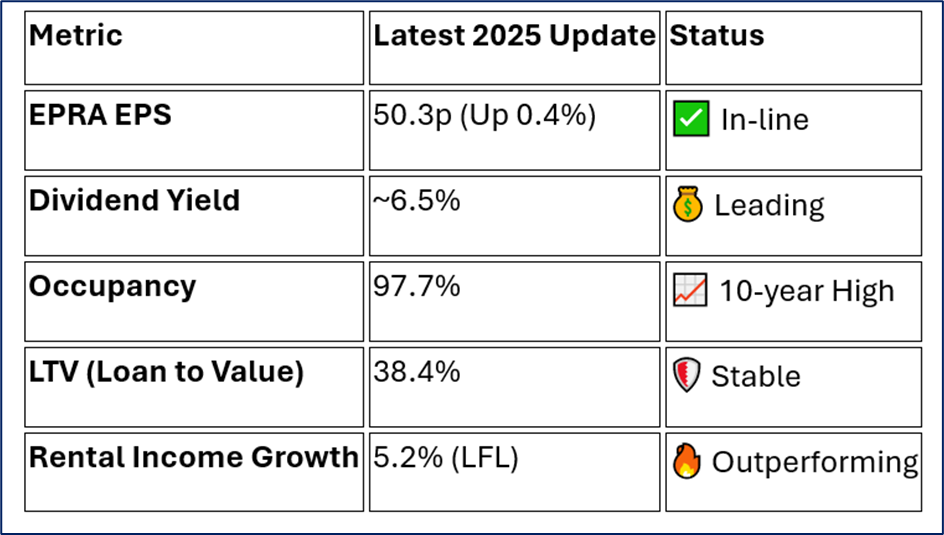
2025 Financial & Operational Snapshot
Source: Company Data
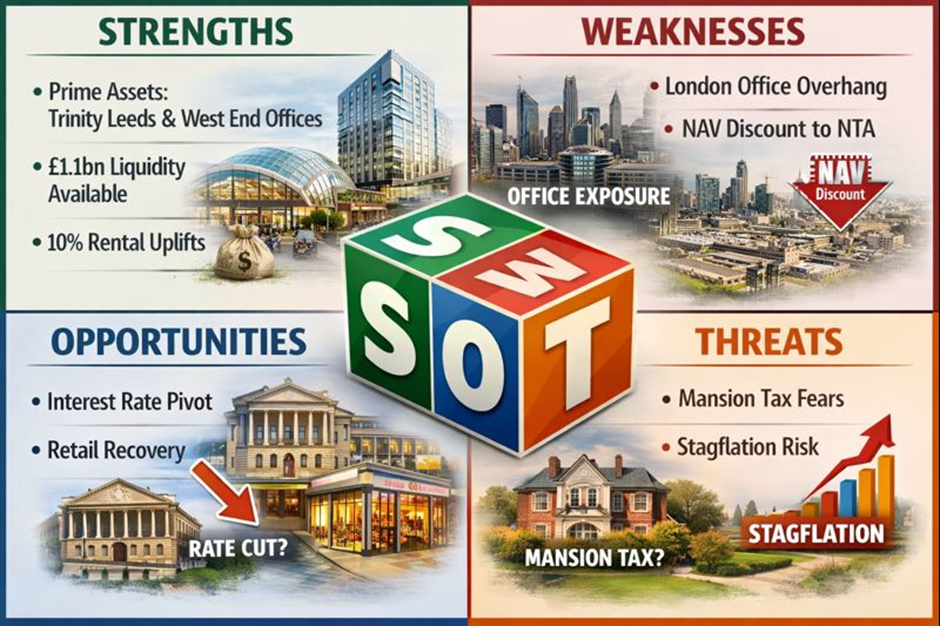
SWOT Analysis: The 2026 Outlook
Source: Kalkine Group
Strengths
- Prime Asset Base: Ownership of "trophy" assets like Trinity Leeds and West End offices that retain value even in downturns.
- Liquidity: £1.1bn in cash and undrawn facilities; no major debt refinancing needed until 2027.
- Pricing Power: 10% rental uplifts on new leases show they can pass inflation costs to tenants.
Weaknesses
- Office Overhang: While they are selling, a significant portion of the portfolio is still tied to London offices, which face long-term "work from home" headwinds.
- Net Asset Value (NAV) Discount: The stock still trades at a significant discount to its 863p NTA (Net Tangible Assets), though this is closing.
Opportunities
- Interest Rate Pivot: If the Bank of England cuts rates further in Q1 2026, REITs are the primary beneficiaries.
- Retail Recovery: The "flight to physical" retail is accelerating as online costs (shipping/returns) rise for brands.
Threats
- Mansion Tax / Budget Fears: Rumors of a "mansion tax" on properties over £2m (from April 2028) could dampen the luxury residential outlook.
- Economic Stagflation: Sticky inflation could force the BoE to keep rates "higher for longer" than the market expects.
Key Risks for Retail Investors
- Capital Recycling Execution: Landsec is trying to sell £2bn of offices. If they can't find buyers at book value, the NAV will take a hit.
- Consumer Spending: Their retail success depends on the UK consumer. If 2026 brings a recession, footfall at Bluewater could drop.
- Refinancing Cliff: While safe until 2027, the cost of debt in two years will likely be higher than the expiring low-interest bonds.
Conclusion
Landsec's performance on December 29 is a classic "value unlock" signal. The company has successfully pivoted from a stagnant office giant to a dynamic operator of "best-in-class" destinations. With 97.7% occupancy and a upgraded earnings guidance for 2030, the market is finally beginning to price in the transformation.


 Jun 24, 2026




 Please wait processing your request...