
 AU
AU
 CA
CA
 US
US
 NZ
NZ
 IND
IND

 UK
UK

 Share
Share
 X (Formerly Twitter)
 Whatsapp
 Facebook
 LinkedIn
 Telegram
 Email This Article
 Copy Link
 Summarize with AI
 Chat GPT
 Perplexity
The London Stock Exchange witnessed a notable late-season spark as Macfarlane Group PLC (LSE: MACF) shares climbed ~3.72% on December 24, 2025, closing at GBX 72.40. In a year characterized by "choppy" retail demand and industrial headwinds, this festive uptick has caught the eye of retail investors looking for value in the FTSE All-Share.
Why the Spike? Key Drivers on Dec 24
While Christmas Eve trading is typically light, Macfarlane’s move was backed by more than just "holiday cheer."
Source: Kalkine Group
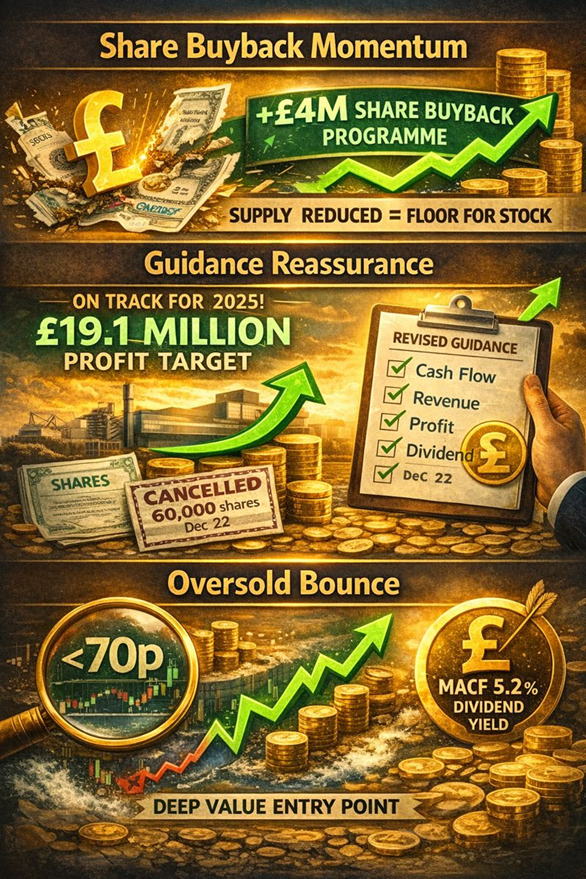
- Share Buyback Momentum: The Group has been aggressively executing its £4m share buyback programme. Just days prior (Dec 22), the company cancelled another 60,000 shares. This consistent reduction in share supply is providing a "floor" for the stock price.
- Guidance Reassurance: Following a turbulent October—where a tragic operational incident at the Pitreavie site led to a profit warning—management recently reiterated that the Group is on track to meet its revised 2025 adjusted operating profit target of £19.1 million.
- Oversold Bounce: MACF had fallen significantly (~32% over 12 months). Investors likely viewed the sub-70p level as a deep-value entry point, especially given the company's robust dividend yield, which currently sits north of 5%.
The 2025 Business Model: A Dual-Engine Strategy
Macfarlane has evolved from a simple box-maker into a high-tech "Protective Packaging" powerhouse. Its latest model relies on two distinct pillars:
- Packaging Distribution (The Volume Engine)
The UK’s leading distributor, serving 20,000+ customers. It uses a "Stock and Serve" model, leveraging 43 sites to provide just-in-time delivery for e-commerce giants and retailers.
- Manufacturing Operations (The Margin Engine)
This segment focuses on high-value, bespoke solutions for Aerospace, Defence, and Medical sectors. This is where the real growth is—shielding the company from the volatility of high-street retail.
Latest Financial & Operational Pulse
Despite a challenging macro environment, the latest updates reveal a company in "stabilization mode":
- Profitability: Adjusted operating profit for FY2025 is expected to be ~20% lower than 2024, but the Manufacturing side remains a standout performer, offsetting some of the distribution weakness.
- Strategic Capex: A £1.2 million investment in new equipment for the Pitreavie business is underway to restore full capacity by Q1 2026.
- Pension De-risking: Macfarlane is positioning its pension scheme for a buy-in, a savvy move to remove long-term volatility from the balance sheet, despite a one-off accounting charge of £2m–£3m.
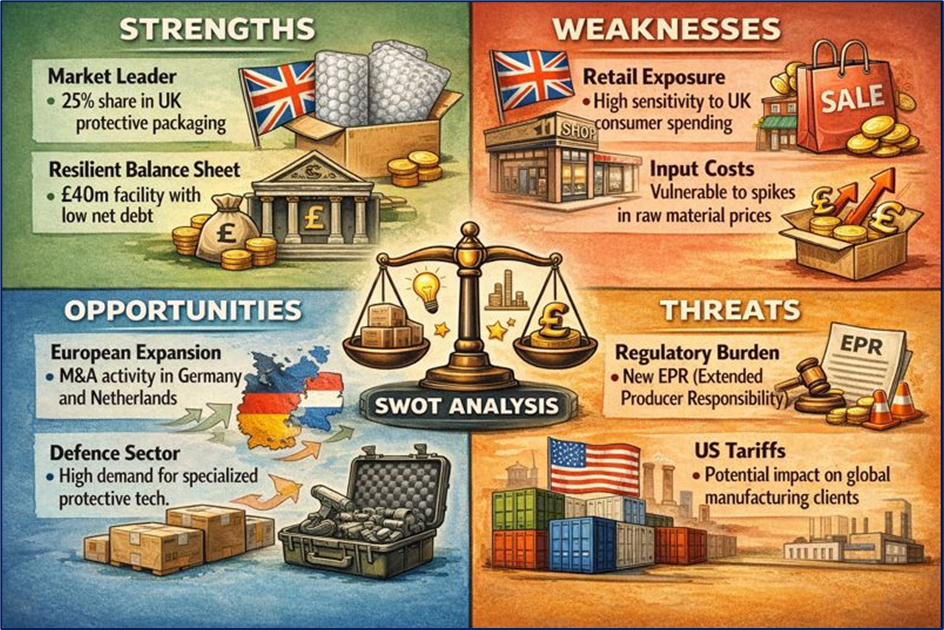
SWOT Analysis: The 2025 Reality Check
Source: Kalkine Group
The "Red Flags": Key Risks to Watch
No stock is without its thorns. For Macfarlane, the risks are primarily external:
- Macro-Economic Drag: If UK inflation or interest rates stay high, the "Distribution" arm will continue to see delayed new business decisions.
- Operational Recovery: Any further delays in the Pitreavie site restoration could cap the upside for early 2026.
- Thin Liquidity: As seen on Dec 24, low volume can cause sharp price swings, which may not always reflect long-term value.
The Verdict: Conclusion
Macfarlane Group is currently a "Recovery Play." The 3.7% jump on Christmas Eve reflects a market that is beginning to forgive the profit warning and focus on the company's underlying strengths: a dominant market position, a growing manufacturing arm, and a commitment to returning capital to shareholders.
While 2025 was a year of "re-basing," the aggressive buybacks and strategic investments suggest that the management is prepping the ship for a much smoother sail in 2026.


 Jun 24, 2026




 Please wait processing your request...