
 AU
AU
 CA
CA
 US
US
 NZ
NZ
 IND
IND

 UK
UK

 Share
Share
 X (Formerly Twitter)
 Whatsapp
 Facebook
 LinkedIn
 Telegram
 Email This Article
 Copy Link
 Summarize with AI
 Chat GPT
 Perplexity
While most of the City was checking out for the holidays, Metro Bank (LSE: MTRO) caught a festive bid on December 24, 2025, closing up approximately 1.51% at GBX 121.
This isn't just a holiday fluke. After a tumultuous few years, the "challenger" that almost folded is transforming into a lean, specialist lending machine. Here is the analytical deep dive into why Metro Bank is suddenly the FTSE 250’s favorite comeback story.
The Christmas Eve Catalysts: Why the Spike?
The 1.5% climb on December 24 was fueled by a "perfect storm" of regulatory relief and internal confidence:

Source: Kalkine Group
- The MREL "Gift": On December 19, the Prudential Regulation Authority (PRA) confirmed Metro Bank would be reclassified as a "Transfer Firm" effective January 1, 2026. This allows them to exit the costly MREL (Minimum Requirement for Own Funds and Eligible Liabilities) regime.
- The Interest Expense Cliff : Metro currently pays a staggering 12% coupon on £525 million of MREL debt. By exiting this regime, analysts expect a massive uplift in Return on Tangible Equity (RoTE)— potentially adding £60m to net interest income (NII) annually.
- Insider Buying Confidence: Regulatory filings on Dec 24 showed further Director/PDMR shareholding activity, signaling to retail investors that leadership is literally putting their money where their mouth is.
The 2025 Business Model: From "Dogs & Free Pens" to Specialist Powerhouse
The "Old" Metro Bank focused on expensive rapid branch expansion and generic retail lending. The 2025 Pivot is far more surgical:
- Asset Rotation: Shifting away from low-yield residential mortgages into high-margin specialist lending (SME, Commercial, and Specialist Mortgages).
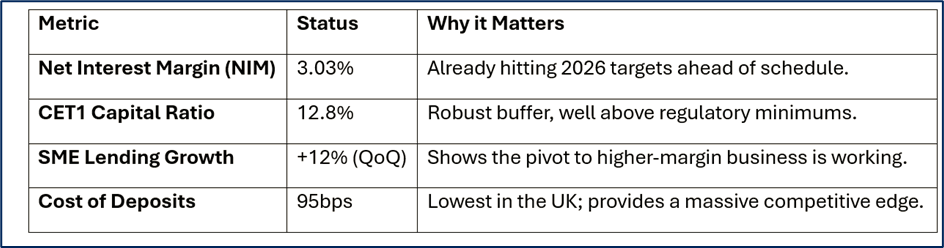
- The Store Strategy: No longer just "banks," the 76 stores are now optimized as SME Hubs. Metro remains the only UK high street bank with 7-day-a-week opening, using this to maintain the lowest cost of deposits in the sector (approx. 95bps–102bps).
- Efficiency First: A brutal £80m annual cost-reduction plan is now fully baked into the 2025 financials, creating a "positive jaws" effect (income growing faster than expenses).
Latest Financial & Operational Pulse (Q3/Q4 2025)
Source: Company Data
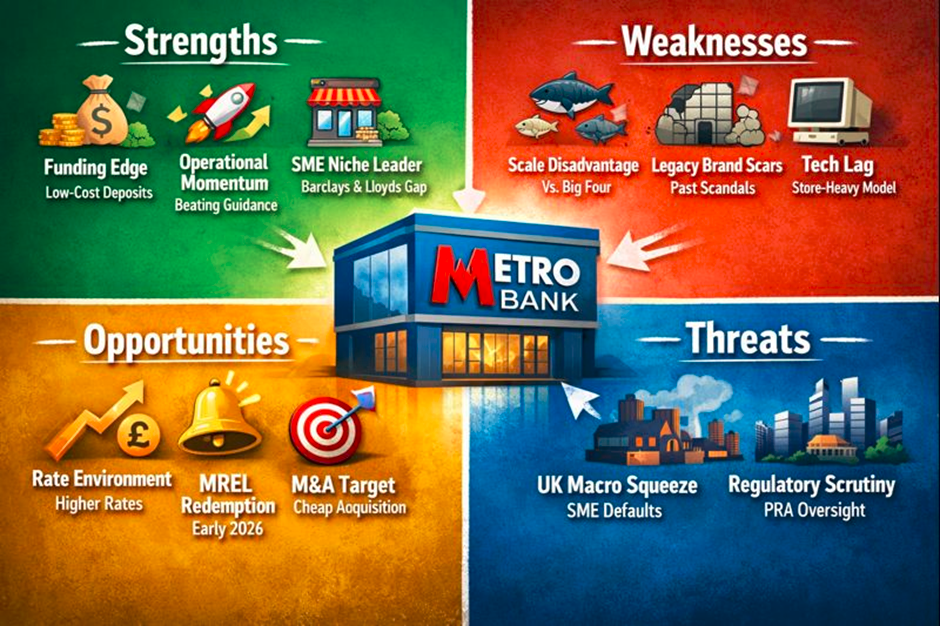
SWOT Analysis
Source: Kalkine Group
Strengths
- Funding Edge: Phenomenal ability to attract low-cost deposits through its "service-led" branch model.
- Operational Momentum: Consistently meeting or beating guidance for the last four quarters.
- Niche Positioning: Dominates the SME "in-person" service gap left by Barclays and Lloyds.
Weaknesses
- Scale: Still a minnow compared to the "Big Four," making it vulnerable to price wars.
- Legacy Brand Scars: The 2019 accounting error and 2023 rescue deal still weigh on some institutional sentiment.
- Technology Lag: Heavy reliance on physical stores is expensive compared to digital-only neobanks like Monzo.
Opportunities
- Rate Environment: Higher-for-longer rates benefit banks with low-cost deposit bases like Metro.
- MREL Redemption: If they call their 12% debt early in 2026, earnings could skyrocket.
- M&A Target: At a 0.7x–0.8x price-to-book ratio, they remain a "cheap" acquisition target for a mid-tier player.
Threats
- UK Macro Squeeze: Any spike in SME defaults due to a cooling UK economy would hit their new core portfolio.
- Regulatory Scrutiny: The PRA remains "once bitten, twice shy" regarding Metro’s reporting.
- CRE Exposure: Commercial Real Estate remains a sensitive area for mid-sized lenders.
The Risk Radar
Investing in a turnaround is never a "sure thing." The primary risks for 2026 include:
- Execution Risk: The bank is targeting a mid-teens RoTE by 2027. This is an ambitious "hockey stick" recovery.
- Refinancing Friction: While MREL relief is coming, the transition and potential early redemption fees could cause short-term capital volatility.
- Liquidity Attrition: As customers seek higher yields elsewhere, maintaining that "lowest cost of deposits" title will become harder.
The Bottom Line
Metro Bank is no longer the "broken bank" of 2023. The 1.5% move on December 24 reflects a market finally pricing in a structurally more profitable business. By shedding expensive debt and doubling down on SMEs, Metro has positioned itself as a high-beta play on the UK’s mid-cap recovery.


 Jun 24, 2026




 Please wait processing your request...