
 AU
AU
 CA
CA
 US
US
 NZ
NZ
 IND
IND

 UK
UK

 Share
Share
 X (Formerly Twitter)
 Whatsapp
 Facebook
 LinkedIn
 Telegram
 Email This Article
 Copy Link
 Summarize with AI
 Chat GPT
 Perplexity
The London Stock Exchange has seen its share of volatility this year, but Kenmare Resources (LSE: KMR) is stealing the spotlight as we close out 2025. On December 30, the stock jumped approximately 12%, leaving retail investors and analysts scrambling to unpack the move.
Is this a "Santa Rally" or a fundamental shift in the mineral sands giant's narrative? Here is the deep-dive breakdown of the latest business model, financial updates, and the forces driving this double-digit breakout.
The Catalyst: Why the 12% Surge Today?
While Kenmare has faced a challenging 2025—including a $100 million non-cash impairment earlier this year—the late-December rally appears driven by three converging factors:

Source: Kalkine Group
- Project Milestone at WCP A: A major operational update released in mid-December confirmed that the Wet Concentrator Plant (WCP) A upgrade and its transition to the high-grade Nataka ore zone are progressing ahead of revised Q4 targets. This project is the "crown jewel" that unlocks 70% of Moma’s mineral resources.
- M&A Speculation Re-ignited: Following the rejection of a takeover bid earlier in the year (which the board claimed "undervalued the business"), fresh rumors of a revised offer from a strategic consortium have begun circulating in the city.
- Ilmenite Price Stabilization: After a weak 2024 and early 2025, market data indicates that titanium feedstock prices are stabilizing, coupled with a "buy the dip" sentiment as KMR was trading near 52-week lows in mid-December.
The Latest Business Model: Efficiency Over Volume
Kenmare operates the Moma Titanium Minerals Mine in Mozambique, one of the world's largest deposits. Their business model has shifted from pure extraction to "High-Margin Life Extension."
- Product Mix: They produce Ilmenite and Rutile (used for whiteness in paints, plastics, and paper) and Zircon (used in ceramics).
- The "Nataka" Pivot: The business is moving its largest plant (WCP A) to the Nataka zone. This isn't just a move; it's a decades-long life extension for the mine, ensuring production through 2045.
- Vertical Logistics: Kenmare owns its own jetty and transshipment vessels, allowing them to control the supply chain from the mine site directly to global customers, insulating them from some third-party port risks.
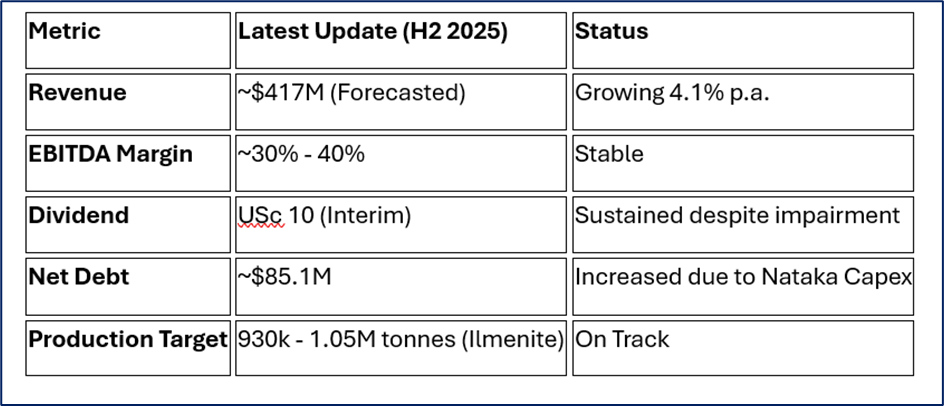
2025 Financial & Operational Snapshot
Source: Company Data
Operational Highlights:
- Selective Mining Operation (SMO): Commissioned in 2025, this small-scale, low-cost dredge allows for mining in peripheral areas, adding 50,000 tonnes of Heavy Mineral Concentrate (HMC) annually.
- ESG Leadership: Kenmare has successfully reduced Scope 1 and 2 emissions by over 12% against their 2021 baseline, a key metric for institutional "Green" funds.
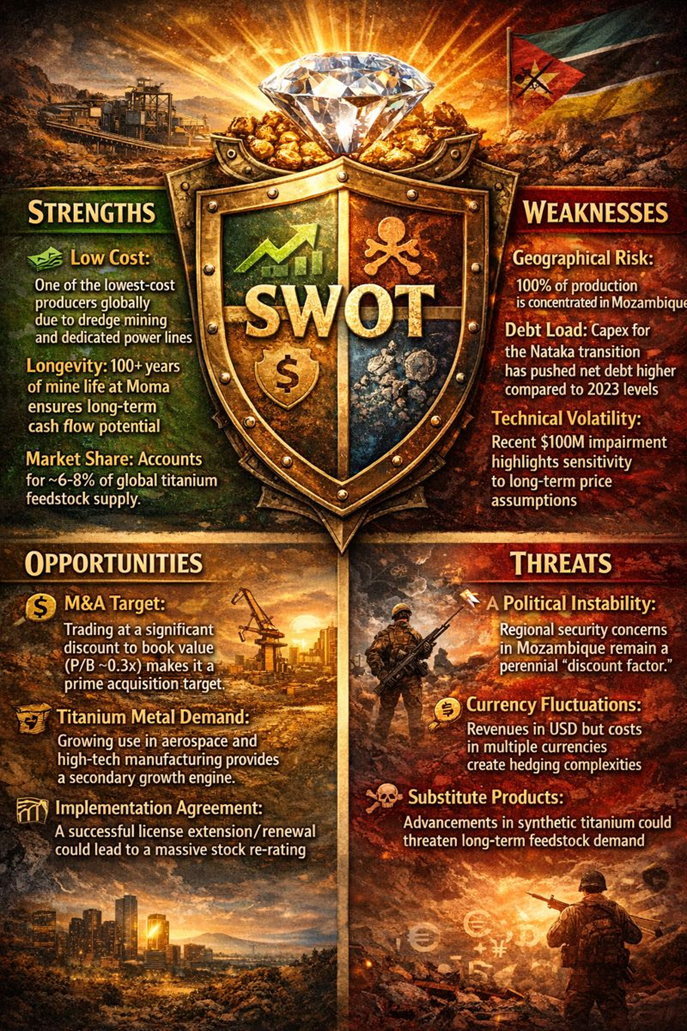
SWOT Analysis (2025 Context)
Source: Kalkine Group
Strengths
- Low Cost: One of the lowest-cost producers globally due to dredge mining and dedicated power lines.
- Longevity: 100+ years of mine life at Moma ensures long-term cash flow potential.
- Market Share: Accounts for ~6-8% of global titanium feedstock supply.
Weaknesses
- Geographical Risk: 100% of production is concentrated in Mozambique.
- Debt Load: Capex for the Nataka transition has pushed net debt higher compared to 2023 levels.
- Technical Volatility: Recent $100M impairment highlights sensitivity to long-term price assumptions.
Opportunities
- M&A Target: Trading at a significant discount to book value (P/B ~0.3x) makes it a prime acquisition target.
- Titanium Metal Demand: Growing use in aerospace and high-tech manufacturing provides a secondary growth engine.
- Implementation Agreement: A successful license extension/renewal could lead to a massive stock re-rating.
Threats
- Political Instability: Regional security concerns in Mozambique remain a perennial "discount factor."
- Currency Fluctuations: Revenues in USD but costs in multiple currencies create hedging complexities.
- Substitute Products: Advancements in synthetic titanium could threaten long-term feedstock demand.
Key Risks to Watch
Investors shouldn't ignore the "Mozambique Discount." While the Moma mine is far from the conflict-prone northern Cabo Delgado region, political risk remains the primary reason for Kenmare's historically low P/E ratio. Additionally, the $341 million capital budget for the Nataka transition leaves little room for operational errors or delays.
Conclusion
Kenmare Resources is finishing 2025 with a "bang," fueled by operational progress and a market that finally seems to realize how undervalued the company's assets are. While the 12% jump is impressive, the stock remains a "show me" story—investors will be looking for the final Nataka commissioning in 2026 to prove that the dividend remains bulletproof.


 Jun 24, 2026




 Please wait processing your request...