
 AU
AU
 CA
CA
 US
US
 NZ
NZ
 IND
IND

 UK
UK

 Share
Share
 X (Formerly Twitter)
 Whatsapp
 Facebook
 LinkedIn
 Telegram
 Email This Article
 Copy Link
 Summarize with AI
 Chat GPT
 Perplexity
Market Snapshot: The "Reshape for Growth" Verdict
On December 31, 2025, Marks & Spencer Group (LSE: MKS) closed trading up approximately 1% (hovering around the GBX 330 mark). While a 1% daily move might seem modest, in the context of a turbulent 2025, it signals resilience.
Why the jump?

Source: Kalkine Group
The rise wasn't triggered by a single explosive press release on New Year's Eve but rather a confluence of year-end "window dressing" and defensive sector rotation. As the FTSE 100 flirted with record highs to close the year, investors gravitated toward "safe haven" retailers that traditionally benefit from the final Christmas spending sprint. The sentiment is clear: the worst of the 2025 operational headwinds (specifically the cyber issues) is priced in, and the market is positioning for a recovery narrative in H2 FY26.
Deep Dive: The 2025 Business Model
M&S has aggressively pivoted from a legacy "department store" mentality to a modern, omnichannel "Reshape for Growth" model.
- The "Capital Light" International Pivot: Gone are the days of owning expensive flagship stores globally. The 2025 strategy doubles down on franchise partnerships (especially in India and the Middle East) and digital-first entry. This reduces overheads and shields the balance sheet from volatile international property markets.
- The Food-First Ecosystem: Food is no longer just a footfall driver for clothing; it is the primary engine. The business model now prioritizes larger, "fresh market" style Foodhalls (averaging 14k sq ft) that function almost like high-end supermarkets rather than convenience stops.
- Digital Brain & AI Supply Chain: Post-April 2025 cyberattack, the operational focus has shifted to supply chain resilience. M&S is heavily investing in the "Digital Brain"—an AI-driven planning system (o9 Solutions) designed to predict stock flow more accurately, reducing the "markdown heavy" legacy of its clothing division.
SWOT Analysis
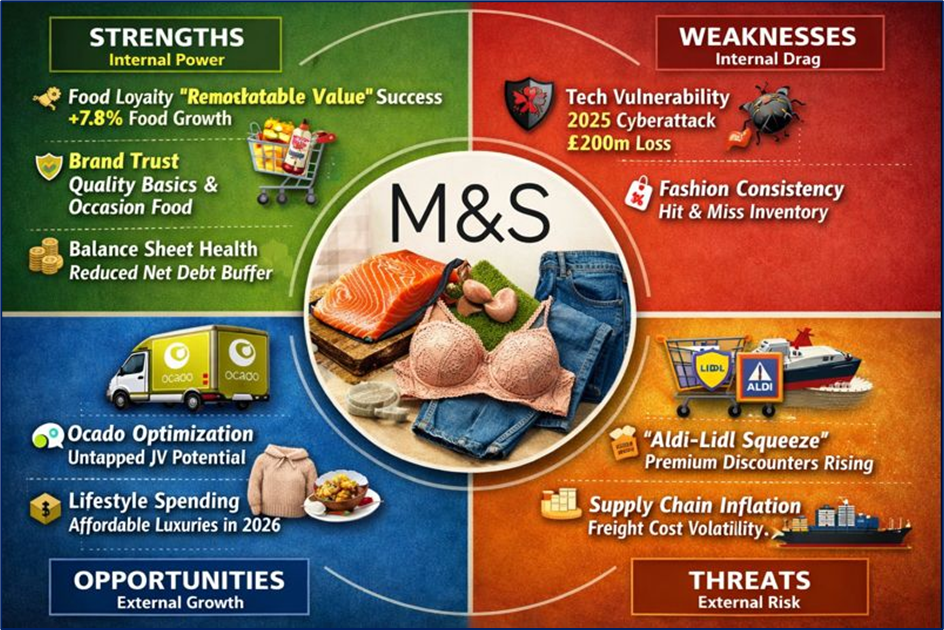
Source: Kalkine Group
Strengths (Internal Power):
- Food Loyalty: The "Remarksable Value" campaign has successfully shaken off the "too expensive" tag while retaining quality perception. Food volume growth (+7.8% in H1) consistently outperforms the wider UK grocery market.
- Brand Trust: Despite tech hiccups, the M&S brand remains a trusted institution for "quality basics" (lingerie, denim) and occasion food.
- Balance Sheet Health: Net debt has been significantly reduced over the last 3 years, giving them the cash buffer to weather operational storms.
Weaknesses (Internal Drag):
- Tech Vulnerability: The April 2025 cyberattack was a critical weakness, exposing fragile legacy systems and wiping out nearly £200m in potential profit momentum.
- Fashion Consistency: While "basics" sell well, the "fashion forward" lines still suffer from hit-and-miss inventory bets, leading to markdown risks.
Opportunities (External Growth):
- Ocado Optimization: The JV with Ocado remains under-potentialized. Improving "same-day" slot availability and integrating M&S loyalty data into Ocado is a massive, untapped revenue stream.
- Lifestyle Spending: As inflation stabilizes, consumer discretionary income for "affordable luxuries" (premium ready meals, cashmere) is forecast to rebound in 2026.
Threats (External Risk):
- The "Aldi-Lidl" Squeeze: While M&S targets quality, the premium tiers of discounters (like Lidl Deluxe) constantly nip at M&S’s heels for the "dinner party" demographic.
- Supply Chain Inflation: Global logistics costs remain volatile. M&S's reliance on imported textiles makes them sensitive to freight rate spikes.
Operational Update: The "Cyber" Shadow
The defining story of late 2025 remains the recovery from the April Cyber Incident.
- Financial Impact: H1 FY26 (ended Sept 2025) adjusted profit before tax fell to £184.1m (down from £413m previous year). The attack paralyzed online clothing orders for nearly two months and disrupted Click & Collect.
- The Recovery Status: By December 31, 2025, systems are fully restored. Crucially, management has guided that H2 profits should match previous years, indicating the bleeding has stopped. The 1% stock rise suggests the market believes this "recovery guide."
- Store Rotation: The closure of "legacy" high street stores continues, with capital being recycled into the high-performing Foodhall formats.
Key Risks for 2026
- Execution Risk: The "Digital Brain" implementation must work. Another system failure would be catastrophic for investor confidence.
- Weather Dependency: M&S Clothing remains heavily weather-dependent. A mild winter in early 2026 could leave unsold coats and knitwear on the rails, forcing margin-killing sales.
- Cost Headwinds: The rise in National Insurance and wage inflation in the UK (the "October Budget" hangover) adds approximately £60m-£100m in operating costs that must be absorbed or passed on.
Conclusion
Marks & Spencer ends 2025 bruised but standing tall. The ~1% rise on December 31 is symbolic of a market that is cautiously optimistic. Investors are looking past the "one-off" cyber disaster of H1 and focusing on the underlying strength of the Food business and the strategic "reshape" of the store estate. M&S is no longer a confused department store; it is a premium food retailer with a recovering digital clothing arm.
If 2025 was the year of the "shock," 2026 is set up to be the year of the "proof."


 Jun 29, 2026




 Please wait processing your request...