
 AU
AU
 CA
CA
 US
US
 NZ
NZ
 IND
IND

 UK
UK

 Share
Share
 X (Formerly Twitter)
 Whatsapp
 Facebook
 LinkedIn
 Telegram
 Email This Article
 Copy Link
 Summarize with AI
 Chat GPT
 Perplexity
In 2026, the UK market continues to offer a distinct "valuation gap" compared to its US counterparts. For an investor with £25,000, the focus for "value" has shifted from simply buying "cheap" stocks to identifying companies with robust cash flows and disciplined capital allocation.
As of January 2026, the UK economy faces a "slow-burn" recovery with interest rates stabilizing. The following five stocks represent the core of the UK value proposition, balancing high yields with operational resilience.
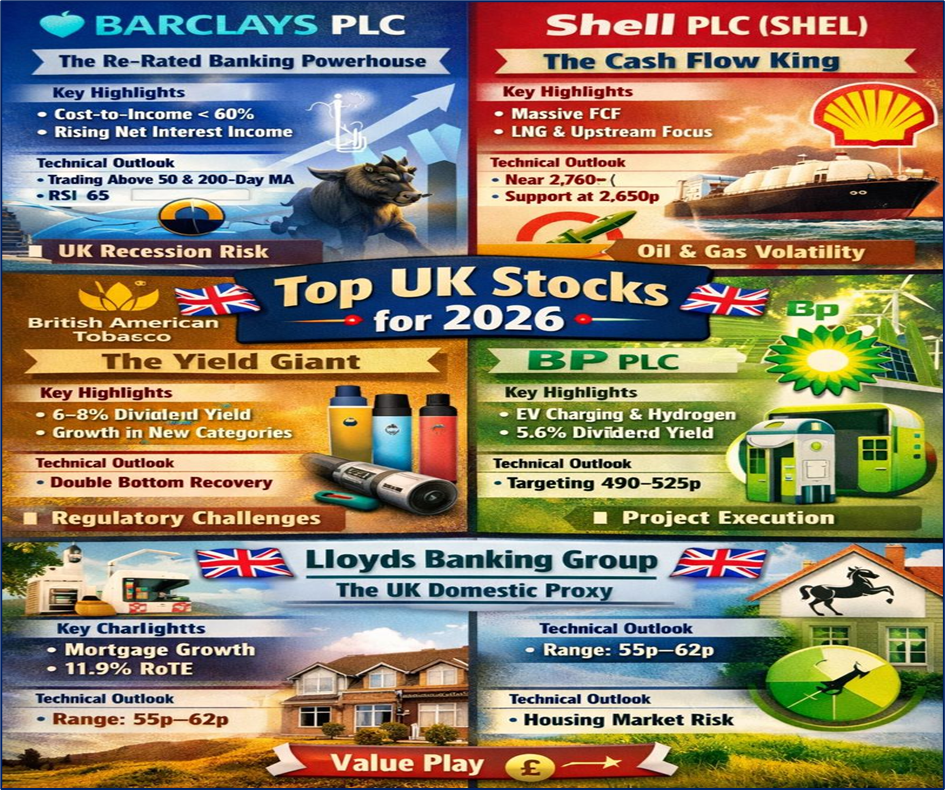
Source: Kalkine Group
Key Reasons and Drivers
Barclays has moved from a "deep value" play in 2024 to a "compounding" story in 2026. The primary driver is the structural hedge benefit; as older, low-interest hedges roll off, they are replaced by higher-yielding ones, bolstering Net Interest Income (NII) even if the Bank of England makes modest rate cuts.
Latest Business Model and Operations
Barclays has successfully streamlined into three clear pillars: UK Retail, US Consumer, and the Investment Bank. In late 2025, the bank completed a significant cost-cutting program, achieving a cost-to-income ratio below 60%. Operationally, the bank is focusing on high-return segments like Barclaycard US and wealth management.
Technical Analysis and Analyst Sentiment
- Technical Profile: The stock is currently trading in a steady uptrend, sitting above its 50-day and 200-day moving averages (approx. 430p and 370p respectively). The RSI is currently around 65, suggesting bullish momentum without being excessively overbought.
- Analyst View: Recent January 2026 updates show a consensus "Buy" with 11 buy ratings. While the stock has seen a significant re-rating, analysts at Jefferies and JPMorgan have recently raised price targets, citing a "conservative" 2026 P/E of roughly 9.2x.
Risks
- Economic Sensitivity: A sharper-than-expected UK recession would increase impairment charges.
- Regulatory Scrutiny: Increased oversight on motor finance and consumer lending remains a persistent "headline risk."
Key Reasons and Drivers
Shell remains a cornerstone value play due to its massive free cash flow (FCF) generation. The driver for 2026 is the "Value over Volume" strategy, where Shell is divesting lower-margin renewables to focus on high-margin Integrated Gas (LNG) and Upstream assets.
Latest Business Model and Financial Updates
Shell’s model is now heavily skewed toward LNG, which acts as a bridge fuel for the global energy transition. Latest financials show FCF exceeding $17.5 billion, allowing for aggressive share buybacks. The company recently committed to returning 30-40% of CFFO (Cash Flow From Operations) to shareholders.
Technical Analysis and Analyst Sentiment
- Technical Profile: Shell is trading near 2,760p, showing strong support at the 2,650p level. The chart shows a "consolidation" pattern, waiting for the next catalyst in oil prices.
- Analyst View: Sentiment is overwhelmingly positive with 10 Buys and 8 Holds. Analysts point to a dividend yield of nearly 4% and a potential upside of 12-15% as it closes the valuation gap with US peers like ExxonMobil.
Risks
- Commodity Volatility: Significant drops in Brent Crude or European Gas prices directly hit the bottom line.
- Windfall Taxes: Political shifts in the UK or EU could lead to renewed energy profit levies.
Key Reasons and Drivers
For the value investor, BATS is a "dividend aristocrat" in all but name. The 2026 driver is the acceleration of "New Categories" (Velo, Vuse, Glo) reaching profitability, which is starting to offset the secular decline in combustible cigarettes.
Latest Business Model and Operational Updates
BATS has pivoted to a "Smokeless World" strategy. Operationally, the company has successfully deleveraged and recently announced a £1.7 billion share buyback program following the partial sale of its stake in India’s ITC. In January 2026, it reaffirmed its guidance for 2% revenue growth despite US regulatory headwinds.
Technical Analysis and Analyst Sentiment
- Technical Profile: After a multi-year slump, the stock has formed a "double bottom" near 2,300p and is trending toward 2,500p.
- Analyst View: BATS currently offers a staggering 6-8% dividend yield. Analysts are cautiously upgrading the stock as the "New Category" margins expand, though the consensus remains "Hold" due to ethical/ESG exclusion.
Risks
- Regulatory Ban: Potential UK bans on disposable vapes or stricter US FDA flavor rulings.
- Litigation: Ongoing litigation in North America regarding legacy health claims.
Key Reasons and Drivers
Unlike Shell, BP is maintaining a more diversified approach to the energy transition, making it a "Value + Growth" hybrid. The driver for 2026 is its dominant position in EV charging (BP Pulse) and hydrogen production, which are beginning to contribute to EBITDA.
Latest Business Model and Financials
BP operates a "trilemma" strategy: secure energy, affordable energy, and lower-carbon energy. Recent Q4 2025 results beat expectations with an EPS of $0.85. The company raised its quarterly dividend to nearly $0.50, offering a 5.6% yield.
Technical Analysis and Analyst Sentiment
- Technical Profile: BP is trading around 425p. It has shown volatility but remains supported by its massive market cap of £86 billion.
- Analyst View: Brokerages like Piper Sandler and Scotiabank have recently "Boosted Targets" to the 490p–525p range, citing undervalued "green" assets that the market is currently pricing at zero.
Risks
- Project Execution: High-cost hydrogen and offshore wind projects carry significant execution and interest-rate risk.
- Leverage: A debt-to-equity ratio of over 100% makes it more sensitive to credit market shifts than Shell.
Key Reasons and Drivers
If you believe in the UK’s resilience, Lloyds is the purest play. As the UK’s largest mortgage lender, its 2026 performance is driven by a stabilizing housing market and the "First Time Buyer Boost" initiative.
Latest Business Model and Operational Updates
Lloyds has transformed into a digital-first bank, with a strategy update in late 2025 focusing on "Digital & AI" to reduce operational costs. It recently committed an additional £1 billion to help homeowners, expanding its loan book. Latest net income was up 6% year-on-year.
Technical Analysis and Analyst Sentiment
- Technical Profile: The stock is trading in a tight range between 55p and 62p. It is a "low beta" stock, meaning it moves less than the market, providing stability.
- Analyst View: Analysts like the 11.9% Return on Tangible Equity (RoTE). Most have a "Buy" or "Strong Buy" rating, eyeing the potential for special dividends or increased buybacks in 2026.
Risks
- Mortgage Defaults: Any spike in unemployment would lead to higher-than-expected credit losses.
- Margin Compression: If the Bank of England cuts rates too aggressively, the "spread" Lloyds earns will narrow.
Conclusion
Investing £25,000 in the UK market in 2026 requires a focus on "Quality Value." These five stocks—Barclays, Shell, BATS, BP, and Lloyds—offer a blend of high dividends, massive share buybacks, and sector leadership. While risks like regulatory shifts and commodity prices remain, their discounted valuations relative to global peers provide a significant "margin of safety."


 Jun 29, 2026




 Please wait processing your request...