
 AU
AU
 CA
CA
 US
US
 NZ
NZ
 IND
IND

 UK
UK

 Share
Share
 X (Formerly Twitter)
 Whatsapp
 Facebook
 LinkedIn
 Telegram
 Email This Article
 Copy Link
 Summarize with AI
 Chat GPT
 Perplexity
Views Expressed Disclaimer:
You are reading a free article with opinions that may differ from the recommendation given by Kalkine in its paid research reports. Become a Kalkine member today to get access to our research reports, in-depth technical and fundamental research.
Pershing Square Holdings (PSH), the London-listed investment vehicle led by renowned investor Bill Ackman, recently declined by more than 4% in a single trading session. As a concentrated, closed-end fund with exposure to a select group of global equities, PSH’s share price movements are influenced by several unique structural and market factors beyond simple portfolio performance.
Understanding the reasons behind the decline requires examining how investment trusts behave, how concentrated portfolios react to market shocks, and how macroeconomic sentiment shapes investor positioning.
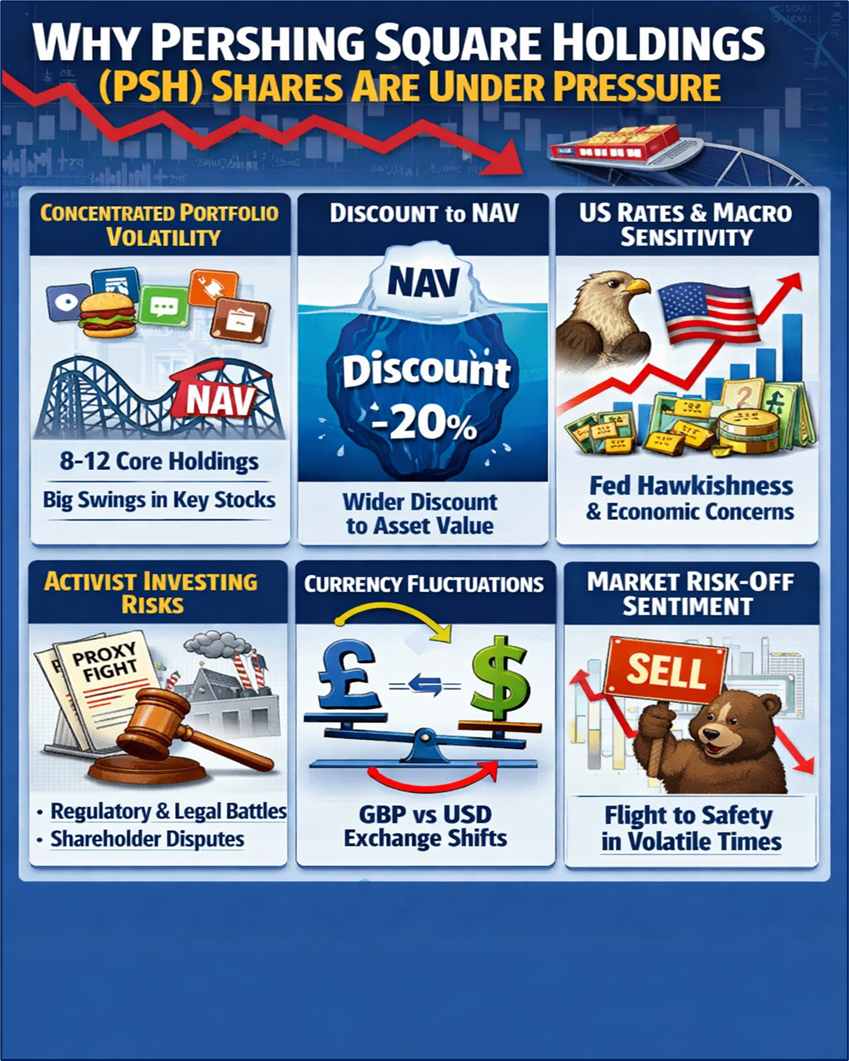
Source: Kalkine Group
1. Concentrated Portfolio Exposure Amplifies Volatility
PSH typically maintains a focused portfolio of roughly 8–12 core holdings. While concentration can enhance returns when investments perform well, it also increases short-term volatility when one or more key positions experience weakness.
Large price movements in sectors such as:
- US technology
- Consumer discretionary companies
- Restaurant and hospitality brands
- Financial services firms
can significantly influence PSH’s net asset value (NAV) within a single trading day. Any negative news — including earnings disappointments, regulatory developments, or macroeconomic concerns — affecting a major holding can quickly translate into a noticeable decline in PSH shares.
2. Discount to Net Asset Value (NAV) May Have Widened
Closed-end funds like PSH often trade at either a premium or a discount relative to their underlying NAV. Changes in investor sentiment can cause this discount to widen even if the portfolio’s intrinsic value remains relatively stable.
During periods of uncertainty, investors may:
- Reduce exposure to investment trusts
- Rotate away from growth-oriented equities
- Increase allocations to defensive or income-generating assets
A widening discount alone can produce a daily share price decline in the range of 3–5%, independent of portfolio performance.
3. Sensitivity to US Interest Rates and Macro Conditions
Although PSH is listed in London, its holdings are predominantly US-based. This makes the fund particularly sensitive to developments in US monetary policy and macroeconomic data.
Factors that can pressure PSH include:
- Hawkish Federal Reserve commentary
- Higher-than-expected inflation readings
- Rising US Treasury yields
- Weakness in US growth stocks
If US markets decline overnight, PSH often reflects that sentiment when London markets open.
4. Risks Associated with Activist Investing Strategy
Pershing Square is widely known for its activist investment approach, which involves taking significant stakes in companies and pushing for strategic or operational changes. While this strategy can unlock substantial value, it also introduces additional risks, including:
- Legal or regulatory challenges
- Proxy contests and shareholder disputes
- Delays in expected catalysts
- Market skepticism around campaign outcomes
Any perceived setback in an activist position can negatively affect investor confidence and contribute to share price volatility.
5. Currency Movements Between GBP and USD
PSH’s structural setup introduces currency exposure. The fund trades in London (GBP) but primarily holds US dollar-denominated assets.
If the British pound strengthens against the US dollar, the translated value of US holdings may decline from a GBP perspective — even if the underlying US share prices remain unchanged. Currency fluctuations can therefore play a meaningful role in short-term price movements.
6. Broader Market Risk-Off Sentiment
Investment trusts and holding companies often underperform during risk-off periods. Investors sometimes prefer direct ownership of equities rather than vehicles trading at discounts during volatile conditions.
When market volatility increases:
- Discounts to NAV tend to widen
- Liquidity can decline
- Selling pressure intensifies across the sector
This dynamic can amplify declines beyond what portfolio performance alone would justify.
Overall Interpretation: Why the Decline Isn’t Unusual
A one-day drop of approximately 4–5% in Pershing Square Holdings is not uncommon given its structural characteristics. The recent decline likely reflects a combination of:
- Weakness in key portfolio holdings
- A widening discount to NAV
- Macro-driven repricing of growth equities
- Investor sentiment shifts toward risk reduction
Because PSH operates with a concentrated strategy and activist positioning, periods of elevated volatility should be expected — particularly during uncertain market environments.
Long-Term Perspective for Investors
Despite short-term fluctuations, many investors evaluate PSH based on:
- Long-term NAV growth
- Activist value creation potential
- Portfolio quality and concentration discipline
- Capital allocation strategy
For long-term shareholders, daily volatility often matters less than sustained performance over multi-year horizons.


 Jun 29, 2026




 Please wait processing your request...