
 AU
AU
 CA
CA
 US
US
 NZ
NZ
 IND
IND

 UK
UK

 Share
Share
 X (Formerly Twitter)
 Whatsapp
 Facebook
 LinkedIn
 Telegram
 Email This Article
 Copy Link
 Summarize with AI
 Chat GPT
 Perplexity
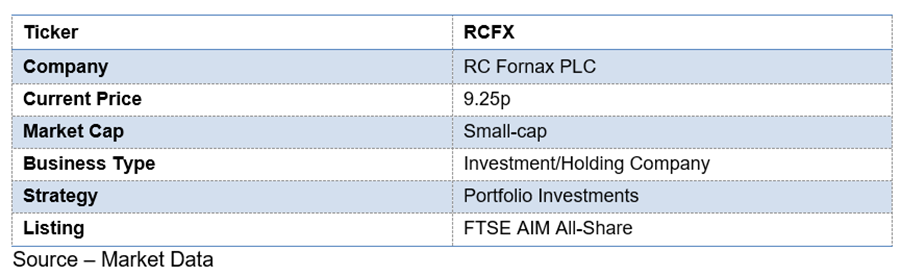
Company Overview
RC Fornax PLC operates as an investment holding company pursuing a business strategy of identifying, acquiring, and managing equity interests in underlying operating companies. This business model positions the company as a financial intermediary creating shareholder value through portfolio company selection, ownership involvement, and strategic oversight. Investment holding companies typically implement value creation strategies including operational improvements within portfolio companies, financial restructuring, strategic partnerships facilitation, and eventual liquidity events through company sales or public market exits. RC Fornax PLC's role as a holding company distinguishes it from operating companies in that its direct business activity involves capital deployment and portfolio management rather than production of goods or services. The company's value proposition to shareholders depends upon management's skill in identifying undervalued investment opportunities and implementing value creation strategies that generate returns exceeding passive investment alternatives.
The holding company model offers distinct advantages and disadvantages relative to direct operating company investment. Advantages include portfolio diversification reducing exposure to any individual company's performance, management leverage through skilled team overseeing multiple portfolio companies, and potential tax and structural efficiencies. Disadvantages include management fee drag reducing net returns available to shareholders, potential agency conflicts between holding company management and shareholders, and tax inefficiencies in some jurisdictions. RC Fornax PLC's effectiveness depends upon whether management's value creation activities generate returns sufficient to justify the holding company structure. Shareholders must evaluate whether the company's portfolio composition, ownership stakes, and strategic initiatives create value or instead destroy value through fee drag and inefficient capital allocation.
RC Fornax PLC's strategic positioning within the AIM-listed investment company sector reflects its focus, capital deployment strategy, and target portfolio companies. The company's share price of 9.25p indicates a small-cap valuation where the company possesses meaningful market presence relative to ultra-micro-cap AIM stocks. The company's valuation relative to net asset value provides indication of market sentiment regarding management quality and portfolio company prospects. If the company trades at significant discounts to net asset value, the market may question management's ability to create shareholder value. Conversely, valuation premiums to net asset value suggest market confidence in management and positive expectations regarding portfolio company performance and liquidity events.
Business Model and Revenue Streams
RC Fornax PLC's business model centers on acquiring equity interests in portfolio companies, providing operational oversight and strategic guidance, and realizing value through portfolio company growth, profitability improvement, or eventual exits. Revenue for the holding company derives primarily from dividends and distributions paid by portfolio companies from their operating earnings, as well as capital gains realized upon sale or strategic exit of portfolio positions. The company's financial performance depends entirely upon the performance of underlying portfolio companies and the effectiveness of management in enhancing portfolio company value. The holding company does not generate revenue from its own operations but rather acts as a financial intermediary managing a collection of business interests.
The capital allocation strategy shapes RC Fornax PLC's financial performance and shareholder returns. Management must deploy capital from previous exits or capital raises into new investment opportunities offering attractive risk-return profiles. The effectiveness of capital allocation determines shareholder returns, as poor investment decisions generate losses while excellent investment choices create substantial value. The company's stated investment strategy provides framework for evaluating management's capital allocation disciplines. Successful holding companies demonstrate clear investment criteria, disciplined acquisition processes, and rigorous post-acquisition management focused on value creation. RC Fornax PLC shareholders must evaluate whether management demonstrates these characteristics and whether portfolio company selections reflect sound investment logic.
Revenue visibility for RC Fornax PLC remains dependent upon portfolio company dividend capacity, which fluctuates with underlying company performance and capital allocation priorities. Some portfolio companies may retain earnings for growth investment while others distribute excess cash to holding company ownership. Portfolio exits upon sale of holdings generate one-time capital gains that can significantly impact period results. The holding company's total return to shareholders depends upon dividend income plus capital appreciation or depreciation of equity stakes based on underlying company value changes. Investors must monitor quarterly results for trends in portfolio company performance, dividend capacity, and any indications of anticipated portfolio exits.
Financial Performance and Valuation
RC Fornax PLC's financial performance should be evaluated through the lens of net asset value (NAV) per share, which represents the underlying value of portfolio company interests attributable to shareholders. The company's share price performance relative to NAV indicates market sentiment regarding management quality, portfolio composition, and expected future value creation. Holding companies trading at significant discounts to NAV may represent valuation opportunities if the market misjudges management capability or portfolio quality. Conversely, trading premiums to NAV suggest market confidence in management and positive future expectations. Quarterly results should be analyzed for trends in NAV per share, dividend income, realized and unrealized investment gains, and cash position.
Financial performance metrics appropriate for holding companies include return on equity generated by portfolio companies, portfolio company revenue and earnings growth, dividend yields on portfolio investments, and expense ratios measuring the cost of holding company operations relative to assets managed. These metrics provide indication of whether management successfully identifies attractive investments and implements effective value creation strategies. The company's return on capital compared to the cost of capital determines whether the holding company creates or destroys shareholder value. Holding companies maintaining returns on capital exceeding weighted average cost of capital create value, while those failing this test destroy shareholder value through capital misallocation.
Valuation of RC Fornax PLC incorporates analysis of portfolio company quality, competitive positioning, growth prospects, and dividend capacity. Additionally, the holding company's own management and administrative costs should be assessed relative to assets under management. High-quality portfolios generating strong returns command valuation premiums, while poorly performing portfolios trade at discounts. Management's historical investment returns, selection criteria, and track record provide indications of likely future performance. Investors should compare RC Fornax PLC's valuation and expected returns to alternative investment vehicles including diversified equity funds, sector-focused investment companies, and direct operating company investment.
Market Position and Competitive Landscape
RC Fornax PLC competes within the investment holding company sector against numerous alternatives for investor capital including large multinational conglomerates, specialized investment companies focused on specific sectors or strategies, diversified equity mutual funds, and alternative investment vehicles including private equity and hedge funds. The competitive landscape encompasses both listed and unlisted vehicles, and investors evaluate holding companies based on historical returns, cost structures, portfolio quality, and management team qualifications. Larger multinational conglomerates maintain advantages including brand recognition, established portfolio companies, and capital markets access. Specialized investment companies compete by providing sector-focused or strategy-focused exposure. RC Fornax PLC must differentiate through superior investment selection, effective portfolio company management, or specialized focus areas offering competitive advantages.
The company's competitive positioning within the AIM-listed investment company sector depends upon the quality of portfolio companies, management team experience, and the attractiveness of the company's investment strategy. AIM listing provides smaller investors access to the holding company structure without requiring large minimum investments typical of private equity or specialized investment funds. The company's relatively modest 9.25p valuation indicates modest competitive positioning within the broader investment company universe, suggesting the market views the company's portfolio or management as less attractive than larger diversified alternatives. The company must demonstrate superior investment selection or portfolio company performance to justify holding company investment relative to diversified equity fund alternatives.
Competitive advantages for holding companies derive from experienced management teams identifying and developing undervalued companies, operational expertise improving portfolio company efficiency, strategic partnerships facilitating growth, and favorable tax structures reducing drag on returns. RC Fornax PLC's competitive positioning depends upon possession of these advantages and demonstration that management's value creation activities generate returns exceeding passive alternatives. Investors should assess whether the company's management team possesses the acumen and experience to consistently identify attractive investment opportunities and successfully implement value creation initiatives.
Risk Factors
Portfolio concentration risk and individual company performance variability represent paramount considerations for investment holding companies. Should RC Fornax PLC's portfolio concentrate in a limited number of companies or sectors, the holding company's returns become highly dependent upon the performance of few underlying businesses. Diversification across portfolio companies reduces single-company risk, but holding companies rarely achieve diversification equivalent to index funds. Individual portfolio companies may experience operational challenges, market disruptions, competitive pressures, or management failures that materially impair value. RC Fornax PLC shareholders bear exposure to all portfolio company risks, requiring investors to assess not only the holding company management but also the quality and prospects of underlying portfolio companies.
Liquidity risk and portfolio exit challenges affect holding company valuations. Some portfolio companies may be difficult to exit, particularly if they lack strategic buyers or public market access. Extended holding periods for illiquid investments create opportunity cost as capital remains invested in underperforming assets. In extreme scenarios, portfolio companies may become worthless, requiring write-downs that materially reduce shareholder value. The holding company's ability to exit positions favorably depends upon underlying company performance, market conditions, and strategic buyer interest. Shareholders must assess portfolio company exit prospects and whether management has developed credible value realization pathways.
Management and operational risks affect holding company performance. Poor capital allocation decisions, ineffective portfolio company management, and strategic misjudgments by holding company leadership can destroy significant shareholder value. The concentration of management power in holding company executives creates potential for agency conflicts and excessive compensation draining returns available to shareholders. Shareholders must evaluate management qualifications, historical performance, and alignment of incentives with shareholder interests. Additionally, the loss of key management personnel or governance failures could impair the holding company's ability to execute its strategy.
Investment Outlook and Conclusion
RC Fornax PLC represents a mid-cap investment holding company offering shareholders exposure to a managed portfolio of business interests. The company's business model depends fundamentally upon management's ability to identify attractive investment opportunities and implement effective value creation strategies. The company's competitive positioning within the investment company sector remains moderate, as evidenced by the 9.25p valuation. Investors must assess whether RC Fornax PLC's management team possesses the investment acumen and experience to consistently generate returns exceeding passive alternatives. The company's prospects depend upon underlying portfolio company performance, management execution, and market conditions affecting portfolio exit opportunities.
The investment case for RC Fornax PLC depends upon belief that the company's management team successfully identifies undervalued business interests and implements value creation initiatives generating returns exceeding holding company cost structures and risk. Should management demonstrate consistent investment skill and portfolio companies achieve strong growth, share price appreciation could be substantial. Conversely, poor investment selection or underperformance of portfolio companies could result in value destruction. The holding company's valuation relative to net asset value provides indication of market sentiment regarding management quality and expected future performance. Investors should conduct thorough due diligence regarding portfolio company quality, management team qualifications, and the company's historical investment returns before committing capital.
In conclusion, RC Fornax PLC warrants consideration by investors interested in holding company structures offering exposure to managed portfolios of business interests. The company's success depends fundamentally upon management team competence and capital allocation discipline. Prospective investors should evaluate the company's portfolio composition, management track record, valuation relative to net asset value, and exit prospects for portfolio companies. The company represents a moderate-risk alternative to direct operating company investment or diversified equity funds, with performance dependent upon management execution rather than market index returns. Position sizing should reflect confidence in management capability and attractiveness of the portfolio composition. Investors should monitor quarterly results for trends in NAV per share, portfolio company performance, and any indications of anticipated exits or new investments.


 Jun 03, 2026




 Please wait processing your request...