
 AU
AU
 CA
CA
 US
US
 NZ
NZ
 IND
IND

 UK
UK

 Share
Share
 X (Formerly Twitter)
 Whatsapp
 Facebook
 LinkedIn
 Telegram
 Email This Article
 Copy Link
 Summarize with AI
 Chat GPT
 Perplexity
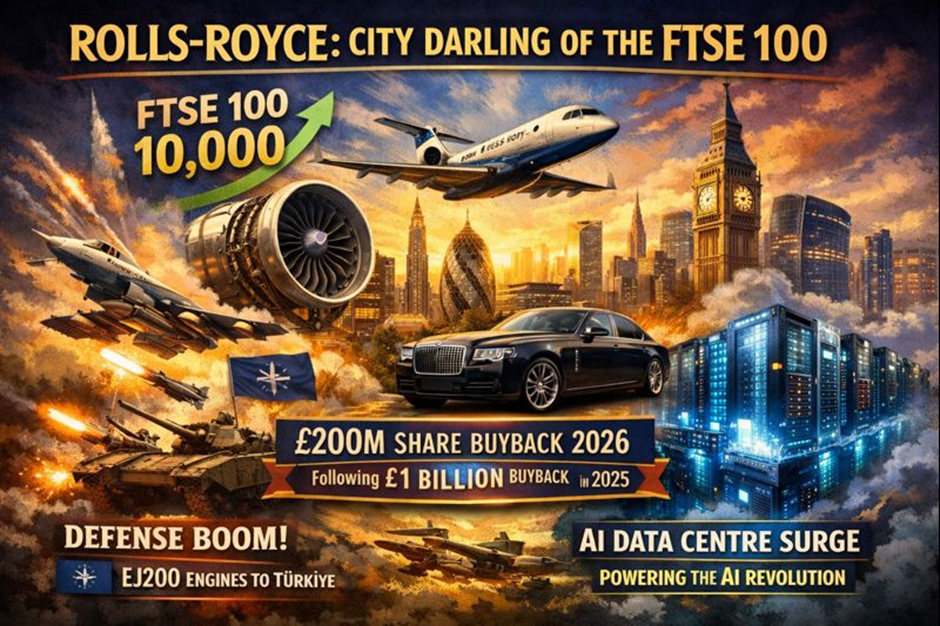
On January 2, 2026, Rolls-Royce Holdings PLC (LSE: RR) continued its meteoric rise, with its stock price jumping approximately 4% to reach a new 52-week high of 1,198p. This surge occurred as the FTSE 100 crossed the historic 10,000-point threshold, led by a bullish outlook on the aerospace and defense sectors.
The 4% Surge: Key Reasons & Market Drivers
Source: Kalkine Group
The primary catalyst for the January 2 gain was a combination of sector-wide rotation into defense and company-specific momentum following a record-breaking 2025.
- New Year Optimism & Index Milestones: As the FTSE 100 hit 10,000, "City Darling" Rolls-Royce became a primary vehicle for investors seeking exposure to high-growth UK industrials.
- Share Buyback Momentum: The company confirmed a new £200 million share buyback program starting in January 2026, following the completion of a massive £1 billion buyback in late 2025.
- Defense Spending Tailwinds: Increased NATO defense budgets and new export deals (notably for EJ200 engines to Türkiye) have solidified the "Defense as a Growth Engine" narrative.
- AI Data Centre Demand: The Power Systems division is seeing unprecedented demand for backup power solutions driven by the global AI infrastructure build-out.
The 2026 Business Model: From Turnaround to Titan
Under CEO Tufan Erginbilgiç, the business model has shifted from a "recovery play" to a high-margin, cash-generative powerhouse.
The Three Pillars of the Latest Model:
- Civil Aerospace (LTSA Focus): Moving away from just selling engines to high-margin Long-Term Service Agreements (LTSAs). Revenue is now tied to "flying hours," making income more predictable.
- Defense & Nuclear Innovation: Positioning itself as the leader in Small Modular Reactors (SMRs). This transforms Rolls-Royce from an engine maker to a clean-energy utility provider.
- Power Systems & AI: Re-engineering engines for data center backup and 100% methanol marine propulsion, targeting the "net-zero" transition.
Financial & Operational Updates (Latest)
- Operating Profit: Projected to reach between £3.1bn and £3.2bn for FY25, with guidance for 2026 showing further margin expansion.
- Free Cash Flow (FCF): The company expects FCF of £3.0bn to £3.1bn, a drastic turnaround from the "cash-burn" years of the pandemic.
- Debt Reduction: Repaid a $1bn bond in October 2025; currently operating with a net cash position of approximately £2bn.
- Operational Milestone: Large-engine flying hours in 2025 reached 109% of 2019 (pre-pandemic) levels, proving the aviation recovery is complete.
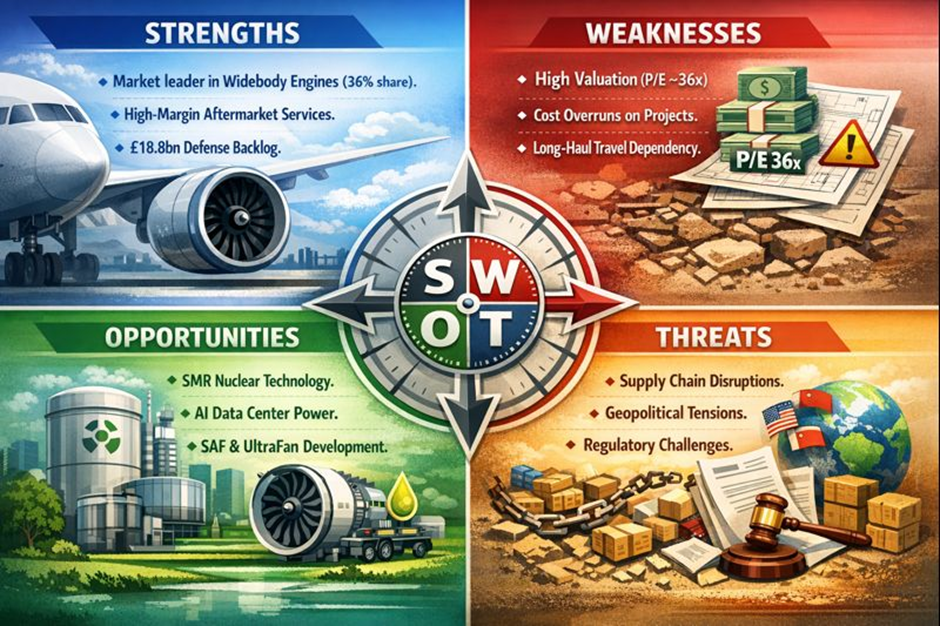
SWOT Analysis
Source: Kalkine Group
Key Risks to Watch
Despite the euphoria, several "tripwires" remain for 2026:
- Valuation Friction: With a P/E ratio exceeding 36x, the stock is "priced for perfection." Any slight earnings miss could trigger a sharp correction.
- Supply Chain: Lingering inflation in aerospace-grade alloys and labor shortages could squeeze margins.
- The SMR "Glow": While exciting, Small Modular Reactors are still in the regulatory phase. Any delays in government approval for the first sites would dent the long-term growth story.
Conclusion
Rolls-Royce has transitioned from a distressed asset to the crown jewel of the FTSE 100. Its 4% jump on the first trading days of 2026 reflects a market that views the company not just as an airline supplier, but as a critical player in global defense and the AI energy transition. While the stock's "rampant" growth may slow as it reaches a £100bn market cap, its operational fundamentals have rarely looked stronger.


 Jun 03, 2026




 Please wait processing your request...