
 AU
AU
 CA
CA
 US
US
 NZ
NZ
 IND
IND

 UK
UK

 Share
Share
 X (Formerly Twitter)
 Whatsapp
 Facebook
 LinkedIn
 Telegram
 Email This Article
 Copy Link
 Summarize with AI
 Chat GPT
 Perplexity

Seascape Energy Asia (LSE: SEA) surged ~13.2% on December 24, 2025, closing around GBX 73 (up from recent lows). This double-digit move wasn't just holiday cheer—it signals a potential structural re-rating as smart money connects the dots between a massive peer valuation read-across and imminent operational catalysts.
Here is the analytical deep-dive into why this Southeast Asian gas play is heating up.
- The 3 Key Drivers Behind the 13.2% Surge
Why the sudden jump? It’s a combination of specific external validation and internal milestones converging at year-end.
Source: Kalkine Group
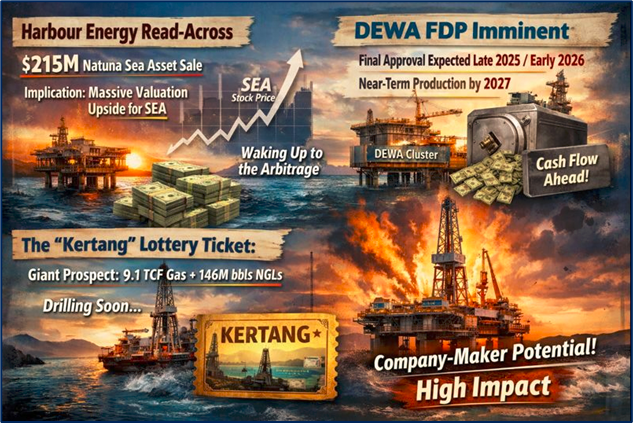
- The "Harbour Energy" Read-Across (Valuation Floor): Earlier this month (Dec 8, 2025), Harbour Energy sold its interest in the Natuna Sea Block A and Tuna projects for $215 million cash.
- The Connection: Analysts noted this deal values comparable regional gas assets significantly higher than SEA’s current market cap. The sale implied a valuation metric that, if applied to Seascape’s resources (specifically the DEWA and Temaris clusters), suggests the stock has been trading at a massive discount. The market is effectively "waking up" to this arbitrage.
- DEWA Field Development Plan (FDP) Imminent: Investors are positioning for the final submission/approval of the DEWA Cluster FDP, expected late 2025/early 2026. This transforms SEA from an explorer into a near-term producer with visible cash flows by 2027. The 13% move suggests leaked confidence or "front-running" of this regulatory milestone.
- The "Kertang" Lottery Ticket: With the JV partners (led by major Inpex) officially approving the drilling of the giant Kertang prospect (estimated 9.1 TCF gas + 146m bbls NGLs) back in October, the timeline for the actual "spud" (drilling start) is nearing. As we enter 2026, the "pre-drill hype" premium is starting to build. Kertang is a company-maker; even a 10% stake is worth multiples of the current share price if successful.
- SWOT Analysis

Source: Kalkine Group
Strengths
- Elite Partnerships: Partnered with Inpex (Japan’s largest E&P) on Block 2A. This validates the asset quality and removes funding stress for the expensive exploration phase.
- Gas-Weighted Portfolio: ~90% gas resources align perfectly with Asia’s energy transition and high demand for LNG feedstock.
- Clean Balance Sheet: Post-Norway exit, the company is lean, with cash reserves bolstered by farm-out carries (Inpex covers costs).
Weaknesses
- Micro-Cap Liquidity: Daily volume can be thin, leading to jagged chart moves (like the 13% jump). Hard for institutions to build large positions without moving the price.
- Revenue Gap: Currently pre-production. The company relies on cash on hand and carries, with no significant operational revenue until DEWA comes online (~2027).
Opportunities
- Temaris Cluster Upgrade: Recent seismic interpretation suggests the Temaris gas volume could be 4x larger than initially thought (potential 1 TCF).
- M&A Consolidation: The SE Asian basin is consolidating. SEA is a prime takeover target for a mid-cap looking for immediate reserves.
Threats
- Drilling Failure: Kertang is a high-reward, but high-risk "wildcat" well. A dry hole would wipe out the "blue sky" premium (though DEWA provides a floor).
- Regulatory Drag: Delays in Petronas approvals for the DEWA FDP would push back first gas and cash flow projections.
Seascape has successfully pivoted from a high-cost Norwegian model to a high-margin Southeast Asian model.
- Strategy: Acquire discovered but undeveloped gas fields (DEWA, Temaris) in shallow waters (low capex).
- Execution: Secure a "Big Brother" partner (like Inpex or EnQuest) to pay for the heavy lifting (drilling/infrastructure) in exchange for equity.
- Goal: Retain a material stake (10-40%) for free (carried interest) and reach "First Gas" quickly to fund further growth.
- Financial & Operational Pulse (Late 2025 Update)
- Financials:
- Cash Position: Healthy (~£6-10m estimated), sufficient to reach FDP approval without immediate dilution.
- Burn Rate: Drastically reduced after the Norway exit; corporate overheads are now "right-sized" for the AIM market (~£3m/year).
- Operations:
- Block 2A (Kertang): Drilling rig procurement likely underway. This is the biggest catalyst for 2026.
- DEWA Cluster: Moving from "Contingent Resources" to "Reserves" upon FDP approval—this is an immediate accounting value uplift.
- Key Risks
- Execution Risk: Can the management deliver the FDP on time? Delays kill IRR (Internal Rate of Return).
- Geological Risk: While DEWA is "discovered" (lower risk), Kertang is "exploration" (binary risk). Don't bet the house on Kertang alone.
- Sentiment Risk: AIM small-caps are sentiment-driven. If the broader energy sector cools off, SEA could drift lower regardless of progress.
- Conclusion
The 13.2% move on Christmas Eve wasn't a glitch; it was a repricing event. The market is catching up to the fact that Seascape holds a free-carried lottery ticket (Kertang) and a bread-and-butter cash cow (DEWA) that is about to get the green light.
With the Harbour Energy deal proving the value of SE Asian gas assets, SEA currently trades at a fraction of its potential Net Asset Value (NAV). If the DEWA FDP is signed and the Kertang drill bit spins in 2026, 73p might look like a bargain in the rearview mirror.


 Jun 24, 2026




 Please wait processing your request...