
 AU
AU
 CA
CA
 US
US
 NZ
NZ
 IND
IND

 UK
UK

 Share
Share
 X (Formerly Twitter)
 Whatsapp
 Facebook
 LinkedIn
 Telegram
 Email This Article
 Copy Link
 Summarize with AI
 Chat GPT
 Perplexity
Image source: Shutterstock
Highlights
- Seplat's FY24 revenue rose 5.2% YoY to USD 1,116.2 million, driven by a 10% increase in crude oil volumes
- The company’s EBITDA for FY24 surged 20.3% YoY to USD 539 million, supported by higher production and a non-cash gain from SEPNU's acquisition
- Seplat raised its FY24 dividend to US 16.5 cents per share, a 10% increase over the previous year, including a special dividend
- Seplat’s FY25 production guidance indicates up to 165% YoY growth, led by SEPNU and ramping up onshore drilling
Seplat Energy PLC (LSE:SEPL), listed on the FTSE index, is a Nigerian-based independent energy company specializing in oil and gas exploration, development, production, and gas processing operations.
Seplat Energy’s revenue for the financial year 2024 (FY24) increased by 5.2% year-on-year, reaching USD 1,116.2 million, up from USD 1,061.3 million in FY23. This growth was driven by a 10% rise in crude oil volumes, totaling 12.4 MMbbls in FY24 (FY23: 11.3 MMbbls), alongside contributions from SEPNU following its acquisition.
EBITDA for FY24 saw a significant 20.3% increase to USD 539 million from USD 448.2 million in FY23. This growth was primarily due to an 11% increase in the group's working interest production, reaching 52,947 boepd, and a non-cash gain of USD 86 million from the SEPNU acquisition.
In addition, the company raised its total dividend for FY24 to US 16.5 cents per share, which includes a special dividend of US 3.3 cents per share. This represents a 10% rise compared to FY23.
Recent Business Update
On March 19, 2025, Seplat Energy PLC announced the results of its cash tender offer for the 7.750% senior notes due 2026. By the expiration deadline of March 18, 2025, USD 567.5 million, or approximately 87.3% of the total outstanding principal, was successfully tendered and not withdrawn.
Company Outlook
Seplat Energy's FY25 production guidance is set at 120–140 kboepd, reflecting potential growth of up to 165% YoY, driven by SEPNU’s expected production of 72–84 kboepd and an increase in onshore drilling activities.
The company expects that the guided capex of USD 260–320 million will fund 13 new wells and integrity upgrades at its offshore SEPNU assets. Additionally, with the commissioning of ANOH in 2Q25 and Sapele ramping up to 90 MMscfd, onshore gas volumes are expected to increase significantly in H2. Seplat is also advancing its ESG strategy with flare-out initiatives at Sapele and Oben, expected to reduce emissions and enhance operational efficiency, positively impacting investor sentiment.
Top 10 Shareholders
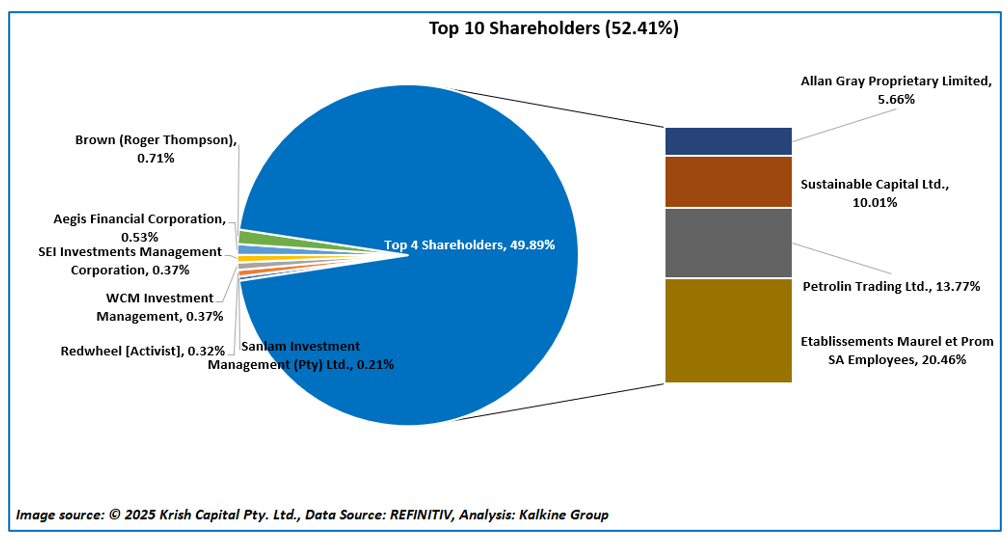
The top 10 shareholders of SEPL together hold approximately 52.41% of the company’s total shares. The largest shareholder is Etablissements Maurel et Prom SA Employees, with around 20.46% stake, followed by Petrolin Trading Ltd. with about 13.77% stake, as shown in the chart below.
Stock Information
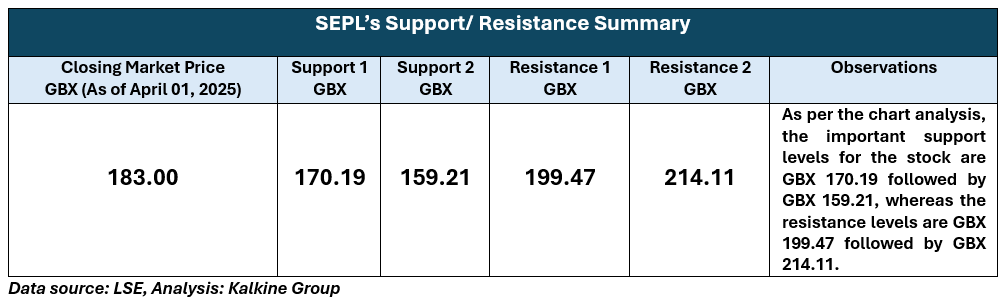
The stock has declined by approximately 6.15% over the past three months and 6.62% over the last six months. It has a 52-week low of GBX 140.84 and a high of GBX 243.00, currently trading below the average of these two values. As of 01 April, the stock’s closing price was GBX 183.00.

Note 1: Past performance is not a reliable indicator of future performance.
Note 2: The reference data for all price data, currency, technical indicators, support, and resistance levels is 01 April 2025. The reference data in this report has been partly sourced from EODHD/Others.
Technical Indicators Defined
Support: A level at which the stock prices tend to find support if they are falling, and a downtrend may take a pause backed by demand or buying interest. Support 1 refers to the nearby support level for the stock and if the price breaches the level, then Support 2 may act as the crucial support level for the stock.
Resistance: A level at which the stock prices tend to find resistance when they are rising, and an uptrend may take a pause due to profit booking or selling interest. Resistance 1 refers to the nearby resistance level for the stock and if the price surpasses the level, then Resistance 2 may act as the crucial resistance level for the stock.


 Jun 24, 2026




 Please wait processing your request...