
 AU
AU
 CA
CA
 US
US
 NZ
NZ
 IND
IND

 UK
UK

 Share
Share
 X (Formerly Twitter)
 Whatsapp
 Facebook
 LinkedIn
 Telegram
 Email This Article
 Copy Link
 Summarize with AI
 Chat GPT
 Perplexity
Severfield PLC (LSE: SFR), the UK’s structural steel powerhouse, closed the 2025 trading year on a high note, with its share price jumping ~3.2% on December 31, 2025, to finish at GBX 28.90.
After a turbulent year defined by a high-profile "bridge crisis" and a significant profit warning in March, the year-end rally signals a shift in retail sentiment toward a "trough-is-in" recovery narrative for 2026.
The 31st December Rally: Key Drivers
While the broader FTSE All-Share remained relatively flat, Severfield’s outperformance was driven by a confluence of technical and fundamental factors:
Source: Kalkine Group
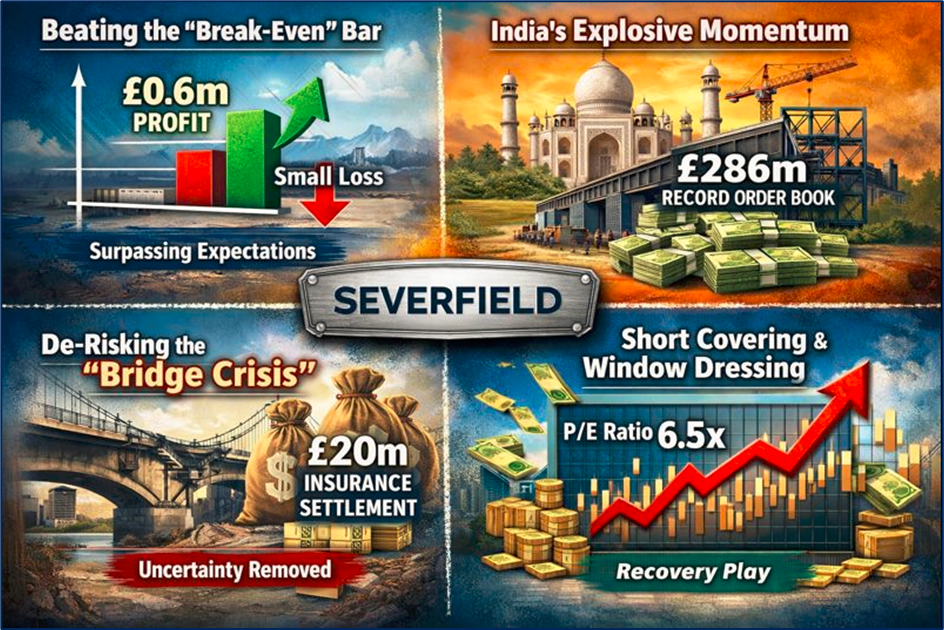
- Beating the "Break-Even" Bar: Investors are still reacting to the December 2nd Interim Results, where Severfield reported an underlying profit of £0.6m. While this was a 96% drop year-over-year, it crucially beat analyst expectations of a "small loss," proving the company’s resilience in a brutal pricing environment.
- India’s Explosive Momentum: The JSW Severfield Structures (JSSL) joint venture in India is the group’s "hidden gem." With a record order book of £286m (up 45% YoY) and a new facility in Gujarat coming online in early 2026, the market is beginning to value the India business as a high-growth engine distinct from the sluggish UK market.
- De-risking the "Bridge Crisis": The completion of the insurance settlement—securing £20.0m in proceeds for bridge remedial works—has removed a massive overhang of uncertainty that plagued the stock since late 2024.
- Short Covering & Window Dressing: As a classic "value play" with a P/E ratio now sitting around 6.5x, institutional fund managers likely adjusted positions on the final day of the year to include "beaten-down" recovery stories for their 2026 portfolios.
The 2026 Business Model: From Steel Fabricator to Solutions Partner
Severfield has evolved its model to combat the "commodity" trap of simple steel fabrication.
- Core Construction: Dominating the UK market with a 150,000-tonne annual capacity, focusing on complex "anchor" projects like data centers, nuclear (Sellafield), and stadia (Everton Stadium).
- Modular & Product Innovation: The Severstor division provides modular housing units for power and data sectors, offering higher margins than traditional structural steel.
- Global Diversification: Shifting capital toward India (JSSL), where steel demand is skyrocketing due to infrastructure expansion and a shift away from concrete.
- Operational Gearing: By cutting costs and reducing capex in 2025, the company is now lean. Even a small 5% recovery in market demand in 2026 could lead to a massive "bounce-back" in profits due to high operational gearing.
Latest Financial & Operational Snapshot
Source: Company Data
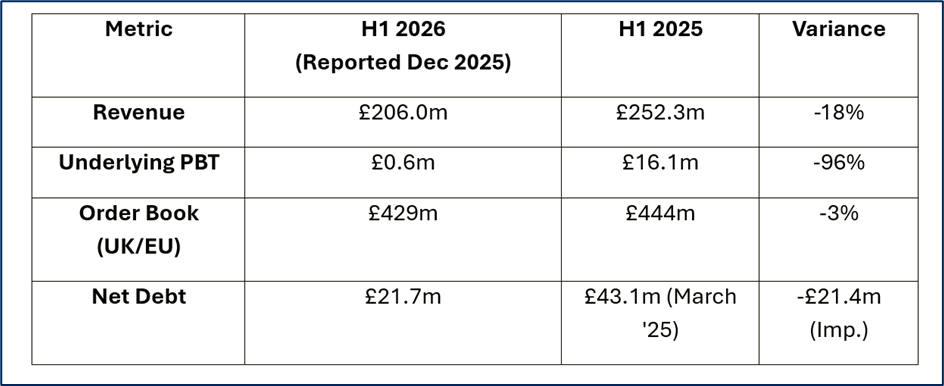
- Operational Wins: Secured £190m of new work in H1 2026.
- Cash Position: Net debt nearly halved in six months, providing a £50m+ headroom in their revolving credit facility.
- Leadership: New CEO Paul McNerney is set to unveil a refreshed "Strategic Roadmap" in early 2026, which the market is eagerly anticipating.
SWOT Analysis: The 2026 Outlook
Source: Kalkine Group
Strengths
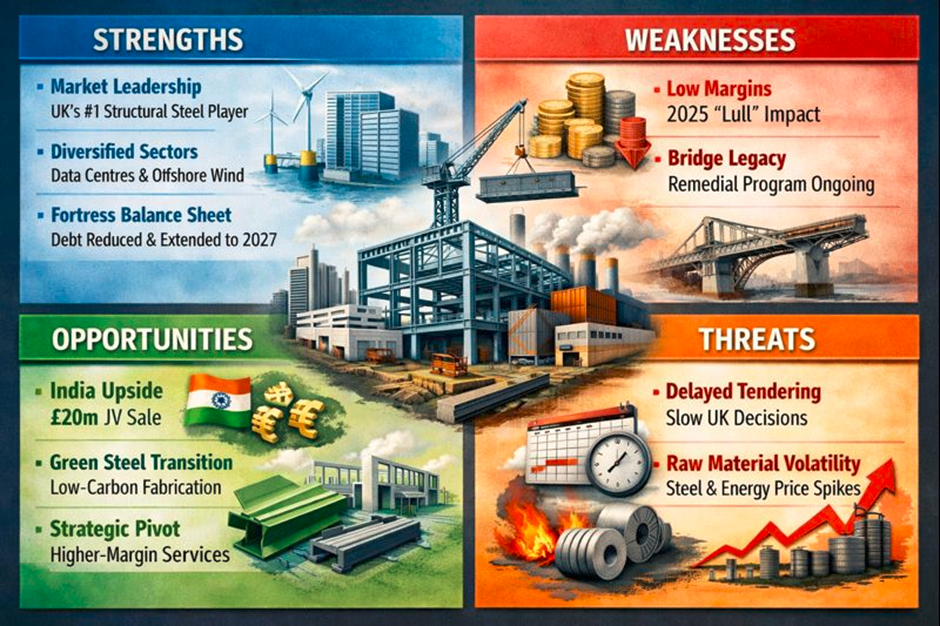
- Market Leadership: UK’s largest structural steel player with unparalleled technical expertise in "mega-projects."
- Diversified Sectors: Exposure to high-growth areas like Data Centres and Offshore Wind (Hornsea 3).
- Fortress Balance Sheet: Significant debt reduction and successfully extended banking facilities to 2027.
Weaknesses
- Low Margins: Current operating margins are thin due to "commodity" project substitution during the 2025 lull.
- Bridge Legacy: While insurance is settled, the remedial work program still requires management bandwidth through 2026.
Opportunities
- India Upside: Potential to sell a 24.9% stake in the Indian JV for up to £20m, providing a massive cash injection.
- Green Steel Transition: Lead the market in low-carbon steel fabrication as ESG requirements for tier-1 contractors tighten.
- Strategic Pivot: The new CEO may shift focus toward higher-margin maintenance and modular services.
Threats
- Delayed Tendering: Client decision-making in the UK remains slow due to high interest rates and subdued economic confidence.
- Raw Material Volatility: Any sudden spike in global steel or energy prices could squeeze the fixed-price contracts currently in the order book.
Critical Risks to Watch
- The "L-Shaped" Recovery: If the anticipated 2026/27 market recovery in the UK commercial sector stalls, the "bounce-back" narrative could fail.
- Project Concentration: The absence of multiple "mega-anchor" projects means the company is more reliant on a higher volume of smaller, more competitive bids.
- Execution Risk: Any further technical issues similar to the 2024 bridge welding problems would be catastrophic for the stock's hard-won "recovery" reputation.
Conclusion
Severfield’s 3.2% gain on New Year's Eve is more than just a daily fluctuation; it is a signal that the market has likely priced in the "worst-case scenario" of 2025. With a record order book in India, a stabilized balance sheet, and a valuation that looks "dirt cheap" compared to historical norms, the steel giant enters 2026 as a classic contrarian play. Investors are no longer looking at the losses of the past; they are looking at the "operational gearing" potential of the future.


 Jun 03, 2026




 Please wait processing your request...