
 AU
AU
 CA
CA
 US
US
 NZ
NZ
 IND
IND

 UK
UK

 Share
Share
 X (Formerly Twitter)
 Whatsapp
 Facebook
 LinkedIn
 Telegram
 Email This Article
 Copy Link
 Summarize with AI
 Chat GPT
 Perplexity
Silver Shatters $100: The New Era of the "White Gold" Rush
The psychological glass ceiling has finally shattered. As silver decisively breached the $100 per ounce mark in January 2026, the global financial landscape shifted, transforming the "poor man’s gold" into the premier industrial and monetary asset of the decade. This historic surge is not merely a speculative spike but the culmination of a structural deficit years in the making, fueled by an insatiable appetite for the metal in the green energy transition and a massive flight to safety amid escalating geopolitical friction.
For the London Stock Exchange, this rally has breathed fire into the FTSE’s mining heavyweights, turning once-steady dividend payers into high-octane engines of capital appreciation. As the gold-to-silver ratio compresses toward levels not seen in a generation, the market is no longer asking if silver is undervalued, but rather how high the ceiling truly sits in this new triple-digit reality.
Surge Drivers and the 2026 Catalyst
Source: Kalkine Group
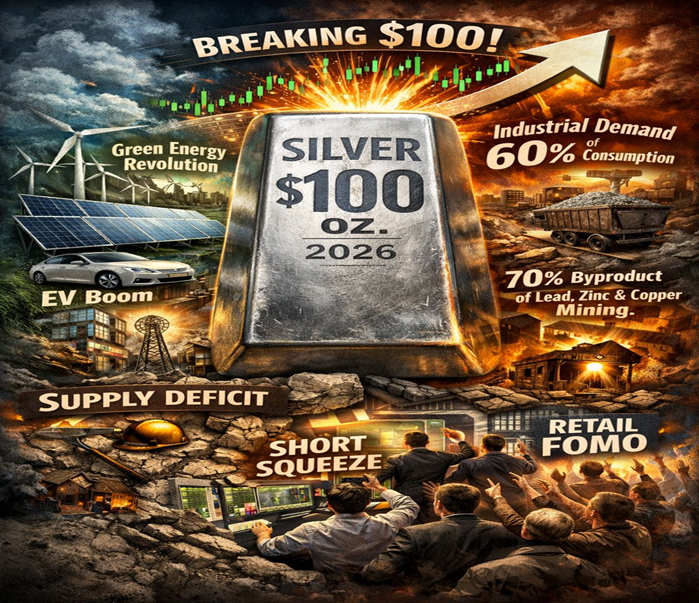
The rally to $100 has been propelled by a "perfect storm" of fundamental and technical drivers. Industrial demand now accounts for over 60% of total consumption, with the solar photovoltaic (PV) sector alone requiring over 125 million ounces annually as global capacity hits 665 GW (Equiti, 2026). This is compounded by the Greening of the Grid—silver's unmatched conductivity makes it indispensable for EV components and 5G infrastructure.
On the supply side, the market is grappling with a persistent multi-year deficit. Over 70% of silver is produced as a by-product of lead, zinc, and copper mining, meaning primary silver supply cannot react quickly to price signals (Equiti, 2026). Furthermore, 2026 has seen a significant "Geopolitical Safe-Haven" pivot. Tensions involving trade policies and territorial disputes have triggered a massive short squeeze and retail FOMO, pushing prices through the $100 barrier (AJ Bell, 2026).
Top 5 FTSE Silver Stocks to Watch
- Fresnillo PLC (LSE: FRES)
- Business Model: As the world’s largest primary silver producer, Fresnillo operates high-margin mines across Mexico. Its model focuses on maintaining a disciplined cost base while leveraging its vast reserve life to sustain production through price cycles.
- Latest Updates: In its recent operational guidance, higher metal prices accounted for 69% of the $630m extra gross profit in the first half of the prior year, even as production volumes saw a slight dip.
- Dividends: A final dividend for 2025 is forecast to be declared on March 3, 2026, with a payment date expected on May 29, 2026 (DividendMax, 2026).
- SWOT Analysis:
- Strengths: Massive scale; world-class assets like Juanicipio.
- Weaknesses: Geographic concentration in Mexico; vulnerability to local regulatory shifts.
- Opportunities: Optimization of the Juanicipio ramp-up to increase attributable production.
- Threats: Rising operational costs (AISC) due to inflationary pressures in Mexico.
- Hochschild Mining (LSE: HOC)
- Business Model: An underground mining specialist focused on high-grade silver and gold deposits in the Americas (Peru, Argentina, and Brazil). Its model prioritizes exploration to replace reserves in established districts.
- Latest Updates: The company recently reported a forward dividend yield of approximately 0.25% as of January 2026, reflecting a strategy of reinvesting cash flow into production growth (Digrin, 2026).
- Dividends: Paid an interim dividend of 0.74p in late 2025; investors are eyeing the 2026 final dividend announcement (Fidelity, 2026).
- SWOT Analysis:
- Strengths: High-grade ore bodies; agile management.
- Weaknesses: Political volatility in Peru.
- Opportunities: Expansion of the Mara Rosa project in Brazil.
- Threats: Narrower margins if silver prices retreat from $100.
- Glencore PLC (LSE: GLEN)
- Business Model: A diversified natural resource giant. Unlike primary miners, Glencore produces silver as a by-product of its massive copper and zinc operations, coupled with a world-leading marketing (trading) division.
- Latest Updates: Glencore is scheduled to release its 2025 Full Year Production Report on January 29, 2026 (Glencore, 2026). Recent acquisitions, such as the Quechua project in Peru, aim to strengthen its transition metals portfolio.
- Dividends: Glencore maintains a policy of returning significant capital through base and variable dividends, often exceeding peer yields during commodity booms.
- SWOT Analysis:
- Strengths: Massive diversification; dominant global trading arm.
- Weaknesses: High exposure to coal (though divestment is planned); complex regulatory history.
- Opportunities: Leadership in the "Circular Economy" through its Britannia Refined Metals recycling plant.
- Threats: Global economic slowdown dampening demand for base metals.
- Antofagasta PLC (LSE: ANTO)
- Business Model: Primarily a copper producer in Chile, but a significant silver by-product contributor. Its model relies on low-cost, large-scale Chilean operations and proximity to Asian export markets.
- Latest Updates: A Q4 2025 production report is due on January 29, 2026, with investors looking for signals on 2026 production guidance (IG, 2026).
- Dividends: A final 2025 dividend payment is scheduled for May 2026 (Antofagasta, 2026).
- SWOT Analysis:
- Strengths: Premier asset quality; strong operational cash flow.
- Weaknesses: High sensitivity to copper prices; water scarcity issues in Chile.
- Opportunities: Desalination plant expansions to secure long-term water supply.
- Threats: Potential Chilean tax reform and mining royalty increases.
- Pan African Resources (LSE: PAF)
- Business Model: A mid-tier producer traditionally focused on gold, but increasingly relevant due to its expanded production guidance and the rising precious metals tide. Its model focuses on low-cost tailings retreatment and high-grade underground mining.
- Latest Updates: The company is embarking on a significant expansion phase, aiming to increase gold output by 100,000 ounces in FY2026 via the Mintails project (Pan African Resources, 2025).
- Dividends: Management will consider paying an interim dividend in FY2026 if precious metal prices remain elevated (Miningmx, 2025).
- SWOT Analysis:
- Strengths: Industry-leading costs in tailings retreatment.
- Weaknesses: South African jurisdictional risk (power and security).
- Opportunities: Main Market listing in London to attract institutional flows.
- Threats: Volatile Rand/Dollar exchange rates.
2026 Outlook and Risks
The outlook for the remainder of 2026 remains structurally bullish due to the widening gap between supply and demand. Analysts suggest that if silver maintains its momentum, targets of $120 per ounce are within reach (Equiti, 2026). However, the road to $120 is fraught with volatility.
Key Risks include:
- Technical Fatigue: After a 35% surge in early 2026, "bearish RSI divergence" suggests the market may be due for a short-term correction or profit-taking (Times of India, 2026).
- Cost Inflation: All-In Sustaining Costs (AISC) for silver miners are rising. For instance, Pan American Silver expects 2026 AISC between $15.75 and $18.25 per ounce due to higher royalties and labor costs (Pan American Silver, 2026).
- Geopolitical Reversals: A sudden de-escalation in global trade wars could puncture the "safe-haven bubble."
Conclusion
Silver’s journey to $100 has rewritten the commodity playbook for 2026. While gold captured the headlines for decades, silver’s unique dual identity—as both a critical industrial component and a monetary shield—has made it the standout performer of the new energy era. For the FTSE miners, this $100 milestone represents a paradigm shift in profitability, provided they can manage the rising costs of extraction and the inherent volatility of a "blow-off top" market. The "White Gold" rush is no longer a forecast; it is the current reality of the global market.


 Jun 03, 2026




 Please wait processing your request...