
 AU
AU
 CA
CA
 US
US
 NZ
NZ
 IND
IND

 UK
UK

 Share
Share
 X (Formerly Twitter)
 Whatsapp
 Facebook
 LinkedIn
 Telegram
 Email This Article
 Copy Link
 Summarize with AI
 Chat GPT
 Perplexity
The final trading days of 2025 are proving to be "ignition time" for the world’s first listed space tech fund. On December 30, 2025, Seraphim Space Investment Trust (LSE: SSIT) saw its share price surge by approximately 7%, closing the year on a high note.
For retail investors who have watched the "Space Race 2.0" from the sidelines, this jump isn't just a holiday fluke—it’s the result of a massive shift in global defense and a "unicorn" validation.
The Launchpad: Key Drivers Behind the Dec 30 Surge
The 7% jump is the culmination of several high-velocity updates that hit the wires in late December:
Source: Kalkine Group
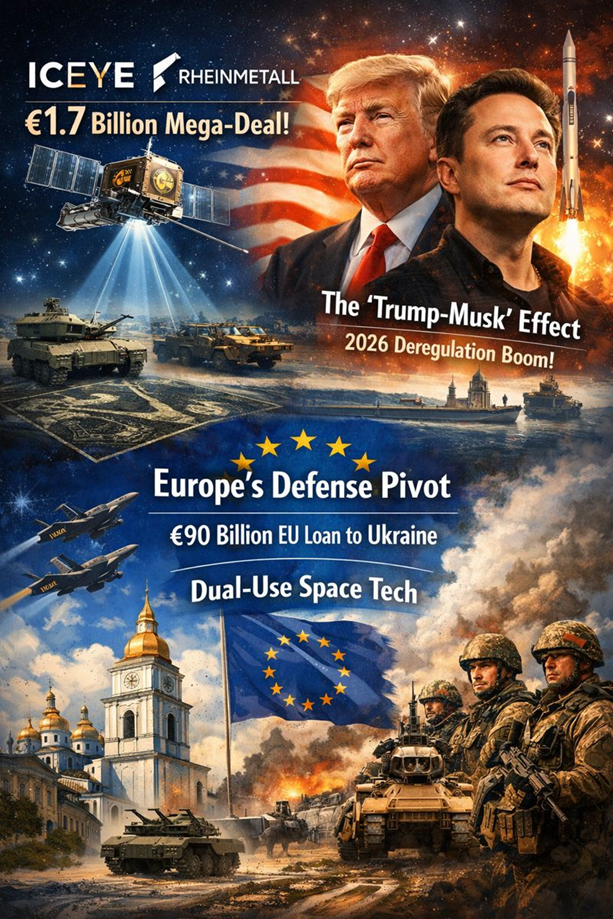
- The €1.7 Billion "Mega-Deal": Portfolio heavyweight ICEYE (representing ~25% of SSIT's NAV) signed a massive contract with Rheinmetall. This deal transforms ICEYE from a satellite operator into a critical defense infrastructure provider for Europe.
- The "Trump-Musk" Effect: As we head into 2026, the market is pricing in a massive deregulatory and pro-space agenda in the US. With Elon Musk’s influence reaching new heights, investors are betting on a "rising tide" that lifts all SpaceTech boats, especially those like SSIT that provide access to private titans.
- Europe’s Defense Pivot: A €90 billion EU loan to Ukraine and shifting NATO priorities have turned "dual-use" space tech (satellites that serve both civilian and military needs) into the most sought-after asset class in the FTSE.
Latest Business Model: From "Venture" to "Strategic Infrastructure"
Seraphim has evolved its model significantly in 2025. It no longer just bets on "moonshots"; it focuses on Digital Infrastructure in the Sky.
- Dual-Use Strategy: SSIT is now laser-focused on companies like ICEYE, HawkEye 360, and LeoLabs that provide "sovereign capabilities." If a nation needs to see through clouds or track "dark ships," they use SSIT’s portfolio.
- Information Asymmetry: Leveraging their "Seraphim Accelerator," the trust gets first look at 70+ deals a month, allowing them to cherry-pick winners before they hit the broader VC market.
- Path to Profitability: In 2025, SSIT shifted from funding "growth at all costs" to supporting companies with "robust runways." Over 60% of their portfolio is now fully funded to profitability or the next major liquidity event.
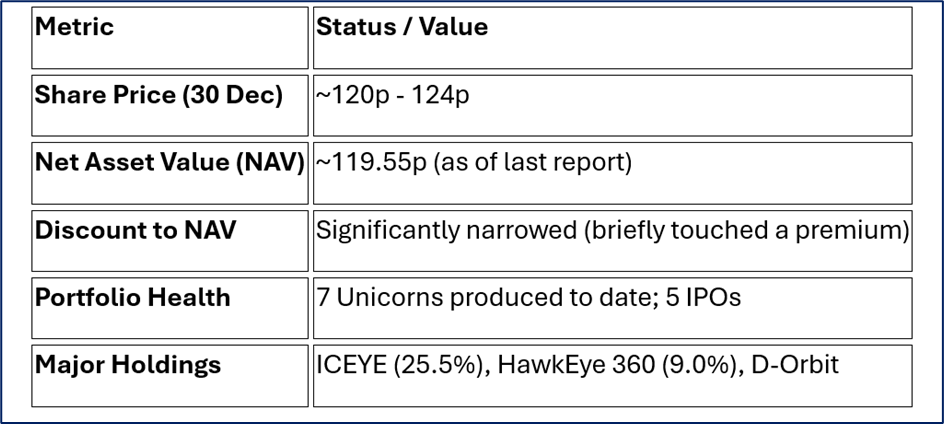
Financial & Operational Update (Year-End 2025)
Source: Company Data
Operational Milestone: The trust successfully realized profits from its AST SpaceMobile investment earlier in 2025, boosting cash reserves to approximately £22.6m for new "Series B" deployments.
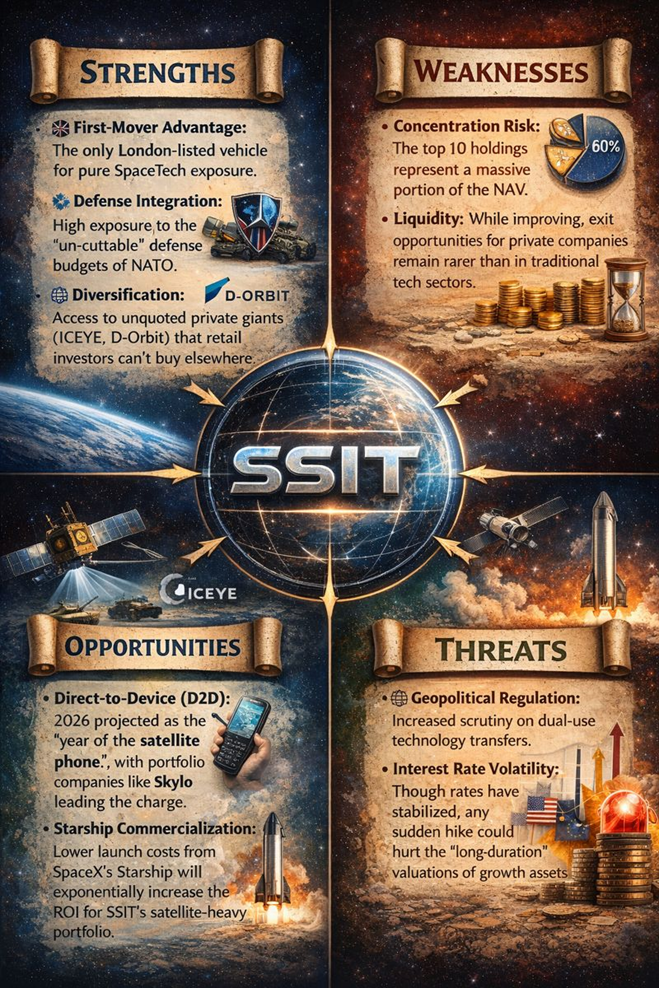
SWOT Analysis: The "New Space" Reality
Source: Kalkine Group
Strengths
- First-Mover Advantage: The only London-listed vehicle for pure SpaceTech exposure.
- Defense Integration: High exposure to the "un-cuttable" defense budgets of NATO.
- Diversification: Access to unquoted private giants (ICEYE, D-Orbit) that retail investors can't buy elsewhere.
Weaknesses
- Concentration Risk: The top 10 holdings represent a massive portion of the NAV.
- Liquidity: While improving, exit opportunities for private companies remain rarer than in traditional tech sectors.
Opportunities
- Direct-to-Device (D2D): 2026 is projected as the "year of the satellite phone," with portfolio companies like Skylo leading the charge.
- Starship Commercialization: Lower launch costs from SpaceX’s Starship will exponentially increase the ROI for SSIT’s satellite-heavy portfolio.
Threats
- Geopolitical Regulation: Increased scrutiny on dual-use technology transfers.
- Interest Rate Volatility: Though rates have stabilized, any sudden hike could hurt the "long-duration" valuations of growth assets.
Risks: Staying Grounded
Investing in space is high-stakes. Technical anomalies (satellite failures) can wipe out a holding's value overnight. Furthermore, the discount to NAV can be volatile; even if the underlying companies grow, the share price might not follow if UK market sentiment sours on growth stocks.
Conclusion: A "Stellar" Outlook for 2026?
The 7% jump on December 30, 2025, isn't just "Santa Rally" noise. It is a fundamental re-rating of Seraphim Space as a strategic defense and data play rather than a speculative tech gamble. With ICEYE reaching unicorn status and the US/UK governments treating space as the "ultimate high ground," SSIT is moving from the fringes to the core of the modern industrial portfolio.


 Jun 24, 2026




 Please wait processing your request...