
 AU
AU
 CA
CA
 US
US
 NZ
NZ
 IND
IND

 UK
UK

 Share
Share
 X (Formerly Twitter)
 Whatsapp
 Facebook
 LinkedIn
 Telegram
 Email This Article
 Copy Link
 Summarize with AI
 Chat GPT
 Perplexity
What Is the SUK2 ETF?
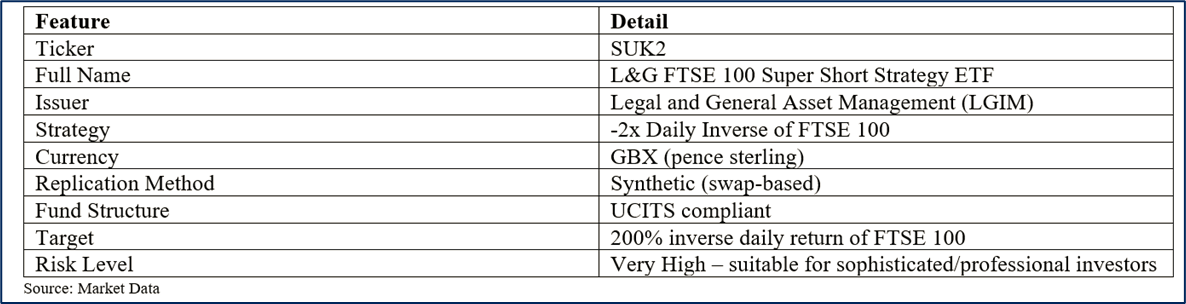
The L&G FTSE 100 Super Short Strategy ETF (SUK2) is a specialist, leveraged inverse ETF that is designed to deliver twice the inverse of the daily performance of the FTSE 100 Index. Managed by Legal & General Asset Management (LGIM) — one of the UK's largest institutional asset managers — SUK2 is a product built for sophisticated investors seeking to profit from, or hedge against, declines in the FTSE 100.
On February 27, 2026, with the FTSE 100 rising, SUK2 is trading at GBX 185.95, down ~-1% — exactly as designed. When the FTSE 100 goes up, SUK2 goes down by approximately double the daily percentage move.
This is not a standard buy-and-hold investment. SUK2 is a tactical, short-term trading tool and is fundamentally different from the other FTSE 100 ETFs discussed in this series.
SUK2 ETF Key Facts and Specifications
Legal & General Asset Management: The Issuer Behind SUK2
Legal & General Asset Management (LGIM) is the investment management arm of Legal & General Group, one of the UK's largest financial services organisations. LGIM manages approximately £1.3 trillion in assets (as of recent figures), making it one of the largest asset managers in Europe and a significant global institutional investor.
LGIM is well-known in the UK for managing pension funds, insurance assets, and a broad range of index and active investment strategies. The company's ETF range spans standard index trackers through to specialist strategies like SUK2, offering institutional and sophisticated retail investors the full spectrum of market exposures.
What Does "Super Short" and "-2x" Actually Mean?
The "Super Short" in SUK2's name signals its leveraged inverse nature. Understanding this requires unpacking two distinct concepts:
1. Inverse (Short) Exposure
An inverse ETF is designed to move in the opposite direction to its benchmark. If the FTSE 100 rises 1%, a standard inverse ETF falls approximately 1%, and vice versa. This is the economic equivalent of holding a short position on the index without needing a margin account or a derivatives trading facility.
2. Leverage (2x)
The "Super" and "2x" component means SUK2 targets twice the inverse daily return. So:
If the FTSE 100 rises 1% in a day → SUK2 targets a fall of approximately 2%
If the FTSE 100 falls 1% in a day → SUK2 targets a gain of approximately 2%
On February 27, 2026, with the FTSE 100 up approximately +0.52%, SUK2's fall of ~-1% is consistent with this 2x inverse relationship.
The Mechanics: Swap-Based Replication
To achieve this leveraged inverse exposure, SUK2 uses total return swap contracts with investment bank counterparties. Rather than shorting individual stocks (which would be operationally complex and capital- intensive), the fund's swap agreements contractually deliver the desired -2x daily return of the FTSE 100.
The Critical Concept: Daily Rebalancing and Compounding Decay
The most important feature that differentiates SUK2 from a conventional ETF — and the most misunderstood — is the effect of daily rebalancing and compounding decay (also called "volatility drag" or "beta decay").
How Daily Rebalancing Works
SUK2 targets -2x the DAILY return of the FTSE 100. The fund rebalances its swap exposure at the end of each trading day to maintain the 2x inverse ratio. This has profound implications for returns over multiple days.
The Compounding Decay Effect: A Critical Example
Consider a highly simplified example over three days with a volatile FTSE 100:
Day 1: FTSE 100 falls 5% → SUK2 gains approximately 10%
Day 2: FTSE 100 rises 5% → SUK2 falls approximately 10%
An investor who bought SUK2 before Day 1 and holds through Day 2 has:
After Day 1: Up 10%
After Day 2: Down 10% from the new higher base — resulting in a net loss of approximately 1% despite the FTSE 100 being almost flat over the two-day period.
This compounding decay means that SUK2 will lose value over time in volatile, sideways, or rising markets — even if the FTSE 100 ends up roughly where it started. The longer the holding period, the more pronounced this decay becomes.
This is why SUK2 is emphatically designed for short-term tactical use, not long-term holding.
Who Uses SUK2 and Why?
Despite its complexity and risk, SUK2 serves legitimate purposes for specific investor types:
Short-Term Traders
Active traders who believe the FTSE 100 will decline in the near term (days or weeks, not months or years) can use SUK2 to capitalise on anticipated downside moves without needing a derivatives account or margin facility. The 2x leverage amplifies returns on correct directional bets.
Portfolio Hedgers
Institutional and sophisticated retail investors with large long positions in FTSE 100 equities (including through ISF, VUKE, or L100) may use SUK2 as a tactical hedge during periods of elevated risk — for example, ahead of a major central bank decision, geopolitical event, or economic data release. Rather than selling existing equity positions (triggering tax events or disrupting long-term strategy), they can temporarily offset downside exposure using SUK2.
Tactical Asset Allocators
Some investors use inverse and leveraged inverse ETFs as part of a systematic tactical allocation model that shifts between long and inverse positions based on quantitative signals.
Key Risks of SUK2
SUK2 is among the highest-risk ETF products available to retail investors on the LSE. The risk factors are not merely "market risk" but include structural risks specific to leveraged inverse products:
Compounding decay / volatility drag: As explained above, holding SUK2 over extended periods in volatile markets destroys value even if the FTSE 100 is flat.
Leveraged loss amplification: In a declining FTSE 100 environment (the scenario where SUK2 gains), the product delivers 2x gains. But in a rising market, it delivers 2x losses. A 5% single-day FTSE 100 rise translates to approximately a 10% loss for SUK2 holders.
Counterparty risk: As a synthetic, swap-based ETF, SUK2 carries counterparty risk. A default by the swap counterparty could result in losses beyond normal market risk.
Inappropriate for most retail investors: UK regulatory guidance strongly cautions retail investors against holding leveraged and inverse products beyond the very short term. Many platforms require investors to confirm they understand the risks before purchasing.
Overnight risk: Positions held overnight carry the risk of gap moves at market open (e.g., from after-hours news), which may not be captured in the daily rebalancing mechanism.
Regulatory Considerations for UK Investors
In the UK, leveraged and inverse ETFs are subject to enhanced regulatory scrutiny from the FCA. Platforms are required to assess investor suitability before permitting purchases. Some platforms restrict SUK2 and similar products to professional or elective professional clients, while others allow appropriately warned retail investors access after completing a knowledge assessment.
The PRIIPS KID (Key Information Document) for SUK2 provides a summary risk indicator and performance scenarios that investors must review before investing.
Performance Context: February 27, 2026
On February 27, 2026, with the FTSE 100 broadly positive, SUK2's decline of -1% is perfectly consistent with its design. Investors short the FTSE 100 via SUK2 on this day are experiencing losses proportionate to the market's positive movement.
Frequently Asked Questions: SUK2 ETF
What does SUK2 do? SUK2 delivers approximately -2x the daily return of the FTSE 100 Index. It rises when the FTSE 100 falls and falls when the FTSE 100 rises.
Who manages SUK2? SUK2 is managed by Legal and General Asset Management (LGIM), one of the
UK's largest institutional asset managers.
Is SUK2 suitable for long-term investing? No. Due to compounding decay and daily rebalancing mechanics, SUK2 is designed for short-term tactical use only and is not appropriate as a long-term investment.
Why is SUK2 falling today when markets are up? SUK2 is an inverse product — it moves in the opposite direction to the FTSE 100. With the FTSE 100 up approximately 0.5% on February 27, 2026, SUK2's fall of -1.08% reflects the approximately 2x inverse relationship.
Can retail investors buy SUK2? Yes, but platforms typically require investors to acknowledge the risks of leveraged and inverse products. Always consult a financial adviser before buying SUK2.
What is the current price of SUK2? As of February 27, 2026, SUK2 is trading at ~GBX 186.
This article is for informational purposes only and does not constitute financial advice. Leveraged and inverse ETFs carry very high risk and are not suitable for most retail investors. Always seek professional financial advice before investing in complex products.


 Jun 03, 2026




 Please wait processing your request...