
 AU
AU
 CA
CA
 US
US
 NZ
NZ
 IND
IND

 UK
UK

 Share
Share
 X (Formerly Twitter)
 Whatsapp
 Facebook
 LinkedIn
 Telegram
 Email This Article
 Copy Link
 Summarize with AI
 Chat GPT
 Perplexity
The dream of a "second income" has shifted from a luxury to a financial necessity in 2026. With the FTSE 100 recently crossing the historic 10,000-point threshold and the Bank of England continuing its cycle of interest rate cuts, the search for yield has moved from high-interest savings accounts back to the "Old Lady of Threadneedle Street"—the London Stock Exchange.
Major financial powerhouses are all echoing the same sentiment: 2026 is the year of the "Income Compounder."

The Golden Number: How Much Do You Need to Invest?
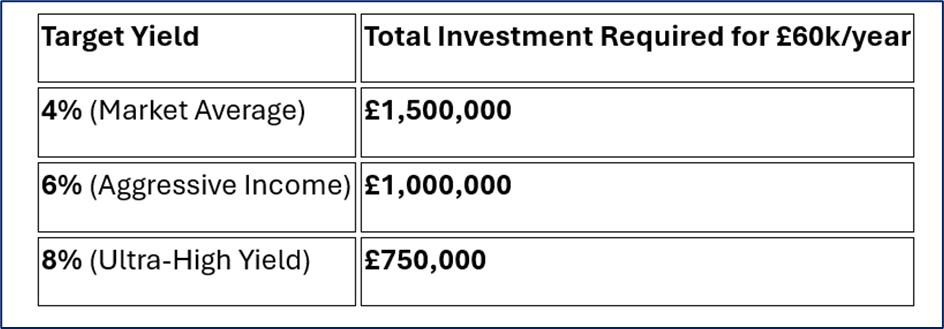
To generate £5,000 a month (£60,000 per year) in passive income, your "magic number" depends entirely on your portfolio's average dividend yield.
In the current 2026 market, the FTSE 100 average yield sits around 3.4% to 4%, but savvy income investors target "high-yielders" to lower the required capital.
Source: Kalkine Group Analysis
While an 8% yield sounds attractive, EODHD/Others data often warns that yields above 7% can signal a "dividend trap" where the payout is unsustainable. Aiming for a balanced 5.5% to 6% yield is the "sweet spot" most analysts recommend for 2026.
Top UK Dividend Stocks to Watch in 2026
Source: Kalkine Group
Based on the latest AJ Bell Dividend Dashboard and Morningstar ratings, these sectors are currently dominating the income charts.
1. The Financial Titans: Legal & General (LGEN) & Phoenix Group (PHNX)
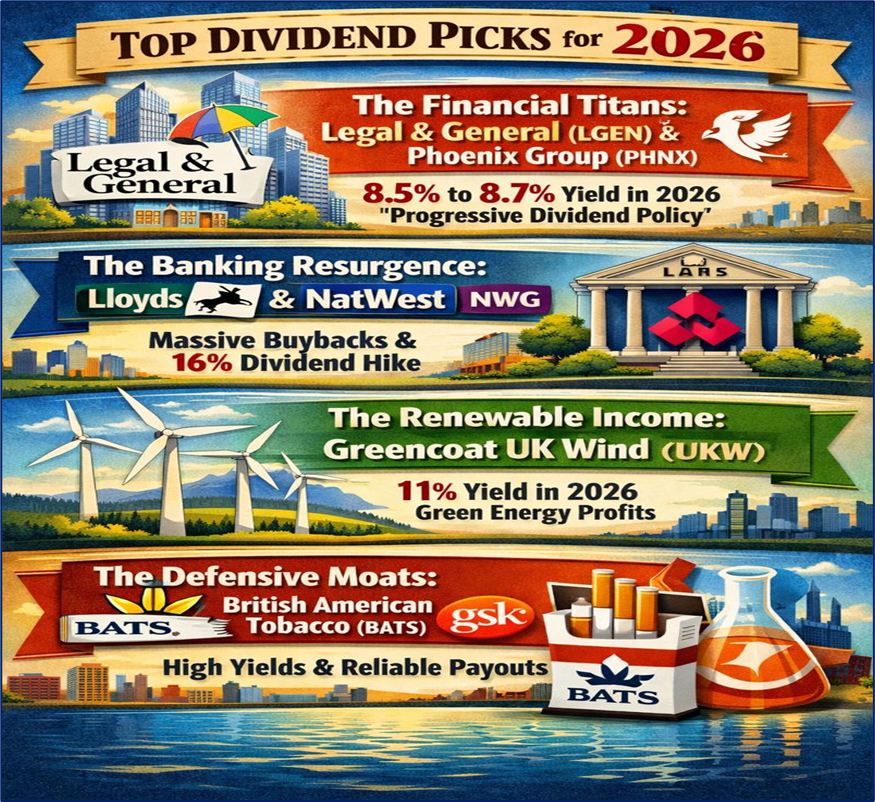
Insurance and wealth management remain the kings of the FTSE dividend hill. Legal & General is currently projected to yield a massive 8.5% to 8.7% in 2026. Despite its share price rally in 2025, it remains a favorite for its "progressive dividend policy"—a commitment to raising payouts annually.
2. The Banking Resurgence: Lloyds (LLOY) & NatWest (NWG)
While the "interest rate tailwind" is slowing as the Bank of England cuts rates, UK banks are sitting on massive cash piles. Lloyds Banking Group has been highlighted by The Motley Fool for its significant share buyback programs and a forecast dividend hike of nearly 16% for the 2026 cycle.
3. The Renewable Income: Greencoat UK Wind (UKW)
For those looking outside the FTSE 100, Greencoat UK Wind offers a unique "green" income stream. With a 2026 forecast yield of 11%, it provides a high-octane boost to any income portfolio, backed by the essential nature of the UK's energy transition.
4. The Defensive Moats: British American Tobacco (BATS) & GSK
Tobacco and Pharma are classic "defensive" plays. BATS continues to offer a yield north of 5.5%, supported by a £1.3 billion share buyback starting in 2026. Meanwhile, GSK remains a staple for stability, yielding around 3.5% with high dividend cover.
The "Tax Trap" of 2026: Protect Your Income
As Bloomberg recently reported, the UK's 2026 tax landscape is shifting. With changes to dividend tax allowances, holding these assets inside a Stocks and Shares ISA or a SIPP (Self-Invested Personal Pension) is no longer optional—it’s essential.
Inside an ISA, your £5,000 monthly income is 100% tax-free. Outside of it, you could lose a significant portion to HMRC, effectively raising the amount of capital you need to invest by 20–30%.
How to Build Your £60,000 Income Stream
- Start with the "Core": Put 50% of your capital into "Dividend Aristocrats" like Unilever or National Grid (reliable 3-4% yields).
- Add the "Boosters": Allocate 30% to high-yield financials like Legal & General or M&G (7-9% yields).
- Diversify with REITs: Use Real Estate Investment Trusts like Land Securities (LAND) to capture the recovery in the UK property market, often yielding over 6%.
Conclusion: The Road to Financial Freedom in 2026
Achieving a £5,000 monthly second income in 2026 is no longer a "pipe dream" reserved for the institutional elite of Bloomberg terminals; it is a tangible reality for disciplined retail investors. As we have seen, the path to a £60,000 annual payout requires a strategic blend of high-yielding financial titans like Legal & General, steady "Dividend Kings" such as GSK, and the high-growth potential of renewable trusts like Greencoat UK Wind.
However, yield is only half the battle. The most successful "passive income millionaires" of 2026 are those who prioritize dividend cover to ensure their checks don't bounce during market volatility and utilize the tax-shielding power of ISAs and SIPPs to keep every penny of their hard-earned yield. Whether you are starting with a modest pot or a seven-figure windfall, the secret remains the same: reinvest, diversify, and let the compounding power of the UK’s greatest companies do the heavy lifting for you.


 Jun 29, 2026




 Please wait processing your request...