
 CA
 NZ
 US
 AU
 IND

 UK

 Share
 X (Formerly Twitter)
 Whatsapp
 Facebook
 LinkedIn
 Telegram
 Email This Article
 Copy Link
 Summarize with AI
 Chat GPT
 Perplexity

Introduction: AI Investing Has Entered a New Era
Artificial intelligence is no longer a speculative concept confined to research labs or science fiction narratives. It has evolved into a powerful economic force that is reshaping industries, redefining productivity, and driving one of the most significant capital investment cycles in modern history. From healthcare diagnostics and financial modeling to logistics optimization and generative content creation, AI is now embedded in the operational backbone of the global economy.
For investors, this transformation presents both a compelling opportunity and a complex challenge. Identifying individual winners in such a rapidly evolving and technically sophisticated domain is inherently difficult. This is where Artificial Intelligence Exchange-Traded Funds (AI ETFs) have emerged as a crucial investment vehicle. They offer diversified exposure to the AI ecosystem, allowing investors to participate in the sector’s growth without relying on single-stock bets.
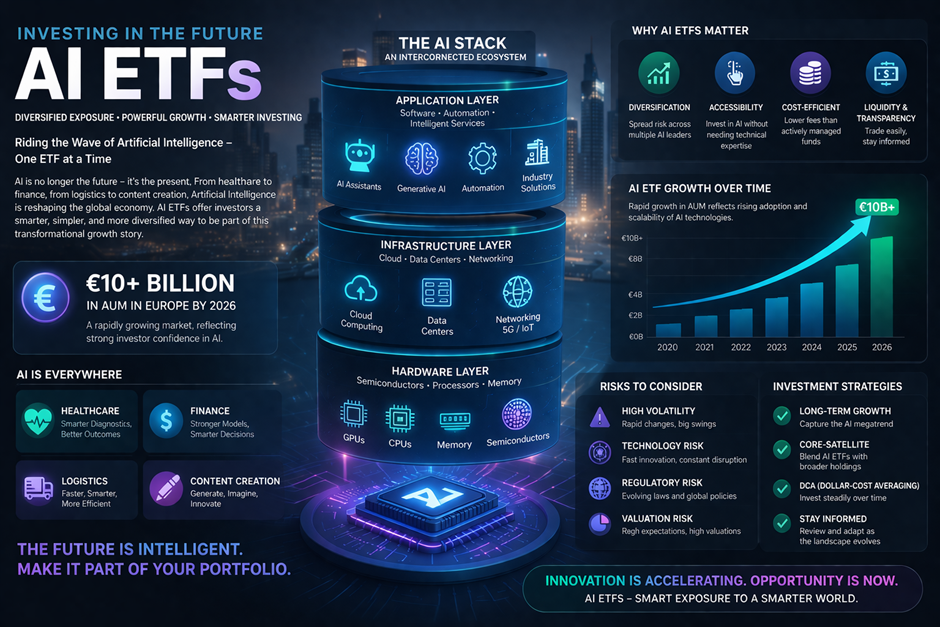
As highlighted in the foundational research , the AI ETF market has grown rapidly, with over €10 billion in assets under management in Europe alone by 2026. This expansion reflects not just investor enthusiasm, but also the maturation of AI as a scalable and monetizable technology.
This article provides a comprehensive, in-depth analysis of AI ETFs—covering their structure, performance, risks, strategies, and long-term outlook—designed to equip investors with the knowledge needed to make informed decisions in this high-growth space.
Source: Kalkine Group
Understanding Artificial Intelligence as an Investment Theme
Artificial intelligence refers to systems capable of performing tasks that typically require human intelligence, including learning, reasoning, perception, and language understanding. However, from an investment perspective, AI is better understood not as a single technology but as an ecosystem composed of multiple interdependent layers.
At the foundation lies the hardware layer, which includes semiconductors, processors, and memory systems that provide the computational power required for AI workloads. Above this sits the infrastructure layer, encompassing cloud computing platforms, data centers, and networking systems. At the top is the application layer, where AI is deployed across industries in the form of software, automation tools, and intelligent services.
The recent explosion of interest in AI has been driven largely by advances in machine learning and deep learning, particularly the development of transformer-based models that enable generative AI. These models have demonstrated unprecedented capabilities in text generation, image creation, and decision-making, leading to widespread commercial adoption.
For investors, the key insight is that value creation in AI is not evenly distributed across this stack. As the research document notes , the majority of economic gains thus far have been concentrated in the infrastructure and hardware layers, where demand for computational resources has surged dramatically.
What Are AI ETFs and Why They Matter
Exchange-Traded Funds are investment vehicles that hold a basket of securities and trade on stock exchanges like individual stocks. AI ETFs specifically focus on companies involved in the development, deployment, or enablement of artificial intelligence technologies.
Their appeal lies in several structural advantages. First, they provide instant diversification, reducing the risk associated with individual company performance. Second, they offer accessibility, allowing investors to gain exposure to a complex technological theme without requiring deep domain expertise. Third, they are cost-efficient, with most AI ETFs charging expense ratios significantly lower than actively managed funds.
Additionally, ETFs provide liquidity and transparency. Investors can buy and sell shares throughout the trading day, and fund holdings are typically disclosed regularly. These features make AI ETFs particularly attractive in a fast-moving sector where flexibility and information are critical.
The proliferation of AI ETFs has also democratized access to this investment theme. Previously, meaningful exposure to AI required either direct stock selection or investment in specialized funds with high fees and limited transparency. Today, ETFs have made AI investing accessible to a much broader audience.
The AI ETF Landscape in 2026
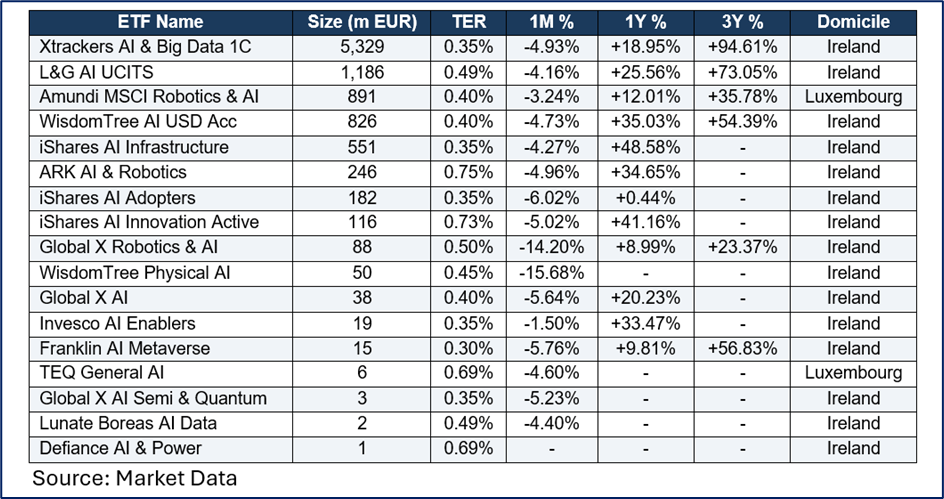
The AI ETF market has expanded significantly in recent years, with a wide range of funds offering different approaches to AI exposure. As of April 2026, there are seventeen major AI-focused UCITS ETFs available to European investors .
These funds vary in several important dimensions. Some track broad indices that include companies across the entire AI value chain, while others focus on specific sub-themes such as robotics, semiconductors, or AI infrastructure. Index methodologies also differ, with some funds using market capitalization weighting and others employing equal weighting or proprietary scoring systems.
This diversity creates both opportunities and challenges. On one hand, investors can tailor their exposure to specific aspects of the AI ecosystem. On the other hand, the label “AI ETF” can be misleading, as funds with similar names may have vastly different holdings and risk profiles.
Understanding these differences is essential for effective portfolio construction and risk management.
Performance Analysis: A Story of Divergence
One of the most striking features of the AI ETF market is the wide dispersion in performance across different funds. While the sector as a whole has delivered strong long-term returns, short-term performance has been highly variable.
In early 2026, the AI sector experienced a notable correction. After a period of exceptional growth in 2023, 2024, and much of 2025, investors began to reassess valuations and take profits. As a result, nearly all AI ETFs recorded negative year-to-date returns .
However, this correction must be viewed in the context of the broader trend. Over a three-year horizon, many AI ETFs have delivered returns exceeding 50% and, in some cases, approaching 100%. These figures significantly outperform broader market indices and underscore the strength of the underlying growth drivers.
More importantly, performance has varied dramatically depending on fund focus. Infrastructure-focused ETFs, which invest in semiconductors and data center providers, have been the top performers. In contrast, ETFs focused on companies that use AI rather than build it have lagged behind.
This divergence highlights a critical investment insight: the economic benefits of AI are currently concentrated among the providers of technology rather than its end users.
Cost Structure and Its Long-Term Impact
While performance often dominates investor attention, cost is an equally important factor in determining long-term returns. AI ETFs typically have expense ratios ranging from 0.30% to 0.75%, with most falling in the mid-range of 0.40% to 0.50%.
At first glance, these differences may appear negligible. However, over a long investment horizon, even small variations in fees can have a significant impact due to compounding. As illustrated in the research , higher fees can reduce final portfolio value by thousands of euros over a decade.
In addition to explicit fees, investors should consider hidden costs such as bid-ask spreads, tracking error, and portfolio turnover. These factors can affect the true cost of ownership and should be evaluated alongside the stated expense ratio.
Emerging Trends Shaping AI ETF Investing
The AI investment landscape is evolving rapidly, with several key trends shaping the future of the sector.
The most important of these is the rise of AI infrastructure as a dominant investment theme. The massive computational requirements of AI systems have triggered an unprecedented wave of capital expenditure in data centers, semiconductors, and energy systems. This trend is expected to continue for years, providing a strong tailwind for infrastructure-focused ETFs.
Another emerging trend is the integration of AI with other technologies, such as robotics, quantum computing, and renewable energy. These intersections are creating new investment opportunities but also increasing complexity.
The concept of physical AI, which includes humanoid robots and autonomous systems, represents a more speculative but potentially transformative area. While still in early stages, this segment could redefine industries ranging from manufacturing to logistics.
Finally, the growing energy demands of AI are bringing attention to the role of power generation and grid infrastructure. As AI workloads scale, energy availability and efficiency will become critical constraints, creating opportunities for investment in related sectors.
Risk Factors and Investment Challenges
Despite its strong growth potential, AI investing is not without risks. One of the most significant is concentration risk. Many AI ETFs are heavily weighted toward a small number of large technology companies, making them vulnerable to fluctuations in a few key stocks.
Valuation risk is another important consideration. The high expectations embedded in AI-related stocks leave little margin for error. If growth projections are not met, valuations could compress, leading to significant price declines.
Regulatory risk is also increasing as governments around the world develop frameworks for AI governance. While regulation can provide clarity and stability, it can also impose constraints on innovation and profitability.
Geopolitical risk is particularly relevant in the context of semiconductor supply chains, which are highly concentrated and politically sensitive. Tensions between major economies could disrupt these supply chains and impact the performance of AI-related companies.
Finally, technological risk must not be overlooked. The pace of innovation in AI is extremely rapid, and today’s leading technologies may be replaced by new paradigms. This creates uncertainty about long-term winners and requires a flexible investment approach.
Portfolio Construction Strategies for AI ETFs
Integrating AI ETFs into a broader investment portfolio requires careful planning and discipline. One of the most effective approaches is the core-satellite strategy. In this framework, the core of the portfolio consists of diversified investments, while AI ETFs are used as satellite positions to enhance growth potential.
A typical allocation might involve 10% to 20% of the portfolio in AI ETFs, depending on risk tolerance and investment horizon. More aggressive investors may allocate a higher percentage, while conservative investors may prefer a smaller exposure.
Diversification within AI is also important. Combining different types of AI ETFs—such as broad-based funds and specialized infrastructure funds—can reduce risk and improve return potential.
Dollar-cost averaging is another valuable strategy, particularly in a volatile sector like AI. By investing regularly over time, investors can mitigate the impact of market fluctuations and avoid the pitfalls of market timing.
Regular rebalancing is essential to maintain target allocations and manage risk. Given the potential for rapid growth in AI investments, periodic adjustments are necessary to prevent overexposure.
Global Competitive Landscape
The global AI landscape is dominated by a few key regions. The United States remains the leader, with a strong ecosystem of technology companies, research institutions, and venture capital. China is a close competitor, with significant government support and a large domestic market.
Other regions, including Europe, South Korea, Japan, and Taiwan, play important roles in specific segments of the AI value chain. For example, Taiwan is critical for semiconductor manufacturing, while Japan leads in robotics.
This global distribution has important implications for AI ETF investors, as it influences geographic exposure and risk factors.
Future Outlook: The Next Decade of AI Investing
The long-term outlook for AI ETFs is highly positive. The technology is expected to drive significant productivity gains and economic growth, creating substantial value for companies involved in its development and deployment.
However, the path forward is unlikely to be smooth. Periods of rapid growth will likely be followed by corrections as the market adjusts to new information and changing expectations.
The key to successful AI investing will be maintaining a long-term perspective, staying informed about technological and market developments, and managing risk through diversification and disciplined portfolio management.
Conclusion
Artificial Intelligence ETFs represent a powerful and accessible way to invest in one of the most transformative technologies of our time. They offer diversified exposure, cost efficiency, and the potential for strong long-term returns.
However, they also come with risks, including volatility, concentration, and valuation challenges. Investors must approach this sector with a clear strategy and a willingness to navigate uncertainty.
Ultimately, AI is not just a trend—it is a structural shift in the global economy. For those who understand its dynamics and invest thoughtfully, AI ETFs offer a compelling opportunity to participate in this transformation.


 Nov 24, 2026





 Please wait processing your request...