
 CA
 NZ
 US
 AU
 IND

 UK

 Share
 X (Formerly Twitter)
 Whatsapp
 Facebook
 LinkedIn
 Telegram
 Email This Article
 Copy Link
 Summarize with AI
 Chat GPT
 Perplexity

Key Takeaways
- Gold mining ETFs have delivered exceptional triple-digit returns in the recent bull cycle
- They provide leveraged exposure to gold, outperforming physical gold in rising markets
- Volatility remains extremely high, with 20–50% drawdowns possible
- ETF performance varies significantly based on index methodology and purity of gold exposure
- Macro drivers like central bank buying, interest rates, inflation, and geopolitics are critical
- Portfolio strategies such as core-satellite and tactical allocation improve risk-adjusted returns
- Long-term outlook remains bullish, but active management and timing matter
Source: Kalkine Group
Introduction to Gold Mining ETFs
Gold mining ETFs are among the most dynamic and misunderstood investment instruments in modern financial markets. They represent a bridge between commodity investing and equity investing, combining the macro-driven nature of gold with the operational dynamics of mining companies.
Unlike physical gold ETFs, which directly track the spot price of gold, gold mining ETFs invest in publicly listed mining companies. These companies generate revenue by extracting gold from the ground, and their profitability depends on both the gold price and their operational efficiency.
This dual exposure creates a powerful effect known as operational leverage, where small changes in gold prices lead to disproportionately large changes in company profits. As highlighted in the research report, this phenomenon was a primary driver behind the extraordinary ETF returns exceeding 100% in 2025–2026.
However, this leverage also introduces complexity. Investors must consider:
- Commodity price cycles
- Company-specific risks
- Global macroeconomic conditions
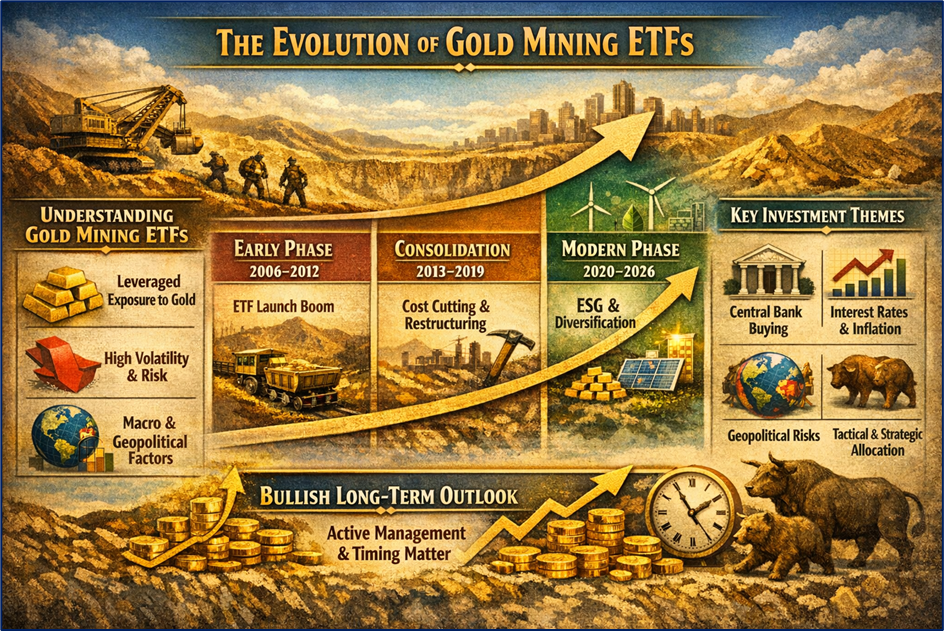
Evolution of the Gold Mining ETF Market
The gold mining ETF market has evolved significantly over the past two decades.
Early Phase (2006–2012)
The launch of early ETFs brought accessibility to gold mining equities, particularly through flagship products tracking global mining indices.
Consolidation Phase (2013–2019)
Following the gold bear market, mining companies restructured:
- Reduced debt
- Improved cost discipline
- Focused on high-quality assets
Modern Phase (2020–2026)
The recent era has been characterized by:
- Massive capital inflows
- Increased institutional participation
- Emergence of ESG-focused ETFs
- Greater product diversification (junior miners, pure gold exposure, screened indices)
This evolution has transformed gold mining ETFs into a core asset class for tactical and strategic investors.
Deep Dive: Gold Price Dynamics and Their Impact
Supply Constraints
Gold supply growth is structurally limited due to:
- Long mine development cycles (7–15 years)
- Declining discovery rates
- Regulatory hurdles
Demand Drivers
Demand has surged due to:
- Central bank accumulation
- Retail investment demand
- ETF inflows
- Safe-haven demand
Why This Matters for ETFs
Mining companies benefit disproportionately because:
- Costs remain relatively stable
- Revenues scale with gold prices
This creates explosive earnings growth during bull markets, directly boosting ETF performance.
Advanced ETF Structure Analysis
Index Methodology: The Hidden Driver of Returns
ETF performance is heavily influenced by index construction:
Market Cap Weighted
- Favors large companies
- More stable returns
- Lower volatility
Equal Weighted
- Greater exposure to smaller firms
- Higher growth potential
- Increased volatility
Production Weighted
- Reflects actual gold output
- Strong correlation with industry fundamentals
Unhedged (Gold BUGS Index)
- Maximum exposure to gold price
- Highest upside in bull markets
Purity of Gold Exposure
A critical differentiator is revenue dependence on gold:
- 50% threshold → diversified miners
- 90% threshold → pure gold exposure
Higher purity results in:
- Greater sensitivity to gold prices
- Higher volatility
In-Depth Performance Attribution
Why Some ETFs Outperformed Others
Performance differences are driven by:
- Hedging Policies
Unhedged miners capture full upside of gold price increases
- Company Size
- Large-cap: stability
- Small-cap: explosive growth
- Geographic Exposure
Mining regions affect costs, risks, and profitability
- Cost Efficiency
Lower AISC → higher margins
Volatility: The Double-Edged Sword
Gold mining ETFs are inherently volatile due to:
- High operational leverage
- Commodity price sensitivity
- Equity market exposure
Historical Behavior
- Bull markets: +100% to +300% returns
- Bear markets: -50% or worse
Key Insight
Volatility is not a weakness—it is the source of alpha for disciplined investors.
Macroeconomic Supercycle and Gold
Gold’s performance is deeply tied to macroeconomic trends.
- Interest Rate Cycles
- Falling real rates → bullish for gold
- Rising real rates → bearish
- Inflation Regimes
Gold acts as a long-term inflation hedge, especially during:
- Currency debasement
- Monetary expansion
- Currency Shifts
Weakening of the US dollar has historically fueled gold rallies.
Central Banks: The Silent Force
Central banks have become one of the most important structural drivers of gold demand.
Why Central Banks Buy Gold
- Diversification away from USD
- Protection against sanctions
- Long-term store of value
Impact on ETFs
This demand creates:
- A price floor for gold
- Sustained long-term upward pressure
Geopolitical Risk and Gold
Gold thrives in uncertainty.
Key Risk Drivers
- War and conflicts
- Trade tensions
- Energy crises
- Global power shifts
These factors increase gold demand and indirectly boost mining ETFs.
Gold Mining Company Fundamentals
Cost Structure (AISC)
All-in sustaining costs determine profitability.
- Low-cost producers → stable returns
- High-cost producers → higher leverage
Margin Expansion
With gold above $4,000:
- Profit margins are historically high
- Cash flow generation is strong
Capital Allocation Trends
Mining companies are now:
- Paying higher dividends
- Reducing debt
- Investing in growth projects
ESG Transformation in Gold Mining
Environmental and social concerns are reshaping the industry.
Key ESG Issues
- Environmental impact
- Water usage
- Community relations
- Governance transparency
Investor Impact
- ESG-focused ETFs are emerging
- May reduce risk but limit returns
Advanced Portfolio Construction Strategies
- Strategic Long-Term Allocation
- Allocate 5–15% to gold assets
- Combine:
- Physical gold ETFs
- Mining ETFs
- Tactical Rotation Strategy
Shift allocation based on:
- Gold momentum
- Interest rate trends
- Market cycles
- Core-Satellite Strategy (Highly Effective)
Core:
- Large diversified ETF
Satellite:
- Junior miners
- Pure gold exposure ETFs
This balances stability and growth potential.
Technical Analysis in Gold Mining ETFs
Advanced investors often use technical indicators:
Key Indicators
- Moving averages (50-day, 200-day)
- Relative strength index (RSI)
- Gold-to-miners ratio
- Volume trends
Important Signal
When mining stocks outperform gold, it often signals:
→ Early stage of a bull market
Comparing Gold Mining ETFs vs Physical Gold
Gold Mining ETFs
- Higher returns
- Higher volatility
- Dividend income
Physical Gold ETFs
- Stability
- Lower risk
- Direct price tracking
Optimal Strategy
Blend both for:
- Stability + growth
- Reduced portfolio volatility
Regional Analysis: Where Gold is Mined
Gold production is concentrated in:
- Canada
- Australia
- Africa
- Latin America
Why Geography Matters
- Political stability
- Cost structure
- Regulatory environment
Junior vs Senior Miners: Full Comparison
Senior Miners
- Stable production
- Lower risk
- Moderate growth
Junior Miners
- Exploration-focused
- High risk
- Potential multi-bagger returns
Future Outlook: Gold Mining ETFs Beyond 2026
Bullish Factors
- Continued central bank demand
- Rising global debt
- Geopolitical instability
- Limited gold supply
Risks
- Interest rate spikes
- Strong US dollar
- Regulatory challenges
Long-Term Expectation
Gold mining ETFs are likely to remain:
→ High-return, high-volatility assets
Comprehensive Conclusion
Gold mining ETFs represent one of the most compelling yet complex investment opportunities in today’s financial markets. They offer a unique combination of commodity exposure and equity-driven growth, allowing investors to capitalize on both macroeconomic trends and company-level performance.
The recent bull cycle has demonstrated their immense potential, with returns exceeding 100% in many cases. However, this performance should not be viewed in isolation. The same structural factors that enable explosive upside also create significant downside risk.
The key to successful investing in gold mining ETFs lies in understanding their dual nature. They are not simply a proxy for gold; they are leveraged instruments influenced by a wide range of variables, including operational efficiency, geopolitical developments, cost structures, and financial market conditions.
Investors who approach this asset class with a disciplined strategy—balancing exposure between physical gold and mining equities, diversifying across ETF types, and adjusting allocations based on macroeconomic signals—are best positioned to capture long-term value.
As the global financial system continues to evolve, marked by rising debt levels, shifting geopolitical power structures, and persistent economic uncertainty, gold is likely to retain its relevance as a store of value. In this context, gold mining ETFs will continue to play a vital role, offering amplified exposure to one of the oldest and most enduring assets in human history.


 Nov 24, 2026





 Please wait processing your request...