
 AU
AU
 CA
CA
 US
US
 NZ
NZ
 IND
IND

 UK
UK

 Share
Share
 X (Formerly Twitter)
 Whatsapp
 Facebook
 LinkedIn
 Telegram
 Email This Article
 Copy Link
 Summarize with AI
 Chat GPT
 Perplexity
The UK housing market shifted gears on December 17, 2025, as Barratt Redrow (LSE: BTRW), the nation’s largest housebuilder, closed ~3.6% at GBX 375.90. While the broader FTSE 100 gained a solid 0.9%, Barratt Redrow’s outperformance signalled a major "risk-on" move from institutional and retail investors alike.
But what actually moved the needle? Let’s dive into the drivers, the business model, and the SWOT analysis of this newly merged titan.
- The Dec 17 Catalyst: A "Goldilocks" Inflation Print

Source: Kalkine Group
The primary driver for the jump was a sharper-than-expected fall in UK inflation.
- The Data: Headline CPI cooled to 3.2% (down from 3.6% in October).
- The Reaction: This data effectively "green-lit" a Bank of England interest rate cut scheduled for December 18.
- Why it matters for BTRW: Lower interest rates are the "lifeblood" of housebuilders. They reduce mortgage costs for buyers—stimulating demand—and lower the cost of capital for construction projects.
- Latest Business Updates: Post-Merger Momentum
Since the transformative merger between Barratt Developments and Redrow in late 2024, the "New Co" has been moving at light speed to prove the deal’s worth.
- Synergy Targets Smashed: The group originally targeted £100m in annual cost savings. As of late 2025, they have already confirmed £80m of these, with £45m expected to hit the bottom line in FY26.
- Completions Guidance: Despite a sluggish early 2025, the group remains on track to deliver 17,200 to 17,800 homes for the full year.
- Cash is King: The company maintains a powerhouse balance sheet with net cash of £772.6m, supporting an ongoing £100m share buyback program.
- The Business Model: A Three-Pronged Strategy
Barratt Redrow doesn't just build "houses"; it operates a diversified brand portfolio designed to capture every segment of the UK market:
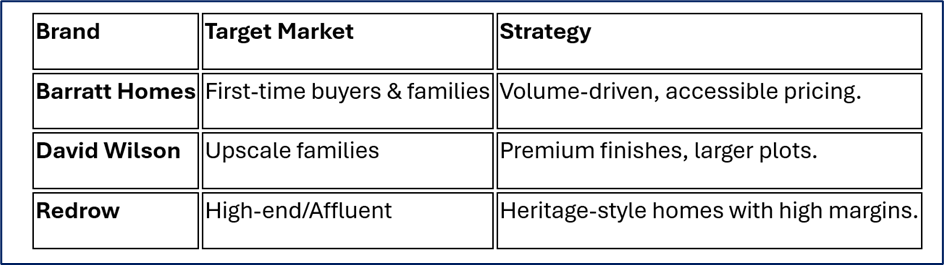
Source: Company Data
- SWOT Analysis: Assessing the Titan
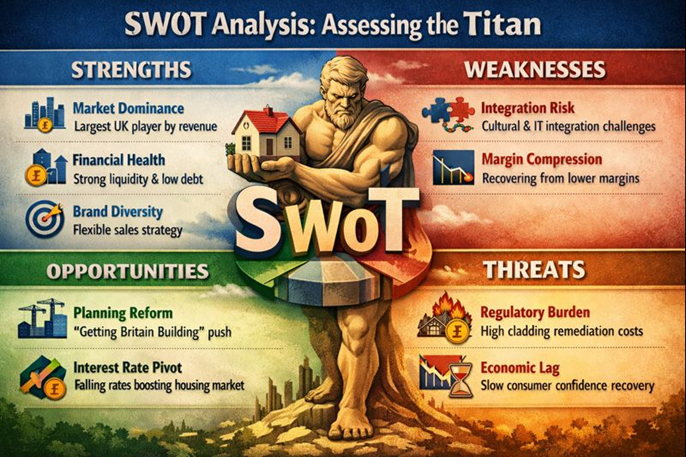
Source: Kalkine Group
Strengths
- Market Dominance: Largest UK player by revenue; massive procurement power reduces build costs.
- Financial Health: Exceptionally strong liquidity and low debt compared to historical cycles.
- Brand Diversity: Ability to pivot sales focus if one demographic (e.g., first-time buyers) slows down.
Weaknesses
- Integration Risk: Merging two corporate cultures and IT systems is complex and can lead to short-term friction.
- Margin Compression: While improving, adjusted gross margins (approx. 15.7%) are still recovering from peak 2022 levels.
Opportunities
- Planning Reform: The UK government's focus on "getting Britain building" could unlock stalled land banks.
- Interest Rate Pivot: We are entering a cycle of falling rates, which historically leads to multi-year rallies in housing stocks.
Threats
- Regulatory Burden: Building safety remediation costs (cladding issues) remain a persistent multi-million-pound drain on cash.
- Economic Lag: Even if rates fall, the "lag effect" means consumer confidence may take months to fully recover.
- Key Risks to Watch
- Mortgage Volatility: If inflation proves "sticky" in early 2026, the Bank of England may pause rate cuts, dampening the recent rally.
- Build Cost Inflation: While currently stable at 1–2%, any spike in energy or labor costs could squeeze margins.
- Planning Bottlenecks: Local authority delays remain the #1 hurdle to reaching the group's medium-term goal of 22,000 homes per year.
Conclusion: A Giant Awakening?
Barratt Redrow’s 3.6% jump on December 17 wasn't just a random fluctuation; it was a market vote of confidence in a business that has successfully integrated a massive acquisition and is now sitting at the "starting blocks" of a new interest rate cycle. With a massive land bank and a £100m buyback supporting the share price, the group is positioned as the primary proxy for a UK economic recovery.
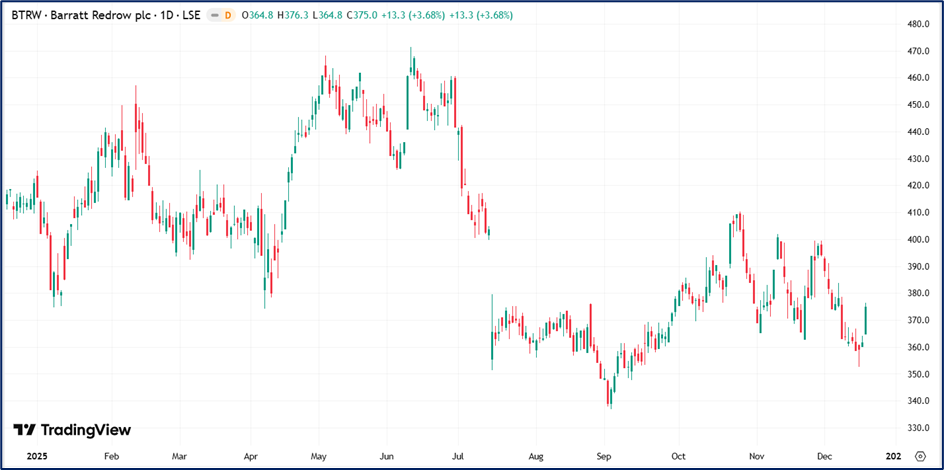
Source: Trading View, 17 December 2025


 Jun 24, 2026




 Please wait processing your request...